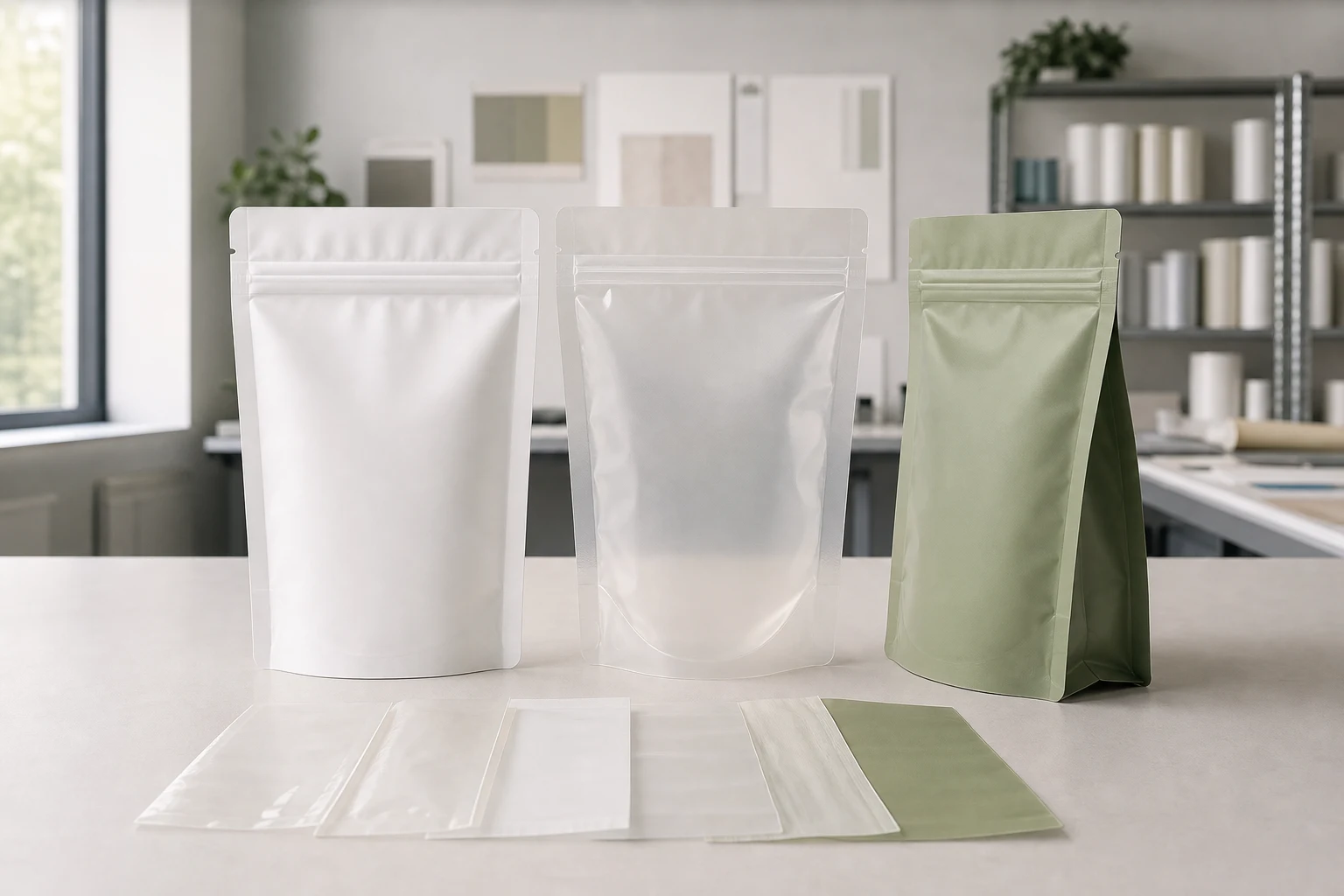
A recyclable pouch project starts by matching product protection and converting performance to a collection and recycling pathway in the destination market. Mono-PE, mono-PP and recycled-content directions are different decisions. None creates a universal recyclability claim on its own.
We first protect the product. A package that causes food waste, leakage or line failure is not an acceptable environmental result. Then we document the exact structure and review the claim language for the market.
What Is the Difference Between Mono-PE, Mono-PP and PCR?
| Direction | What it means | Main questions |
|---|---|---|
| Mono-PE | Predominantly polyethylene-family structure designed for a PE pathway | Barrier, stiffness, heat resistance, zipper and local acceptance |
| Mono-PP | Predominantly polypropylene-family structure designed for a PP pathway | Seal window, stiffness, temperature and local acceptance |
| PCR content | Uses post-consumer recycled resin in an allowed part of the structure | Product contact, odor, color, performance, supply and claim scope |
A material description should identify the complete pouch, including zipper, valve, spout, ink, adhesive or coating where relevant.
Can a Mono-Material Pouch Provide High Barrier?
Selected structures can improve oxygen or moisture performance through coatings, barrier layers and careful design. The relevant question is whether the proposed structure reaches the required performance under stated test conditions and still seals on the real line.
We compare OTR, WVTR, seal window, hot tack, puncture, flexing, zipper performance and converted-pouch integrity. The high-barrier mono-material guide explains why flat-film data is only one part of the decision.
Which Applications Are Better Starting Points?
Dry snacks, coffee, pet treats, powders and other low-moisture products can be practical candidates when the required barrier and line performance are achievable. Greasy, sharp, hot-filled, retort, aggressive chemical or very long shelf-life products may need a more demanding evaluation.
We do not force a mono-material structure into an application it cannot protect. A controlled trial should compare it with the current benchmark.
How Should Recyclability Claims Be Controlled?
Review the exact material, components, collection system, sortation and reprocessing pathway in the destination. Use qualified language when access is limited. Do not use a recycling symbol, certification or broad statement unless the evidence and local rules support it.
Keep supplier declarations, specifications and test reports connected to the final artwork. If any layer or component changes, reopen the claim review.
What Should the Trial and Quote Include?
- Product, shelf life, fill temperature and storage.
- Required OTR, WVTR or current benchmark where available.
- Filling-line speed, sealing temperature range and contamination risk.
- Pouch style, zipper or fitment, size and quantity per design.
- Destination market and proposed claim language.
- Filled-pack, line, distribution and shelf-life approval steps.
See the anonymized recyclable snack pouch case for a project example.
Which Applications and Buying Situations Fit This Page?
Recyclability is not established by changing one layer or adding a symbol. The complete pouch, attachments, inks, coatings and local collection pathway matter. The product still needs adequate barrier, sealability and physical strength, otherwise leakage, spoilage or line waste can offset the intended improvement.
Buyers looking for recyclable pouches and mono PE stand up pouch can reach this guide through related searches such as the terms below. We use them as different entry points into one specification process rather than forcing one generic recommendation onto every search.
- recyclable pouches
- mono PE stand up pouch
- mono material packaging
- recyclable coffee and snack bags
| Application or decision | Practical starting direction | Reason to evaluate it |
|---|---|---|
| Dry snacks and nuts | Mono-PE or mono-PP direction after oil, barrier and seal review | Often provides a practical starting point for a controlled benchmark trial |
| Roasted coffee | High-barrier mono-material candidate with compatible valve and zipper | Requires aroma, oxygen, valve and destination-claim review together |
| Pet treats | Puncture- and grease-reviewed mono-material candidate | Connects recyclable design to sharp pieces, oils and repeated opening |
| Powders and supplements | Barrier pouch with clean-seal and static review | Tests whether fine product and handling fit the proposed sealant system |
| Refill and nonfood products | PE or PP family selected for contents and process | Compatibility and leakage remain required even when food shelf life is not relevant |
For recyclable pouches and mono PE stand up pouch, the table is a screening tool, not a material prescription. Product formulation, contact requirements, shelf life, filling equipment, destination rules and distribution can change the direction. The next step is to turn the promising route into a measurable sample and approval plan.
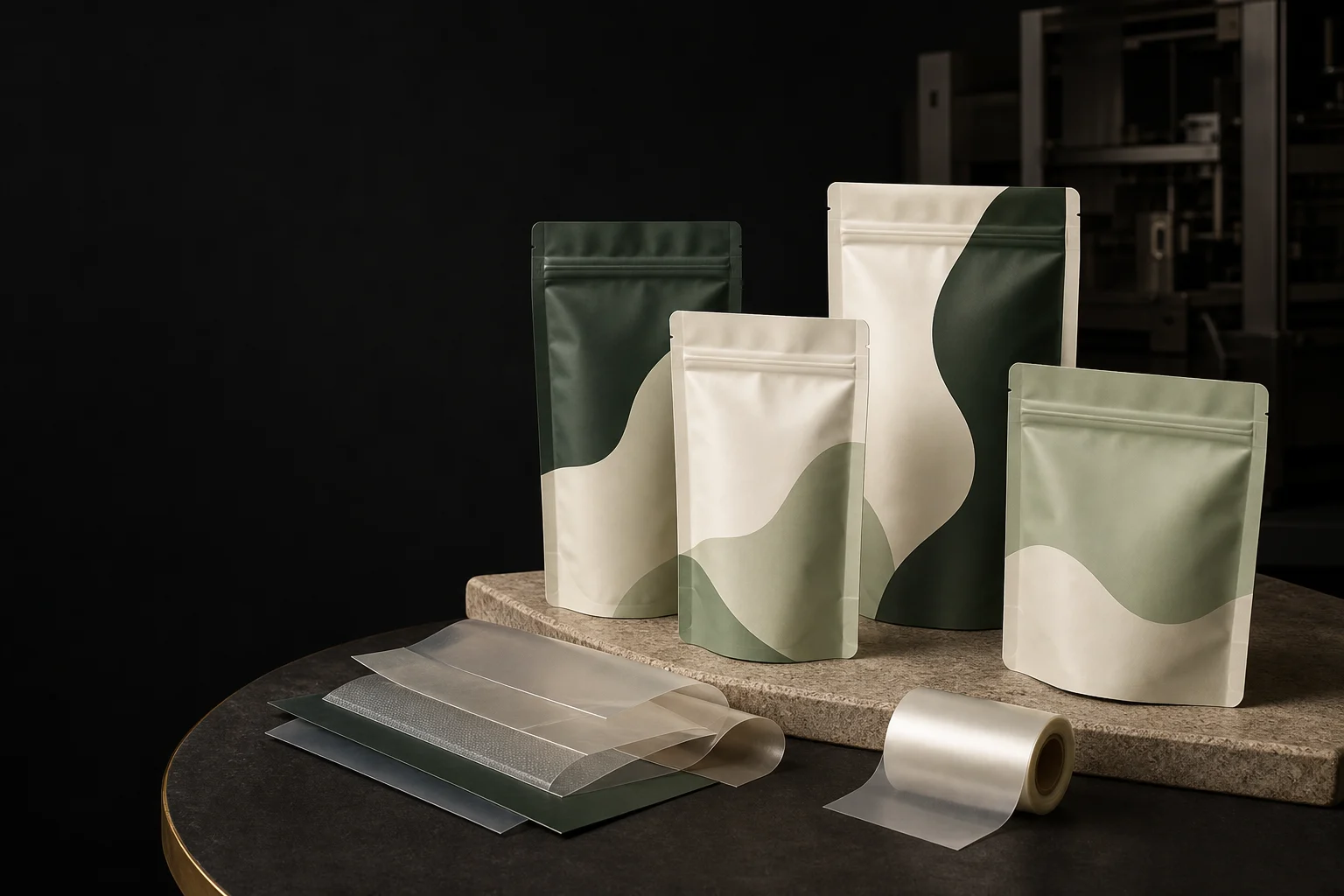
How Do Buyers Turn the Idea Into a Controlled Specification?
For recyclable pouches and mono PE stand up pouch, a useful specification records decisions at the finished-pouch level. Marketing names can help teams communicate, but production needs measurable dimensions, an identified construction, feature positions, tolerances, an artwork version and acceptance criteria. Every alternative should be labeled clearly so a commercial comparison does not hide a technical change.
| Control point | Input needed | Approval record |
|---|---|---|
| Destination pathway | Collection, sorting, program rules and claim language | The target market and qualification are recorded |
| Complete structure | Main web, sealant, barrier layer, coating, adhesive, ink and attachments | Supplier declaration describes the whole pouch rather than one film |
| Product protection | OTR, WVTR, light, grease, puncture and shelf-life target | Proposed values include units, conditions and comparison basis |
| Line performance | Seal window, hot tack, speed, contamination and coefficient of friction | Trial documents settings, rejects and pack integrity |
| Finished-pack approval | Zipper, valve, spout, seals, folds and distribution | Converted pouch and real product pass the agreed validation plan |
For recyclable pouches and mono PE stand up pouch, start with the real product and its worst credible condition. That may be the sharpest piece, highest oil content, least dense recipe, hottest fill, longest distribution route or most demanding SKU. State which condition was used. Without that note, a sample can pass while the production range remains undefined.
In a recyclable pouches and mono PE stand up pouch specification, dimensions should use a consistent measurement method and identify whether the value is inside or outside, finished or pre-conversion. Feature coordinates should reference a controlled dieline. Material descriptions should identify the full structure or the required performance basis, while test values should include units and conditions. The goal is not paperwork for its own sake; it is a repeatable reference for quotation, sampling, production and reorders.
What Can Fail, and How Should It Be Checked?
recyclable pouches and mono PE stand up pouch development asks what can fail first and what evidence would reveal it before a commercial shipment. Visual inspection is necessary, but it cannot establish barrier, seal robustness, compatibility, closure performance or distribution durability. The checks below connect common failure modes to practical controls.
| Failure mode | Why it happens | Control or evidence |
|---|---|---|
| A recyclability claim is not valid locally | Market infrastructure or program criteria differ | Review the exact destination and use qualified wording |
| Barrier is lower than the current pack | Structure was selected by resin family alone | Benchmark product protection with comparable test conditions |
| Pouches wrinkle or leak on the line | Heat resistance and seal window were not trialed | Run at realistic speed and record settings and reject modes |
| Attachment changes the pathway | Zipper, valve or spout was omitted from the material review | Document every component of the finished pouch |
| A later material change invalidates artwork | Claim evidence is not tied to change control | Reopen technical and claim review for every relevant change |
For recyclable pouches and mono PE stand up pouch, an acceptance plan should name the sample stage, test owner, method or working instruction, sample count where appropriate, condition and decision rule. The scope can be simple for a low-risk launch, but it should never be invisible. If the brand is responsible for shelf-life validation or regulatory interpretation, that responsibility should be stated rather than implied to sit with a film or pouch supplier.
When a recyclable pouches and mono PE stand up pouch trial fails, preserve the failed sample and record the lot, settings and observed location. A leak at a zipper end, bottom corner or fitment area tells a different story from random film puncture. Correct the cause, create a new controlled sample and repeat the relevant check instead of accepting an undocumented adjustment.
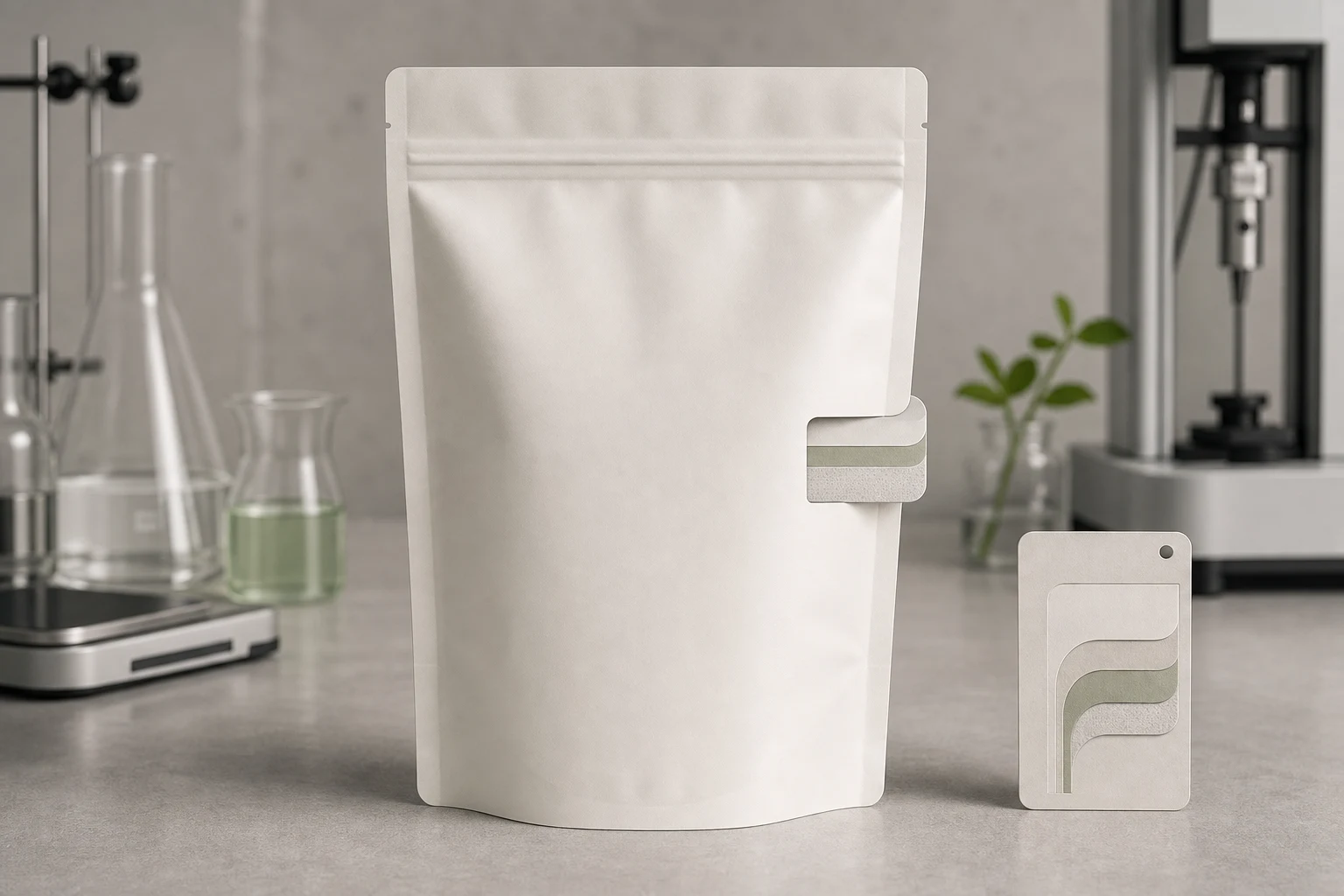
What Is the Sample-to-Production Workflow?
1. Define the question before ordering a sample
For recyclable pouches and mono PE stand up pouch, a stock sample can demonstrate general film feel, finish and feature operation. A blank size sample can confirm volume, headspace, filling access, standing and case fit. A digital artwork proof can confirm copy, dieline version and placement. A printed prototype can support a color and presentation decision. A production proof can become a physical reference. None of these automatically replaces compatibility, distribution or shelf-life work.
Compare the candidate with the current package using the same product, fill, sealing process and distribution route. A film hand sample can show stiffness and appearance, but it cannot demonstrate zipper performance, gusset integrity or a useful seal window. Keep both the proposed specification and the benchmark result in the approval record.
2. Trial the real filling and sealing process
Mono-material structures may behave differently under heat, tension and speed from mixed laminates. The line trial should include startup, normal running and intentional checks near the agreed operating window. Record seal temperature, dwell, pressure, jaw condition, contamination, web tracking and rejected pouch observations rather than relying on a single successful seal.
For recyclable pouches and mono PE stand up pouch, use enough samples to see variation rather than judging one ideal pouch. Observe opening, filling, trapped product, web or pouch handling, seal appearance, cooling, coding and operator adjustments. Record the settings and keep representative filled packs. If production will run at more than one site or on several lines, identify which setup the approval covers.
3. Freeze the approved record
For recyclable pouches and mono PE stand up pouch, the approval pack should include the quotation revision, signed specification, dieline, artwork version, material description, color reference, feature details, agreed tolerances, sample or proof reference, test records, carton requirements and shipping marks. Connect it to the purchase order and SKU. A supplier change, resin or film change, feature substitution, thickness change, new artwork or different filling condition should trigger a documented review.
4. Verify the first production and repeat orders
For recyclable pouches and mono PE stand up pouch, first production should be checked against the approved record, not against memory or a sales image. Review critical dimensions, print content, feature placement, seals, appearance, packing and agreed functional evidence. For repeats, compare the new order with the controlled reference and record requested changes before production. This is how a successful trial becomes a stable packaging program.
How Should Performance, Compliance and Sustainability Claims Be Handled?
Use claim language that identifies the relevant pathway and qualifications. “Recyclable everywhere” is usually too broad because access varies. Recyclable design and recycled content are different claims. Any logo or on-pack instruction should be checked against current program criteria for the exact structure and market.
For recyclable pouches and mono PE stand up pouch, separate supplier documentation from the brand’s final claim decision. A material declaration, component report or laboratory result can be useful evidence, but its scope must match the exact structure, test article, method, date and market. Do not extend a result from one film, size or component to a materially different finished pouch without review.
For recyclable pouches and mono PE stand up pouch, artwork approval should include a claim checkpoint before printing. Keep claim wording, supporting documents and the approved structure in the same change-control record. If a film, closure, valve, spout, coating, adhesive, ink, dimension or opening path changes, ask whether the evidence and artwork remain valid.
What Belongs in the RFQ and Final Approval Checklist?
For recyclable pouches and mono PE stand up pouch, a complete RFQ makes the quotation faster and more comparable. If a value is unknown, mark it as open rather than allowing an assumption to become an invisible requirement.
- Product name, formulation concerns, contact condition and worst-case SKU.
- Target fill weight or volume, product density, headspace and planned pouch format.
- Finished dimensions, gusset, opening method, closure and other functional features.
- Shelf-life target, storage, filling temperature, sealing process and distribution route.
- Material benchmark or performance needs, including relevant test units and conditions.
- Quantity per design, number of designs, annual forecast and expected reorder pattern.
- Artwork status, print route, color reference, finish, coding area and barcode needs.
- Sample and proof sequence, validation responsibilities and acceptance records.
- Carton, pallet, shipping marks, destination, Incoterm and requested delivery window.
- Destination-market claim language and supporting documentation required before print.
For recyclable pouches and mono PE stand up pouch, before final approval, confirm that the quotation, specification, dieline, artwork and physical sample describe the same pouch. Resolve every “or equivalent,” provisional dimension and unapproved substitute. The resulting record should let purchasing, quality, production and the supplier reach the same conclusion without reconstructing the project from email history.
For recyclable pouches and mono PE stand up pouch, place every supplier response in the same table and flag deviations instead of averaging them away. One supplier may propose a different sealant, thickness, zipper, proof route, inspection plan or delivery term. That may be a useful alternative, but it is not the same offer until the technical and commercial effects are reviewed. Keep one-time costs separate from repeat-order costs, and distinguish production time from approval, transit and customs time.
For recyclable pouches and mono PE stand up pouch, assign an owner for each open item and a date by which it must be closed. Purchasing should know the approved commercial scope; quality should know the evidence and acceptance criteria; production should know filling and sealing assumptions; brand teams should know the current dieline and claim boundaries. A short, controlled record prevents later decisions from depending on who remembers the project. It also makes future value engineering safer because the team can compare a proposed change against a known baseline rather than against an undefined “same as last time” request.
Frequently Asked Questions
Is every mono-PE pouch recyclable everywhere?
No. The complete structure and local collection, sorting and recycling access determine whether a claim is supportable.
Does recyclable mean it contains recycled content?
No. Recyclability and recycled content are separate claims and require different evidence.
Can a recyclable pouch replace foil for every product?
No. Barrier, sealability, puncture, shelf life and line performance must meet the product requirement.
Can you print a recycling logo on the pouch?
Only after the responsible brand confirms the exact structure, destination rules, program requirements and supporting evidence.
Are mono-material pouches the same as recyclable pouches?
Mono-material design can support a recycling pathway, but the complete structure and local collection, sorting and reprocessing access still determine the supportable claim.
Can recyclable coffee bags include valves and zippers?
Potentially, when those components are compatible with the intended pathway and the complete pouch still meets barrier, sealing and valve requirements.
How should a recyclable pouch be tested on a filling line?
Use realistic speed, sealing settings, contamination and filled product. Record operating window, rejects, seal integrity and distribution performance.
What evidence should support a recyclability claim?
Keep the complete material declaration, relevant program or market criteria, test evidence, artwork approval and change record connected to the final SKU.