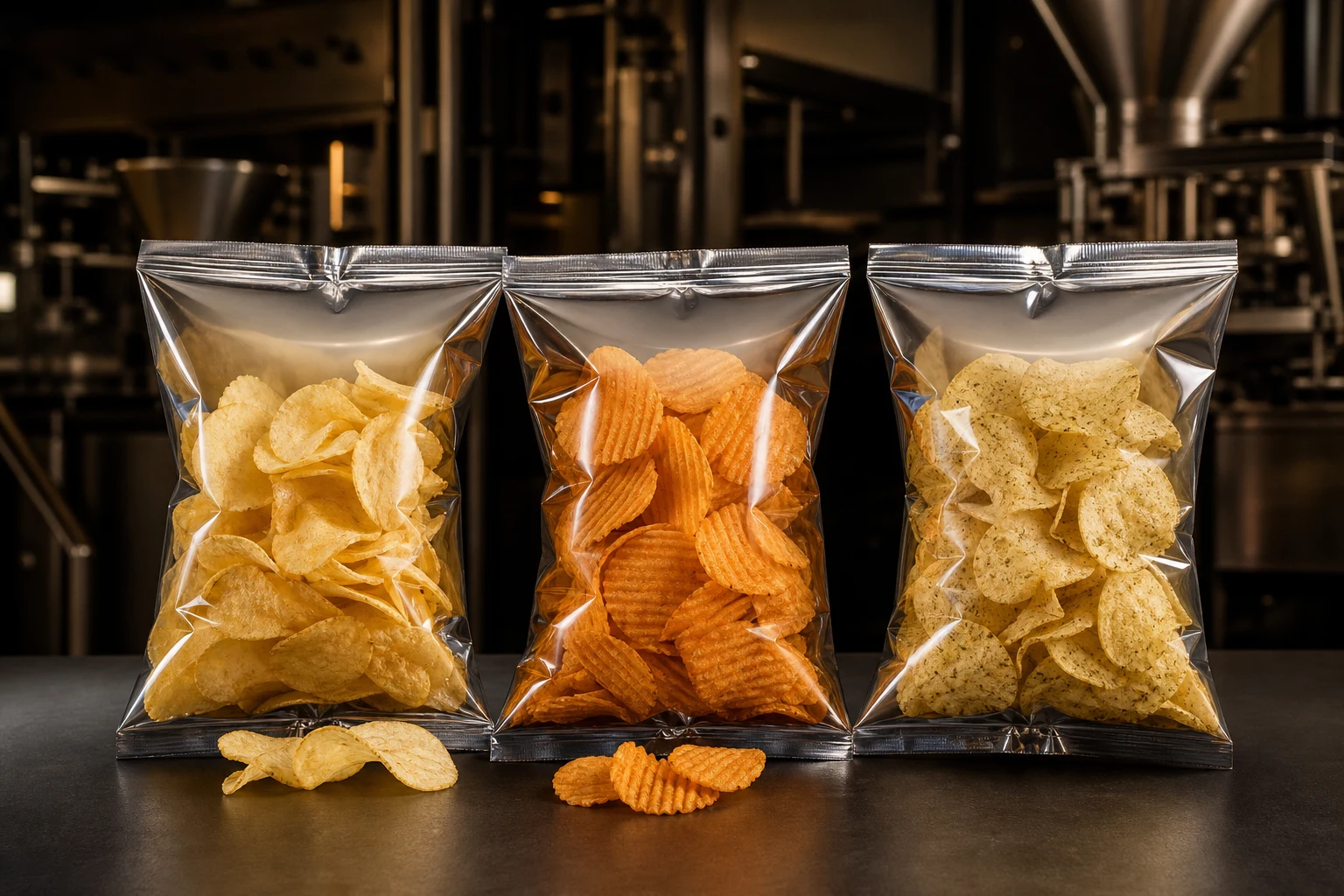
Nitrogen alone cannot rescue a weak pouch, a poor seal, or a snack that was never tested through its real shelf and delivery route.
I design nitrogen-flushed snack packaging by defining the product risk, choosing a proven laminate and seal, controlling residual oxygen and headspace, then validating filled packs over the intended route.
I treat the pouch as a complete system. I confirm the product, material, filling, handling, and customer experience before I approve production.
Why Does a Nitrogen-Flushed Snack Need More Than Gas?
A puffy snack bag can look protected while oxygen, moisture, weak seals, or rough handling still shorten the acceptable product life.
Nitrogen displaces some oxygen and can cushion fragile snacks, but the pouch barrier, seal integrity, product moisture, headspace, and real distribution conditions still determine package performance.
I begin with the dominant failure: rancid flavor, lost crispness, breakage, leakage, or a combination. I then define the desired shelf route, fill weight, bag volume, and tolerance for breakage. I do not promise a shelf life from gas alone because film transmission, sealing, product formulation, and storage conditions work together.
How I make this decision specific
For “Why Does a Nitrogen-Flushed Snack Need More Than Gas?” in this how do i design packaging for nitrogen-flushed snacks review, I define the actual product, pouch configuration, intended use, and decision owner before I ask a supplier or tester for evidence. I keep the selected structure, component details, sample condition, and any stated test method together, then compare the result with the buyer’s actual route rather than a catalogue promise. That record lets me use the barrier-film guide as a decision aid and retain a specification that another team member can check.
For How Do I Design Packaging for Nitrogen-Flushed Snacks, I state what is known, the condition it applies to, and what must still be checked with the actual product. I do not transfer a number, a test result, or a feature choice from another product simply because its pouch looks similar. The result of “Why Does a Nitrogen-Flushed Snack Need More Than Gas?” should give the buyer a clear next check, the supplier a precise request, and the project owner a record of the remaining uncertainty.
For How Do I Design Packaging for Nitrogen-Flushed Snacks, I request the exact pouch structure, component specification, and test conditions from the supplier. A broad material name or catalogue claim is not a production specification. The right next step is a representative filled sample, where relevant, with observations recorded before production is approved.
Which Pouch Structure and Seal Design Should I Specify?
A gas-flush system cannot compensate for a sealant that is contaminated, a laminate with the wrong barrier, or a bag that bursts in a carton.
I specify a nitrogen-flush pouch through the product’s oxygen and moisture risk, film data at stated conditions, sealant, seal width, puncture needs, bag geometry, and line compatibility.
I review the full structure, not only a metallized appearance or a material nickname. I ask for oxygen- and moisture-transmission evidence at comparable conditions and test the seal at realistic speed. I check whether crumbs reach the seal area, whether the pouch has sufficient top-seal clearance, and whether the headspace protects without creating misleading empty volume.
How I make this decision specific
For “Which Pouch Structure and Seal Design Should I Specify?” in this how do i design packaging for nitrogen-flushed snacks review, I define the actual product, pouch configuration, intended use, and decision owner before I ask a supplier or tester for evidence. I keep the selected structure, component details, sample condition, and any stated test method together, then compare the result with the buyer’s actual route rather than a catalogue promise. That record lets me use the barrier-film guide as a decision aid and retain a specification that another team member can check.
For How Do I Design Packaging for Nitrogen-Flushed Snacks, I state what is known, the condition it applies to, and what must still be checked with the actual product. I do not transfer a number, a test result, or a feature choice from another product simply because its pouch looks similar. The result of “Which Pouch Structure and Seal Design Should I Specify?” should give the buyer a clear next check, the supplier a precise request, and the project owner a record of the remaining uncertainty.
How Do I Validate a Nitrogen-Flushed Snack Pack?
A good first pouch can still lose gas, gain moisture, crush the snack, or disappoint customers after storage and transport.
I validate the finished pack with retained oxygen and seal checks, filled storage, sensory and texture review, carton handling, drops, compression, and an agreed release record.
I sample across normal production conditions rather than saving only the best unit. I record fill weight, residual-oxygen result where measured, gas setting, film roll, seal settings, and line speed. I inspect packs after a defined hold and after carton handling, then compare the snack, seal, pouch shape, and customer opening experience with acceptance criteria.
How I make this decision specific
For “How Do I Validate a Nitrogen-Flushed Snack Pack?” in this how do i design packaging for nitrogen-flushed snacks review, I define the actual product, pouch configuration, intended use, and decision owner before I ask a supplier or tester for evidence. I keep the selected structure, component details, sample condition, and any stated test method together, then compare the result with the buyer’s actual route rather than a catalogue promise. That record lets me use the barrier-film guide as a decision aid and retain a specification that another team member can check.
For How Do I Design Packaging for Nitrogen-Flushed Snacks, I state what is known, the condition it applies to, and what must still be checked with the actual product. I do not transfer a number, a test result, or a feature choice from another product simply because its pouch looks similar. The result of “How Do I Validate a Nitrogen-Flushed Snack Pack?” should give the buyer a clear next check, the supplier a precise request, and the project owner a record of the remaining uncertainty.
For How Do I Design Packaging for Nitrogen-Flushed Snacks, I treat the filled pack as a separate check from the material data. I record the fill condition, seal area, opening or closure behavior, carton arrangement, handling observations, and limits of the comparison. That prevents a favourable bench result from becoming an unsupported claim about shelf life, transport, or every product route.
Conclusion
I choose packaging through evidence, filled-pack testing, and clear specifications. That process protects the product, the launch, and the customer experience.
Sources and Further Reading
- ASTM F02 Primary Barrier Packaging fact sheet.
- Reddit r/foodscience, nitrogen-flush equipment community discussion.
- PMC, biodegradable polymer packaging review of oxygen and water-vapor barrier.
- ASTM D3985, oxygen transmission through plastic film.
- ASTM F1249, water-vapor transmission through plastic film.
- ASTM F88/F88M, seal strength of flexible barrier materials.
- Unique Packaging snack pouch options.
- Unique Packaging quality control.
Need a pouch specification?
I can review your product, size, quantity, artwork, and target market.