The wrong print process can force excess inventory, delay artwork changes, or make a growing product too expensive to scale.
I choose digital printing for short runs, many SKUs, and fast changes, while I choose rotogravure for stable high volumes, repeatable color, and lower unit cost at scale.
I compare the total program, not one pouch price. SKU count, forecast confidence, graphics, material, timing, and future revisions can change the result.
How Do Digital Printing and Rotogravure Work?
Both processes can look excellent, but they create images, setup costs, and production economics in very different ways.
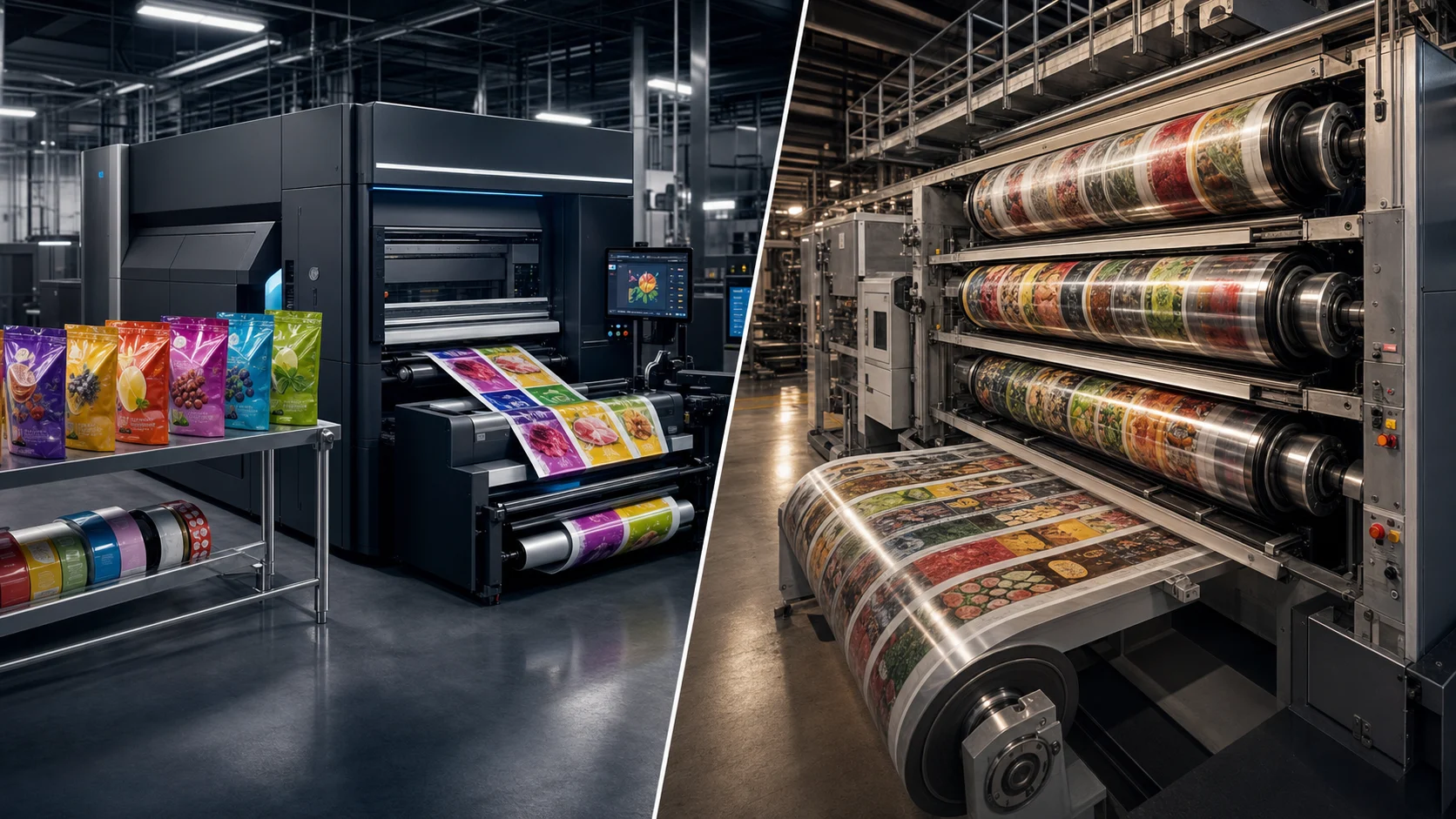
Digital presses print artwork directly from files, while rotogravure transfers ink from engraved cylinders, so each process has a different setup and scale profile.
Digital printing sends approved artwork to a press without making one engraved cylinder for each color. This removes much of the conventional plate or cylinder setup. It supports shorter runs, variable designs, and fast file changes. The exact ink, press width, substrate, white layer, varnish, and finishing route still matter. Digital does not mean that every material or effect is available.
Rotogravure uses engraved cylinders. Recessed cells carry ink and transfer it to the moving film web. The process can deliver strong solids, fine detail, and stable long runs at high speed. Each design and color separation requires cylinder preparation. That creates cost and lead time before printing, but the cost spreads across a large quantity.
I compare the production chain
| Decision | Digital | Rotogravure |
|---|---|---|
| Image setup | I approve a production file and press workflow. | I approve separations and engraved cylinders. |
| Change between SKUs | I can change files with limited physical setup. | I change cylinders and press settings. |
| Best economic range | I favor lower or fragmented volume. | I favor stable, larger volume. |
| Special effects | I verify press and finishing limits. | I can use mature spot-color and coating workflows. |
I ask the converter which process will make my actual pouch. I also ask whether lamination, varnish, white ink, pouch making, and inspection happen on the same route. A process name alone does not define the finished result.
Which Process Costs Less for My Order?
A low setup cost can hide a high unit price, while a low unit price can hide cylinders and unused inventory.
Digital often costs less for small, multi-SKU runs; rotogravure often wins at stable scale, but I calculate setup, waste, revisions, storage, and forecast risk.
I calculate total program cost by SKU. For digital, I include prepress, print, material, lamination, pouch converting, finishing, proof, and freight. For rotogravure, I add cylinder cost, cylinder storage or replacement, setup waste, and the minimum quantity per design. I then divide by expected usable pouches, not only ordered pouches.
I price the inventory risk
A brand with ten flavors can meet a high total volume while each flavor remains small. Digital printing may let me order closer to real demand. That choice can reduce obsolete packaging after a recipe, claim, barcode, or regulation changes. Rotogravure can have a lower unit price, but unused printed packaging can erase that saving.
I run at least three forecast cases. I use cautious, expected, and high demand. I include reorder frequency and lead time. I ask when the rotogravure crossover appears for my material and pouch size because no universal quantity applies. A published comparison can help explain the general trade-off, but I still need a supplier quote for the exact project.1
I also value cash and learning. A short digital run can test shelf response before I lock cylinders and inventory. Once demand stabilizes, I can move a proven design to rotogravure. I plan the transfer early because color and tonal behavior can change between processes. I keep approved physical references for both routes.
Which Process Gives Better Print Quality?
Print quality is not one score; fine type, solid color, gradients, metallic effects, and repeat orders create different tests.
Both processes can deliver premium work, so I judge quality on the actual substrate, artwork, finish, color tolerance, and repeatability my brand requires.
Digital presses can reproduce detailed images, gradients, and many colors without separate cylinders. They are strong for photographic graphics and frequent artwork changes. Rotogravure is known for rich solids, smooth tonal work, and repeatable high-speed production when cylinders and process control are strong. The converter’s equipment, operators, color management, and inspection can matter as much as the process name.
I build an objective approval
I identify critical colors and measurable tolerances. I provide brand standards and a physical reference where possible. I ask how the supplier measures color and controls changes across a web, roll, and repeat order. I inspect small text, reverses, fine lines, barcodes, white ink, registration, and any transparent or metallic area. I view samples under controlled light.
I test finish with print. A matte varnish can change density and contrast. A soft-touch coating can alter color and rub resistance. A metallic substrate can show through weak white ink. A clear window can change the balance of the front panel after filling. I approve the combined construction, not an isolated paper print.
I also check barcode performance on the finished package. GS1 explains that symbol selection, size, placement, quiet zones, and print quality need to fit the scanning environment.2 I avoid folds, seals, and curved areas when possible. I verify the final code rather than trusting its appearance on screen.
When Should a Growing Brand Switch Print Processes?
Switching too early adds setup and inventory, while switching too late can keep unit costs high and capacity tight.
I switch when SKU demand is stable, artwork changes are less frequent, savings exceed setup and risk, and the new process passes a controlled color transfer.
I watch volume by SKU, not only total company volume. I also watch forecast accuracy, write-offs, change frequency, reorder interval, and production capacity. Stable products can move to rotogravure while seasonal or experimental designs stay digital. I do not force one process across the entire portfolio.
I plan a hybrid print strategy
I group products into launch, growth, core, and seasonal stages. Launch products need flexibility and learning. Growth products need regular cost reviews. Core products may justify cylinders and larger runs. Seasonal products need low inventory exposure. This portfolio view keeps printing aligned with business risk.
Before a transfer, I ask the supplier to separate the artwork for the new process and explain expected color changes. I approve a proof and, when needed, a production sample. I compare the digital and rotogravure packs under the same light and on a filled pouch. I update color standards for future orders. I also check whether the material, finish, seal, and pouch dimensions remain identical.
I calculate the payback period for cylinders and additional inventory. I include financing and storage. I require a change-control record so the print-process switch does not quietly change the laminate or sealant. I can review available print and finishing support on the custom packaging services page. The best process is the one that supports the current brand stage and leaves a clear route for the next stage.
Conclusion
I choose packaging through evidence, filled-pack testing, and clear specifications. That process protects the product, the launch, and the customer experience.
Sources and Further Reading
Need a pouch specification?
I can review your product, size, quantity, artwork, and target market.