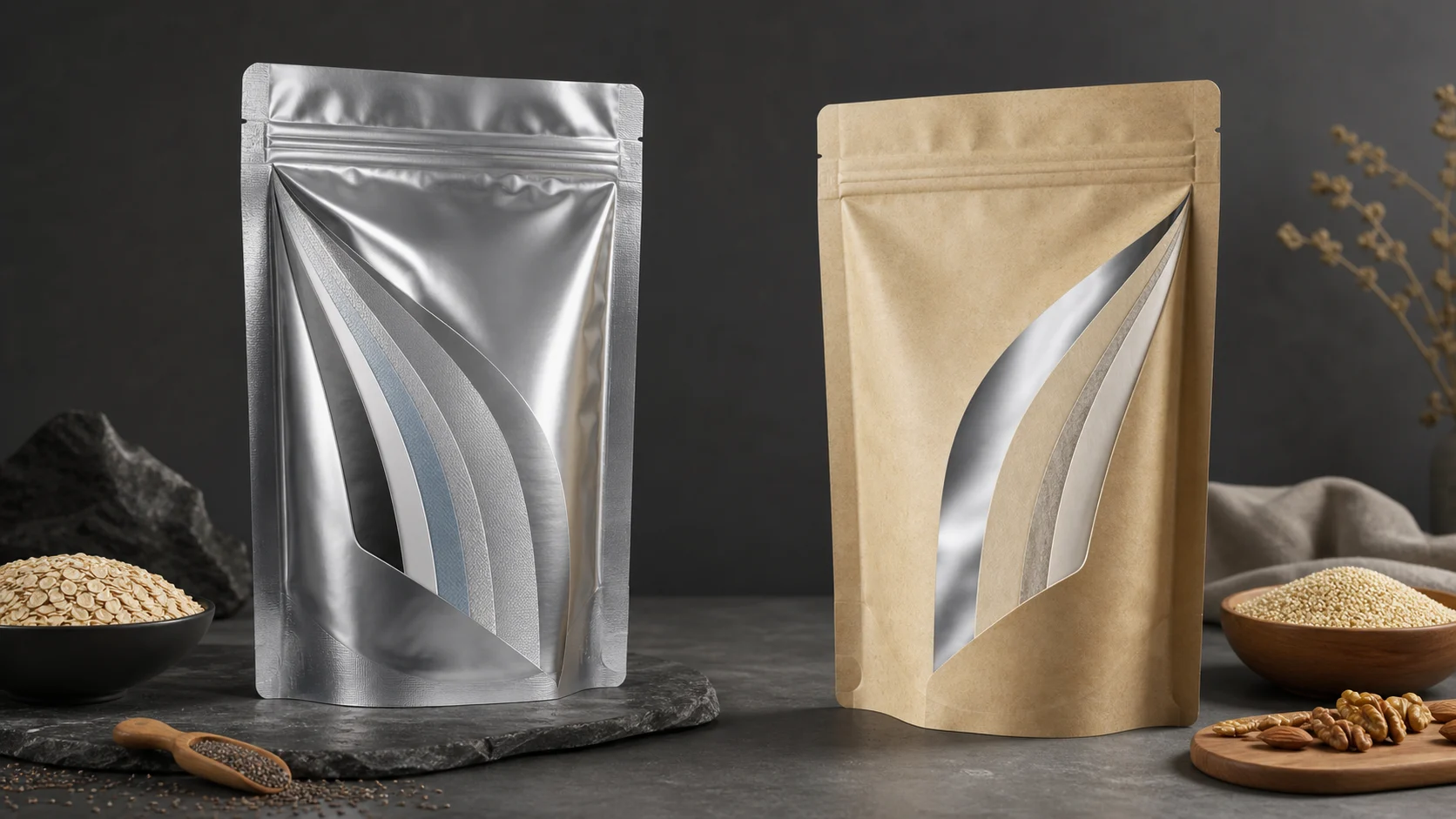
A natural surface or metallic shine can attract attention, but appearance alone cannot protect a sensitive product.
I choose between Mylar-style and kraft-look pouches by required barrier, seal performance, print goals, product sensitivity, market rules, and verified end-of-life options.
I first separate the visible surface from the full laminate. Many kraft bags contain barrier films, and many metallic pouches use several functional layers.
What Is the Real Difference Between Mylar and Kraft Bags?
Buyers often compare two surfaces while the hidden layers decide most of the package performance.
A Mylar-style pouch usually uses polyester or metallized film for strength and barrier, while a kraft pouch may use paper outside and plastic layers inside.
I use the word “Mylar” carefully. Mylar is a trade name often used broadly for polyester film, and many market listings use it for shiny or metallized pouches. The final structure may contain PET, metallized PET, aluminum foil, polyethylene, or other sealant films. I ask for the exact layer sequence, thickness, and function. I do not rely on the product name.
A kraft-look pouch can be paper-based on the outside, but it often needs an inner film to seal and protect food. The paper provides texture, stiffness, and a natural visual cue. The inner layers provide moisture resistance, oxygen barrier, grease resistance, and heat sealing. A window, zipper, valve, or high-barrier coating changes the structure again. I therefore compare two complete specifications, not “plastic versus paper.”
I map each layer to a job
| Layer or feature | Job I expect | Question I ask |
|---|---|---|
| Outer print web | Graphics, abrasion resistance, stiffness. | Will ink sit on the surface or be reverse printed? |
| Barrier layer | Control oxygen, moisture, aroma, or light. | What measured target supports shelf life? |
| Sealant layer | Close the pouch on the filling line. | What seal range and contamination tolerance apply? |
| Paper layer | Texture, stiffness, natural appearance. | Does it affect recycling or moisture behavior? |
I request a technical data sheet and a filled sample. I flex the pack, inspect the folds, and test the zipper. I also ask whether the proposed material is authorized for the intended food-contact use and conditions.1
Which Bag Gives Better Product Protection?
A weak barrier can turn a low unit price into stale product, returns, and damaged trust.
I use the structure with the verified oxygen, moisture, light, aroma, and seal performance that matches the product and its full distribution life.
I begin with the product’s failure mode. Nuts and coffee can oxidize. Powders can absorb moisture and clump. Strong aromas can escape or migrate. Light can change color, flavor, or nutrients. Grease can stain paper. Sharp products can puncture thin films. I rank these risks and set a target shelf life before I compare materials.
I test the complete pack
A foil or metallized Mylar-style structure often offers strong light and gas protection. It can be a good direction for aroma-sensitive dry foods, supplements, and products with long distribution. Kraft laminates can also reach useful barrier levels when the inner structure is designed for the product. The paper face does not prove poor barrier, and a silver face does not prove excellent barrier. Thickness also does not tell the full story. Material type, layer quality, seals, and converting control matter.
I ask for oxygen and moisture transmission data under stated test conditions. I compare those conditions with my storage environment. I test seal strength, leakage, puncture resistance, drop behavior, and zipper repeat use. I include valves and windows because they can become the limiting point. I also fill the actual product. A dry laboratory value cannot show every effect of oils, dust, filling temperature, and shipping vibration.
I document the approved structure and sample. If I change a layer, supplier, thickness, or adhesive, I treat the change as a new risk. I ask for another review. This process costs less than discovering after launch that a beautiful bag does not support the promised shelf life.
Which Material Prints and Looks More Premium?
Premium packaging fails when the finish fights the brand position or the print loses contrast on the chosen surface.
I choose the surface by desired color, texture, opacity, finish, and shelf signal, then I proof the design on the actual structure.
Mylar-style films support rich reverse printing, strong color, metallic effects, and smooth matte or gloss finishes. A metalized base can create bright highlights when I control white ink. Clear windows can be integrated in some structures. Kraft paper gives a tactile, fibrous surface and a familiar craft signal. It can make muted palettes feel honest and small-batch. It can also reduce color brightness and fine-detail sharpness compared with a smooth white film.
I avoid visual shortcuts
I do not assume that kraft means sustainable or that metallic means luxury. Shoppers read the whole system. Typography, spacing, pouch shape, print quality, finish, and product category all influence the signal. I use kraft only when its texture supports the brand. I use metallic effects only when they guide attention and stay controlled. I often prefer a quiet matte field with one precise highlight over a fully shiny pouch.
I request a substrate-specific proof. White ink coverage changes color. Matte varnish lowers contrast. Soft-touch finishes can mark or scuff. Paper fibers can change small type. Metallic film can make a barcode or ingredient panel hard to scan if the white backing is weak. I check the physical sample under store light and daylight. I rub, crease, and handle it.
I also inspect the filled pouch from normal shelf distance. The front panel may curve. A bottom gusset may lift the design. A zipper can shorten usable space. I compare the result with nearby competitors, but I do not copy their visual language. I use the final material as part of the identity, not as a background added at the end.
Is Kraft Paper Always the More Sustainable Choice?
A green-looking pack can create risk when the material claim does not match local collection and recycling reality.
I make sustainability claims only after I verify the full structure, local collection path, recyclability evidence, and the exact wording allowed in the target market.
I separate renewable appearance from end-of-life performance. A kraft laminate may combine paper, adhesive, barrier coating, and plastic sealant. Those layers can be difficult to separate. A mono-material plastic pouch may use less material and may fit a store-drop-off or flexible-film stream in some places. It may have no practical collection route in another place. The right answer depends on the exact structure and the market.
I make claims that I can support
The United States Federal Trade Commission warns against broad environmental claims that are hard to substantiate. Its Green Guides also explain when recyclable claims need qualification based on access to suitable facilities.2 I therefore avoid phrases such as “eco-friendly” without a specific, documented meaning. I state the material, the relevant program, and any disposal limits in plain language.
For European sales, I track the Packaging and Packaging Waste Regulation and the rules that apply to my launch timing and country. The European Commission states that the PPWR entered into force in February 2025 and generally applies from August 2026, with a goal for packaging to be recyclable by 2030.3 I still seek market-specific compliance advice because labels, producer obligations, and collection systems can differ.
I compare product protection too. A pack that causes more food waste can undermine a material reduction. I choose the lightest structure that meets the needed shelf life and survives distribution. I keep evidence for claims, and I review it when the structure or destination changes. I can compare available formats on the pouch catalog before I request samples.
Conclusion
I choose packaging through evidence, filled-pack testing, and clear specifications. That process protects the product, the launch, and the customer experience.
Sources and Further Reading
Need a pouch specification?
I can review your product, size, quantity, artwork, and target market.