Film abbreviations can make a pouch quote look clear while hiding the layer role, seal risk, and product condition that decide whether it works.
I compare PET, PE, BOPP, and CPP by the job each layer performs in the complete laminate, then validate the finished pouch with the actual product and process.
I treat the pouch as a complete system. I confirm the product, material, filling, handling, and customer experience before I approve production.
What Job Does Each Film Do in a Pouch?
A laminate fails when I choose by an abbreviation alone instead of assigning every layer a job.
I use PET or BOPP where stiffness, print surface, or appearance fit; PE or CPP often provide seal and product-contact functions, but the final structure must be engineered and tested as one system.
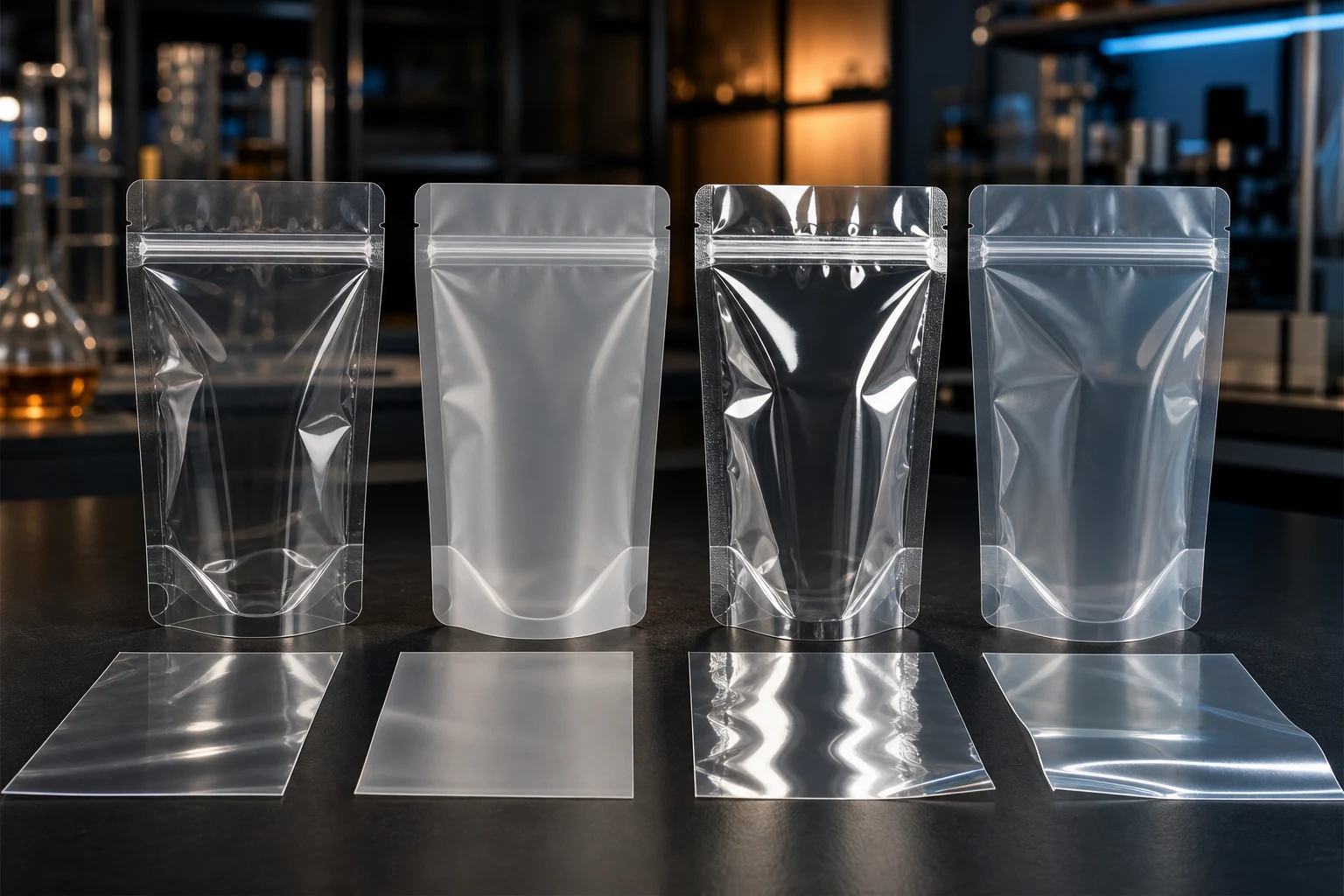
PET, PE, BOPP, and CPP are not interchangeable labels. A PET/CPP packaging film and a BOPP/PE laminate can assign different jobs to the outer and sealant layers, so “PET vs BOPP” is not a complete purchasing comparison. I ask which layer faces the product, which carries print, which creates the seal, and which layer provides the stated barrier or puncture support. I compare thickness, orientation, coatings, metallization, adhesive, and any tie layer before I accept a quote.
How I make this decision specific
| Film | Common role to discuss | What I verify in the finished structure |
|---|---|---|
| PET | Outer print, stiffness or heat-resistant web | Grade, thickness, print, bond and process exposure |
| BOPP | Outer web, appearance or moisture-barrier contribution | Orientation, coating or metallization and seal design |
| PE | Sealant, product-contact layer or mono-material direction | Seal window, stiffness, puncture and intended-use documents |
| CPP | Cast sealant layer and selected heat-use routes | Grade, seal behavior, thickness and complete laminate |
For “What Job Does Each Film Do in a Pouch?” in this what is the difference between pet, pe, bopp, and cpp films review, I define the actual product, pouch configuration, intended use, and decision owner before I ask a supplier or tester for evidence. I keep the selected structure, component details, sample condition, and any stated test method together, then compare the result with the buyer’s actual route rather than a catalogue promise. That record lets me use the food barrier film guide as a decision aid and retain a specification that another team member can check.
For What Is the Difference Between PET, PE, BOPP, and CPP Films, I state what is known, the condition it applies to, and what must still be checked with the actual product. I do not transfer a number, a test result, or a feature choice from another product simply because its pouch looks similar. The result of “What Job Does Each Film Do in a Pouch?” should give the buyer a clear next check, the supplier a precise request, and the project owner a record of the remaining uncertainty.
For What Is the Difference Between PET, PE, BOPP, and CPP Films, I request the exact pouch structure, component specification, and test conditions from the supplier. A broad material name or catalogue claim is not a production specification. The right next step is a representative filled sample, where relevant, with observations recorded before production is approved.
How Do Product and Filling Conditions Change the Choice?
A film that works for a dry ambient snack can be the wrong answer for oil, heat, freezing, dust, or a fast seal line.
I match the structure to product chemistry, oxygen and moisture sensitivity, fill temperature, handling, expected shelf route, and the seal window on the real equipment.
I record whether the product is dry, fatty, acidic, hot filled, refrigerated, frozen, sharp, dusty, or aromatic. FDA’s conditions-of-use tables distinguish food types and temperature routes, so I do not treat a broad food-grade statement as proof for every product and process. I fill samples at target weight and examine seals, corners, folds, and headspace.
How I make this decision specific
For “How Do Product and Filling Conditions Change the Choice?” in this what is the difference between pet, pe, bopp, and cpp films review, I define the actual product, pouch configuration, intended use, and decision owner before I ask a supplier or tester for evidence. I keep the selected structure, component details, sample condition, and any stated test method together, then compare the result with the buyer’s actual route rather than a catalogue promise. That record lets me use the food barrier film guide as a decision aid and retain a specification that another team member can check.
For What Is the Difference Between PET, PE, BOPP, and CPP Films, I state what is known, the condition it applies to, and what must still be checked with the actual product. I do not transfer a number, a test result, or a feature choice from another product simply because its pouch looks similar. The result of “How Do Product and Filling Conditions Change the Choice?” should give the buyer a clear next check, the supplier a precise request, and the project owner a record of the remaining uncertainty.
What Should I Test Before Approving PET, PE, BOPP, or CPP?
A material datasheet can be useful, but an empty film sample cannot prove a finished pouch will protect or run correctly.
Before approval, I compare the exact laminate, barrier test conditions, seal performance, product-contact documents, filled storage, handling, and a retained reference sample.
I ask for the named structure rather than a sales shorthand. I review reported oxygen or water-vapor data only with its method, temperature, relative humidity, and thickness, using the packaging test guide to connect each risk to evidence. I then validate production-style pouches through filling, sealing, cooling, cartoning, handling, opening, and repeat closure when relevant. For a food application I compare suitable formats on the food-pouch page, then send product, route, size, quantity per design and current structure through the material assessment request before asking for samples, a locked specification and a comparable quotation.
How I make this decision specific
For “What Should I Test Before Approving PET, PE, BOPP, or CPP?” in this what is the difference between pet, pe, bopp, and cpp films review, I define the actual product, pouch configuration, intended use, and decision owner before I ask a supplier or tester for evidence. I keep the selected structure, component details, sample condition, and any stated test method together, then compare the result with the buyer’s actual route rather than a catalogue promise. That record lets me use the food barrier film guide as a decision aid and retain a specification that another team member can check.
For What Is the Difference Between PET, PE, BOPP, and CPP Films, I state what is known, the condition it applies to, and what must still be checked with the actual product. I do not transfer a number, a test result, or a feature choice from another product simply because its pouch looks similar. The result of “What Should I Test Before Approving PET, PE, BOPP, or CPP?” should give the buyer a clear next check, the supplier a precise request, and the project owner a record of the remaining uncertainty.
For What Is the Difference Between PET, PE, BOPP, and CPP Films, I treat the filled pack as a separate check from the material data. I record the fill condition, seal area, opening or closure behavior, carton arrangement, handling observations, and limits of the comparison. That prevents a favourable bench result from becoming an unsupported claim about shelf life, transport, or every product route.
Conclusion
I choose packaging through evidence, filled-pack testing, and clear specifications. That process protects the product, the launch, and the customer experience.
Sources and Further Reading
- FDA, Food Packaging and Other Substances that Come in Contact with Food.
- Reddit r/Packaging, metallized BOPP food-packaging community discussion.
- FDA, Food Types and Conditions of Use for Food Contact Substances.
- PMC, Cast polyolefin-film extrusion review.
- ASTM D3985, oxygen transmission through plastic film.
- ASTM F1249, water-vapor transmission through plastic film.
- Unique Packaging film guide.
- Unique Packaging materials inquiry.
Need a pouch specification?
I can review your product, size, quantity, artwork, and target market.