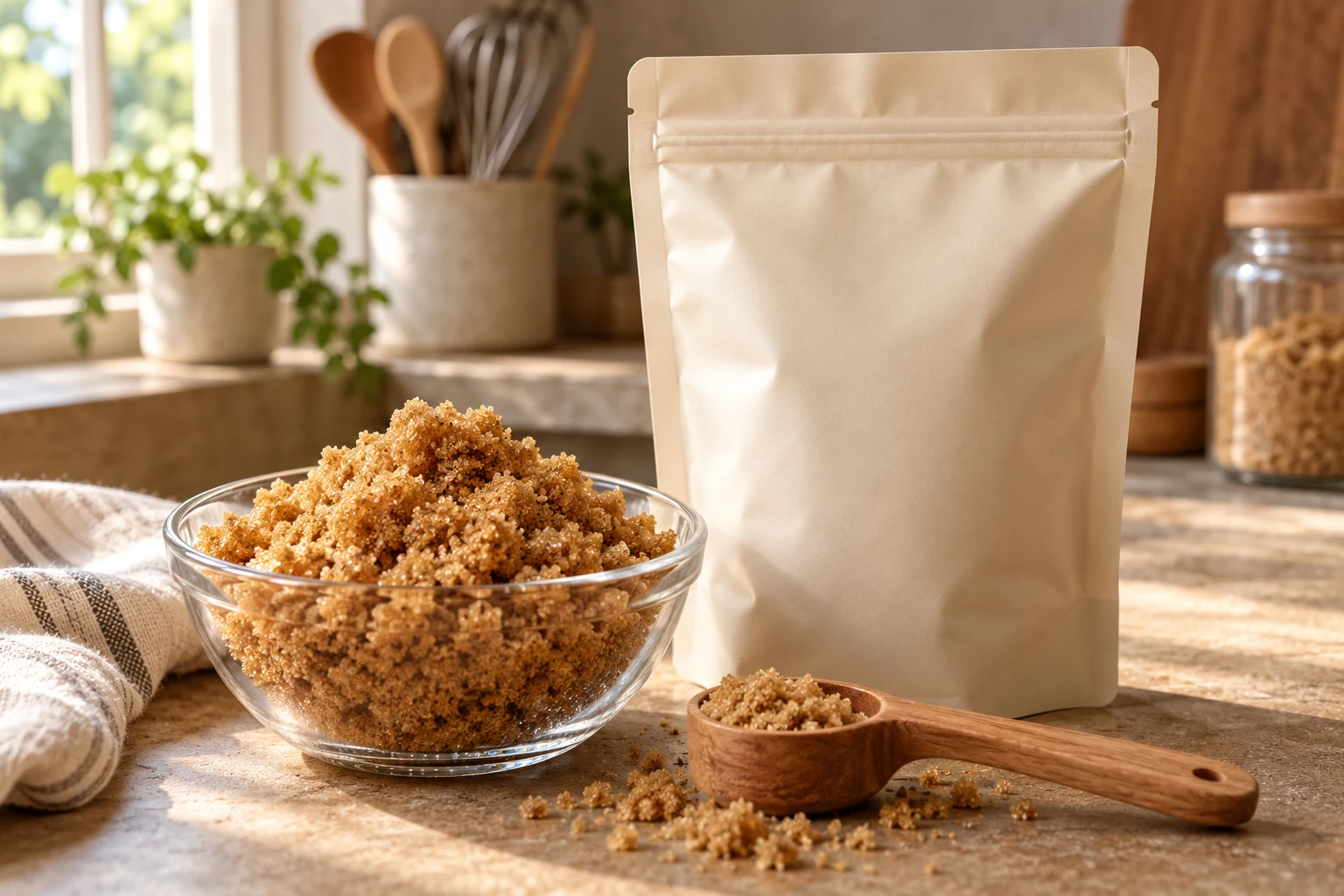
Brown sugar that hardens between uses frustrates bakers. A zipper looks convenient, but the complete pouch and the way people close it still need checking.
I select a brown sugar pouch around moisture retention, reliable sealing, and repeated kitchen use. I compare the exact construction, test scooping and reclosure with the real sugar, and keep unopened-pack and opened-pack evaluations separate.
At Unique Packaging, I treat softness as a product quality target that needs evidence. I do not assume that a resealable feature alone establishes how long sugar will stay soft.
Why Does Brown Sugar Need a Different Moisture Brief?
A specification copied from granulated sugar can miss the intended texture. I first establish what moisture change would mean for the actual brown sugar.
I define the sugar formulation and softness target before comparing moisture-barrier evidence. I evaluate the full structure and closure against the planned environment, rather than treating every sugar as the same dry ingredient.
I identify the product precisely: light or dark brown sugar, its formulation, supplier, incoming condition, and intended use. Domino explains that brown sugar loses moisture when it hardens and recommends a tightly closed storage container or suitable moisture-proof bag.1 That supports a moisture-retention question. It does not establish a specific barrier target for a new pouch or a guaranteed period of softness.
I distinguish this question from the granulated sugar packaging decision. The ingredient owner should confirm the desired texture and the evaluation method for this brown sugar. I ask for a retained incoming sample and agree how the team will compare softness later. Otherwise one buyer may judge a sample by hand while another expects it to pour freely, and neither can explain the acceptance decision.
I compare the actual laminate
| Option to sample | Buying question | Evidence I request |
|---|---|---|
| Clear film or windowed pouch | Is visibility valuable for this pack? | Complete structure, window design, and comparable WVTR data |
| Opaque flexible laminate | Does the proposed structure meet the product brief? | Layer and sealant details, test conditions, and filled trial |
| Paper-faced pouch | Does the presentation justify this construction? | Inner barrier film and seal evidence; paper appearance is insufficient |
I use the barrier-film core guide to prepare the comparison. For ASTM F1249 data I request film identification, conditioning, temperature, humidity gradient, units, and agreed limits.4 I ask the laboratory which conditions represent the comparison and which product exposures still need a separate study. A rate measured on film is one piece of the decision, not proof about the zipper or kitchen use.
I also document the market and food-contact use. FDA’s tables distinguish food types and storage or processing conditions.3 I ask the supplier to match its documents to the proposed construction and actual use. I do not infer compliance, recyclability, or performance from a cream finish, a kraft appearance, or the word resealable on a sample request.
How Should I Check Scooping and Zipper Closure?
A narrow opening can make scooping awkward, and sugar left near the track can complicate closing. I need to see the real baking routine.
I check a full and partly empty pouch with the intended scoop or cup. I observe first opening, access, rim cleanliness, and complete zipper engagement before choosing the mouth and closure position.
I begin with the measuring tool, not the empty pouch width. I ask whether the user takes a spoonful, fills a measuring cup, or transfers the whole pouch into a canister. I choose tools that match that task and test access with the sugar in place. I watch the wrist position, grip room above the fill, and whether a cup can leave without scraping the opening. A pouch that works with a teaspoon may not work with the cup pictured on the brand’s recipe instructions.
In an r/Cooking discussion, one user described squeezing air from a purchased zipper bag and putting it inside another zipper bag; other participants preferred jars or separate containers.6 These are individual storage experiences, not a controlled comparison. I use the thread to ask whether buyers expect the original pack to remain their storage container and what extra steps they currently take.
I make closure use observable
Domino describes pressing its zipper together and sliding fingers along it to close the remaining length. Its FAQ also says freshness depends on location and environmental factors.2 That is a useful example of instructions tied to a particular branded pack. It is not evidence that another zipper, laminate, or fill weight performs the same way. I ask people unfamiliar with the proposed closure to use it before I finalize the instructions.
For my comparison I inspect the torn top edge, available grip above the zipper, sugar around the opening, and whether the user recognizes an incompletely engaged section. I record the tool, remaining fill, repeated opening sequence, and visible residue. I compare alternatives under the same routine. I do not add household moisture remedies to a commercial pack or treat community storage tricks as a validated product formulation.
If the sugar reaches the top-seal area during filling, I use the seal and zipper contamination guide to structure a separate line review. That review asks how the filling process keeps the seal zone clear. The consumer zipper and the original production seal have different jobs, and I need evidence for both before ordering.
Which Filled-Pack Checks Belong in the Purchase Brief?
An attractive sample cannot explain later hardening or a failed reorder. I need a comparison plan that records both storage and use conditions.
I compare unopened and repeatedly opened samples using agreed product criteria and recorded environments. I confirm seals, carton handling, material details, and change controls before requesting a quote for the approved brown sugar pouch.
I split the trial into two questions. First, how does the filled and sealed pack behave before opening? Second, how does it behave under the intended opening routine? I use the same sugar lot and identify the material and closure in each sample. I record starting condition, fill weight, storage temperature, ambient relative humidity, observation dates, and handling sequence. I agree the criteria with the ingredient team before looking at results, so the evaluation does not change to favor one design.
I keep an unopened comparison sample and another group used for the defined scoop-and-reclose routine. I note how often each opened sample is handled and how it is stored between uses. The product team decides how to evaluate texture, moisture, and any other relevant attributes. I do not assign a shelf life from these illustrative buying checks or claim that a short observation proves the complete commercial storage period.
I keep seal evidence and texture evidence distinct
For production seals I can request a laboratory comparison using ASTM F88/F88M, the seal-strength method described in ASTM’s public overview.5 I ask for the agreed specimen setup, conditioning, results, and observed failure behavior. I also inspect filled pouches for visible channels, folds, loose sugar outside the seal, and changes after the agreed carton handling. Seal measurement does not replace the brown sugar quality study. I retain photographs and labeled samples from each configuration.
- Brown sugar type, formulation reference, lot, and incoming texture.
- Fill range, dimensions, usable opening, zipper, notch, and seal allowance.
- Full structure and food-contact evidence for the intended market.
- Barrier method, test conditions, and written acceptance criteria.
- Separate unopened and opened-use plans with environment records.
- Carton plan, artwork revision, sample approvals, and change triggers.
I complete the written pouch specification after material assessment and a representative filled-pack trial. I then request a brown sugar pouch quotation against that record, including quantity per artwork and destination. The supplier must confirm its current commercial terms for the exact brief. This guide offers no verified MOQ, lead time, price, or storage-life result.
Conclusion
I choose packaging through evidence, filled-pack testing, and clear specifications. That process protects the product, the launch, and the customer experience.
Sources and Further Reading
- Domino Sugar, Baking and Product FAQs: brown sugar storage.
- Domino Sugar, Zipper Bags FAQs.
- FDA, Food Types and Conditions of Use for Food Contact Substances.
- ASTM F1249-25, water-vapor transmission test scope.
- ASTM F88/F88M-21, public seal-strength method scope (historical edition).
- Reddit r/Cooking, brown sugar storage experiences.
Need a pouch specification?
I can review your product, size, quantity, artwork, and target market.