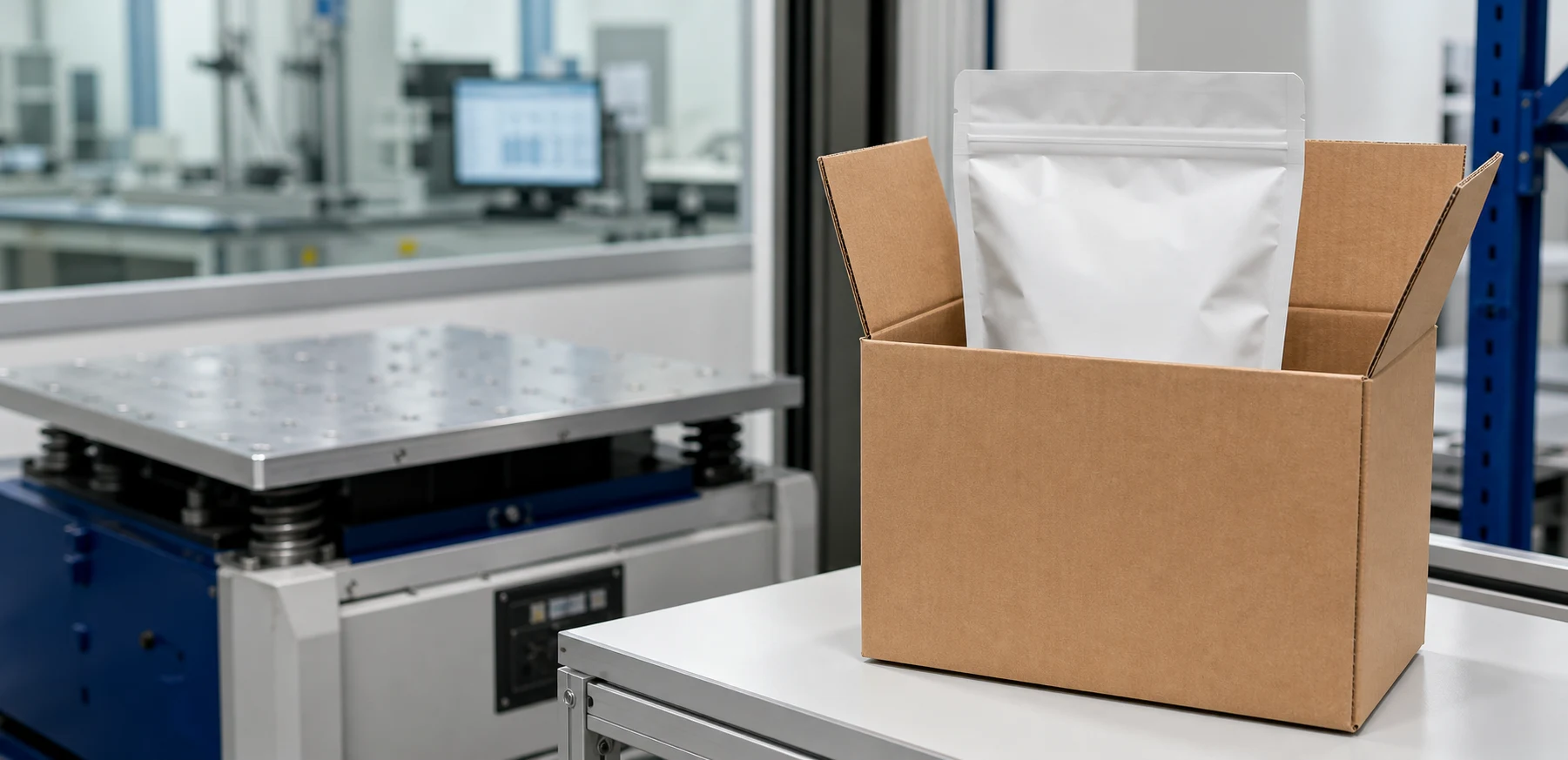
A pouch can pass a bench check yet leak, scuff, crush, or fail at the zipper after its carton meets a real shipping route.
I select filled-pouch distribution tests from the product, pouch, carton, pallet or parcel route, and likely hazards, then inspect the same complete configuration the customer receives.
I treat the pouch as a complete system. I confirm the product, material, filling, handling, and customer experience before I approve production.
Which Route and Hazards Should Define the Test Plan?
A generic drop test can miss the stresses that matter when parcel, pallet, export, chilled, or retail routes expose a pouch differently.
I define the distribution route, package weight, carton, unit count, handling points, storage exposure, shipment mode, and observed failure risk before I select tests.
I map the journey from filling through warehouse, carrier, retailer, and customer. I ask whether pouches travel as parcels, in mixed pallets, in full truckloads, or through a retail distribution center. I record carton dimensions, gross weight, pack orientation, void fill, stacking, temperature and humidity exposure where relevant, and likely drop or vibration events. I also ask which failures matter most: leakage, crush damage, puncture, scuffing, seal opening, zipper damage, or an unstable pouch. The complete pack is the unit I test.
How I make this decision specific
For “Which Route and Hazards Should Define the Test Plan?” in this which filled-pouch distribution tests should i run before launch review, I define the actual product, pouch configuration, intended use, and decision owner before I ask a supplier or tester for evidence. I keep the selected structure, component details, sample condition, and any stated test method together, then compare the result with the buyer’s actual route rather than a catalogue promise. That record lets me use the flexible packaging pinhole-prevention guide as a decision aid and retain a specification that another team member can check.
For Which Filled-Pouch Distribution Tests Should I Run Before Launch, I state what is known, the condition it applies to, and what must still be checked with the actual product. I do not transfer a number, a test result, or a feature choice from another product simply because its pouch looks similar. The result of “Which Route and Hazards Should Define the Test Plan?” should give the buyer a clear next check, the supplier a precise request, and the project owner a record of the remaining uncertainty.
For Which Filled-Pouch Distribution Tests Should I Run Before Launch, I request the exact pouch structure, component specification, and test conditions from the supplier. A broad material name or catalogue claim is not a production specification. The right next step is a representative filled sample, where relevant, with observations recorded before production is approved.
How Do Drop, Vibration, and Compression Checks Work Together?
One gentle handling check may overlook repeated vibration, stacking load, and impacts that interact with seals, corners, and carton protection.
I combine the route-appropriate drop, vibration, compression, conditioning, and handling checks so I can inspect how the pouch, carton, and product behave as one system.
ISTA lists procedures with elements such as shock, vibration, compression, and atmospheric conditioning; the suitable choice depends on the shipment system. I select the sequence that fits the defined route and use the complete filled pouch and outer pack. I avoid claiming that a basic in-house test equals certification. A modest screen can still be valuable if its limits are clear, while a formal protocol should be performed as required by the customer, insurer, retailer, or project risk.
How I make this decision specific
| Observed hazard | What I inspect | Pack-level evidence |
|---|---|---|
| Drop or impact | Corners, seals, punctures, product breakage. | Post-test photos and leak checks. |
| Vibration | Rub, settling, zipper and seal stress. | Carton and pouch comparison. |
| Compression | Panel collapse, seam load, carton protection. | Stack orientation and observations. |
| Atmosphere | Condensation, stiffness, and seal condition. | Defined condition and timing. |
For “How Do Drop, Vibration, and Compression Checks Work Together?” in this which filled-pouch distribution tests should i run before launch review, I define the actual product, pouch configuration, intended use, and decision owner before I ask a supplier or tester for evidence. I keep the selected structure, component details, sample condition, and any stated test method together, then compare the result with the buyer’s actual route rather than a catalogue promise. That record lets me use the flexible packaging pinhole-prevention guide as a decision aid and retain a specification that another team member can check.
For Which Filled-Pouch Distribution Tests Should I Run Before Launch, I state what is known, the condition it applies to, and what must still be checked with the actual product. I do not transfer a number, a test result, or a feature choice from another product simply because its pouch looks similar. The result of “How Do Drop, Vibration, and Compression Checks Work Together?” should give the buyer a clear next check, the supplier a precise request, and the project owner a record of the remaining uncertainty.
What Should I Inspect After Distribution Simulation?
A carton can look acceptable from outside while a pouch inside has a damaged seal, rubbed panel, hidden pinhole, or poor consumer opening experience.
I inspect every representative pouch and carton after the sequence, checking product condition, pouch body, seals, corners, zipper, artwork, barcode area, carton integrity, and opening use.
I compare the post-test sample with a retained pre-test sample. I look at pouch surfaces, gussets, top and side seals, zipper tracks, tear features, and product movement. I inspect the carton for collapse, rubbing, shifting, or a pack count that creates excess movement. I check a filled pouch for leaks using an appropriate method for the project, and I record any failure by exact location. If the product requires a shelf-life study, I separate that study from a transit screen and define its own conditions and acceptance criteria.
How I make this decision specific
For “What Should I Inspect After Distribution Simulation?” in this which filled-pouch distribution tests should i run before launch review, I define the actual product, pouch configuration, intended use, and decision owner before I ask a supplier or tester for evidence. I keep the selected structure, component details, sample condition, and any stated test method together, then compare the result with the buyer’s actual route rather than a catalogue promise. That record lets me use the flexible packaging pinhole-prevention guide as a decision aid and retain a specification that another team member can check.
For Which Filled-Pouch Distribution Tests Should I Run Before Launch, I state what is known, the condition it applies to, and what must still be checked with the actual product. I do not transfer a number, a test result, or a feature choice from another product simply because its pouch looks similar. The result of “What Should I Inspect After Distribution Simulation?” should give the buyer a clear next check, the supplier a precise request, and the project owner a record of the remaining uncertainty.
For Which Filled-Pouch Distribution Tests Should I Run Before Launch, I treat the filled pack as a separate check from the material data. I record the fill condition, seal area, opening or closure behavior, carton arrangement, handling observations, and limits of the comparison. That prevents a favourable bench result from becoming an unsupported claim about shelf life, transport, or every product route.
How Do I Turn Test Results Into a Launch Decision?
Test photos alone do not tell a production team what configuration passed, what changed, or when a future alteration requires another check.
I document the exact pouch, product, carton, route, test sequence, observations, acceptance decision, and re-test triggers so the result guides a real launch.
I retain approved samples and identify the pouch structure, dimensions, fill weight, closure, print revision, carton count, orientation, and storage conditions. I state the procedure or internal screen used and its scope. If the team changes film, pouch geometry, filler, fill, carton, route, or handling condition, I review whether the original test still represents the product. That record supports an evidence-led launch and a faster response if a customer later reports a transit failure.
How I make this decision specific
For “How Do I Turn Test Results Into a Launch Decision?” in this which filled-pouch distribution tests should i run before launch review, I define the actual product, pouch configuration, intended use, and decision owner before I ask a supplier or tester for evidence. I keep the selected structure, component details, sample condition, and any stated test method together, then compare the result with the buyer’s actual route rather than a catalogue promise. That record lets me use the flexible packaging pinhole-prevention guide as a decision aid and retain a specification that another team member can check.
For Which Filled-Pouch Distribution Tests Should I Run Before Launch, I state what is known, the condition it applies to, and what must still be checked with the actual product. I do not transfer a number, a test result, or a feature choice from another product simply because its pouch looks similar. The result of “How Do I Turn Test Results Into a Launch Decision?” should give the buyer a clear next check, the supplier a precise request, and the project owner a record of the remaining uncertainty.
For Which Filled-Pouch Distribution Tests Should I Run Before Launch, I preserve the final decision in a written brief that names the approved sample, conditions, observations, open risks, and change triggers. I then use the flexible packaging seal-leak guide to keep the quotation tied to the evidence rather than to a remembered sample or a generic product name.
Conclusion
I choose packaging through evidence, filled-pack testing, and clear specifications. That process protects the product, the launch, and the customer experience.
Sources and Further Reading
Need a pouch specification?
I can review your product, size, quantity, artwork, and target market.