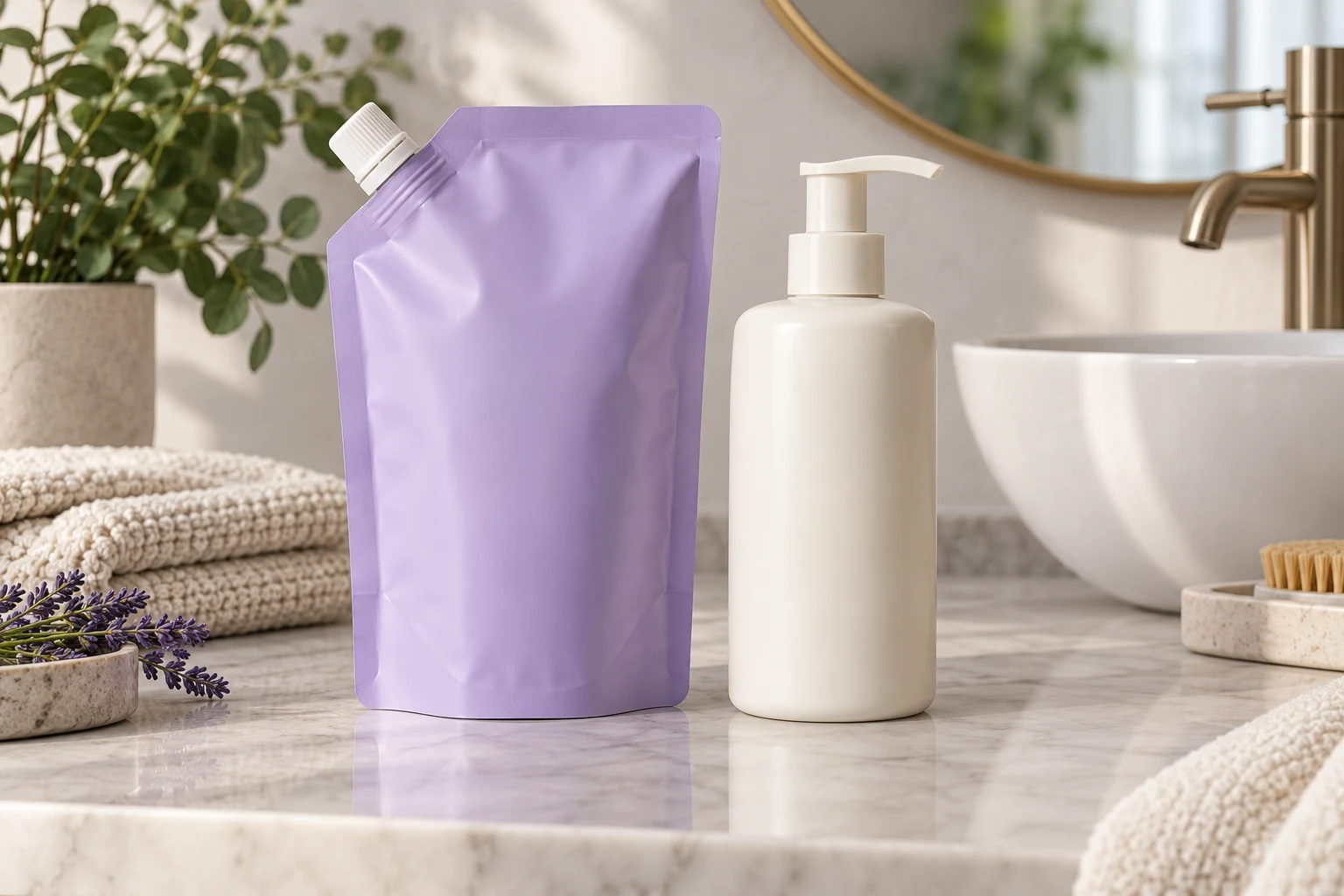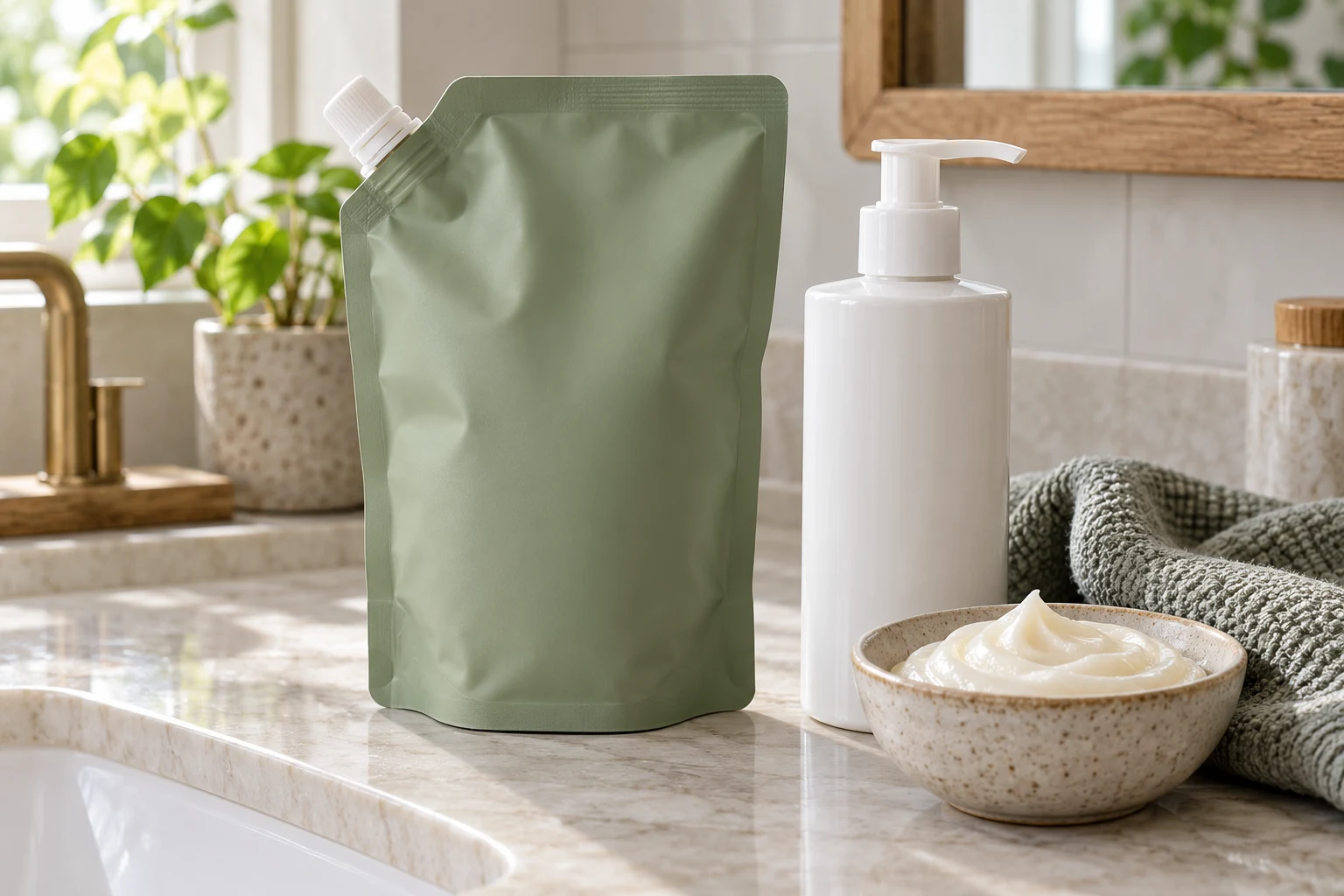
A refill pouch loses its appeal when thick conditioner refuses to pour, coats the bottle neck, or remains trapped in the corners.
I test conditioner refill pouches with the actual formula and receiving bottle, comparing transfer control, usable recovery, cap and seal integrity, compatibility, and the brand’s validated refill instructions.
In my packaging reviews at Unique Packaging, I treat thick-product transfer as a separate job from a shampoo or hand-wash refill.
Which Spout and Bottle Combination Should I Trial?
A spout that looks convenient in a catalogue can be awkward when a thick formula meets a narrow bottle neck.
I compare candidate spouts with the actual conditioner and receiving bottles, checking opening access, grip, alignment, transfer rate, interruption, and recovery across the proposed use conditions.
I start by asking the brand which formula revision and bottle it intends to support. I record the fill quantity, bottle capacity, neck opening, pump removal sequence, and whether a pouch should refill one bottle or several. I also ask the formulator to define the relevant condition range for handling trials. I do not prescribe a universal viscosity or tell customers to warm, dilute, or modify the conditioner to make an unsuitable pack work.
In the cited r/ZeroWaste discussion, a user asked why a conditioner was unavailable in the desired refill format. A commenter suspected that flow through the outlet could be a problem and suggested a wider opening on a squeezable bag.
1That is a concrete user concern and a hypothesis, not confirmation of the manufacturer’s reason. I use it to justify a comparison trial. I do not repeat the speculation as a product-development fact or claim it establishes demand across a market.
For each candidate, I run the same transfer task. The user opens the cap, removes the bottle pump, aligns the spout, starts the flow, stops, and closes the pouch if any product remains. I note whether the pouch needs two hands, whether the bottle stays stable, and whether the spout fits into or above the neck. A wider outlet is only a candidate: it may change control as well as access.
I compare a corner spout and a central spout where the project supports both. I check how the pouch folds near the outlet when it is nearly empty. The spout-pouch selection guide helps define the component and geometry questions, while the filled trial determines whether this combination is usable.
A commercial conditioner refill already exists on L’Occitane’s Malaysian site, with instructions to transfer it to the usual bottle and replace the pump.
2That example establishes a specific marketed use, not compatibility between its pack and another formula. I still require our own approved pairing. The trial should make the supported bottle and user sequence explicit before the artwork implies that any household container will work.
How Do I Measure Clean Transfer and Remaining Product?
A fast first pour can hide mess, poor stopping control, and conditioner that users cannot remove near the end.
I weigh the starting and remaining pack, document a repeatable transfer task, and compare usable recovery, drips, grip effort, and bottle filling without inventing a universal pass threshold.
I define the user task before taking measurements. The plan states the formula lot, sample conditioning, pouch fill, receiving bottle, operator instructions, transfer endpoint, and tools allowed. If one sample is rolled from the bottom and another is only tilted, I cannot attribute the result to the spout alone. I keep the task consistent and record any extra action a user needed to complete it.
I weigh the filled pouch before and after the agreed sequence, accounting for the empty packaging and any separately collected spills. I distinguish product left inside from product successfully delivered to the bottle. A low remaining weight is not a good result if the missing conditioner is on the counter. I also record transfer duration, pauses, visible neck residue, cap mess, and any discomfort reported during squeezing. These are proposed trial observations, not performance numbers already measured for our pouches.
I use the comparison below to keep usability separate from integrity and formula work.
| Observed issue | What I compare | Evidence to keep |
|---|---|---|
| Slow or interrupted flow | Spout geometry and formula condition | Timed transfer sequence with sample identity |
| Drips at stopping | Outlet control and bottle alignment | Photos and collected spill record |
| High remaining product | Corner shape and agreed emptying method | Starting, delivered and residual mass |
| Cap becomes messy | Closing after a partial refill | Reopening and closure inspection |
I include the nearly empty stage because users experience it even if launch photography does not show it. I ask whether they can guide the remaining conditioner toward the outlet without blocking the spout or losing their grip. I do not encourage cutting open the pack in consumer instructions simply to improve a recovery figure. Any alternative opening or emptying method would need its own product and user review.
The brand also needs a bottle-capacity rule. A pouch larger than the receiving bottle requires controlled stopping and storage of the remainder. A one-bottle refill has a different use brief. I check this before the team finalizes nominal size, rather than assuming all conditioner bottles accept the same quantity.
I connect the observations to the written pouch specification. The accepted drawing records the outlet, cap, pouch dimensions, fill range, and supported receiving bottle. I retain a filled reference alongside it. That makes the final decision reproducible and prevents a later component substitution from being treated as a cosmetic change.
What Compatibility and Hygiene Evidence Must I Confirm?
A good transfer test does not establish formula stability, microbial protection, or seal integrity throughout the product’s intended life.
I ask the responsible cosmetic team to approve formula-package compatibility and refill instructions, while the converter documents components, sealing, closure integrity, and the tested configuration.
I request the full packaging component list, including film, product-contact layer, adhesive, spout, cap, and relevant sealing interfaces. I give the formulator representative finished packs rather than a single flat film swatch. The review needs the actual formula and intended storage and use conditions. FDA identifies inadequate packaging, preservation problems, poor storage, and consumer handling among possible routes to microbial contamination in cosmetics.
3That supports a system review. It does not mean an integrity test alone can establish microbiological safety.
I ask the cosmetic team to define compatibility and stability observations. Depending on its assessment, these may include appearance, odor, texture, separation, changes to components, and the appropriate laboratory work. FDA explains that cosmetic shelf life varies with the product, use, and storage, and describes moisture and temperature exposure among relevant factors.
4I therefore avoid a generic accelerated-storage duration or a claim that a new pouch automatically inherits the bottle’s shelf life. The responsible team must connect its plan and conclusions to this configuration.
Refill instructions also require a product-specific decision. I do not tell every buyer to rinse a bottle or transfer into any convenient container. The supported bottle, preparation, transfer sequence, handling of remaining product, and reuse limits must come from the brand’s validated system. FDA’s cosmetic GMP checklist includes preservation assessment under foreseeable storage and consumer use, along with primary-packaging and batch records.
5I ask how those records will identify the refill lot after transfer and how a complaint will be investigated.
For the converter’s work, I distinguish the flat pouch seals from the spout weld and cap closure. ASTM F88/F88M covers seal-strength measurement.
6I retain its relevant specimen and test conditions, but do not present that one result as proof of the entire spouted system. The quality-tests guide helps the team select further checks for the actual failure modes and packed route.
My release record lists formula revision, fill range, structure, spout and cap codes, drawing, written test conditions, acceptance criteria, approved instructions, receiving bottle, carton arrangement, and retained samples. I complete material assessment and a representative filled-pack trial before requesting written confirmation and a quote against the agreed specification. I also define review triggers for any formula, contact-layer, outlet, cap, or bottle change. Price, environmental comparisons, certification, and shelf-life claims stay out unless this specific project supplies evidence for them.
Conclusion
I release conditioner refills only when the formula, spout, bottle, transfer sequence, integrity evidence, and validated user instructions work as one documented system.
Sources and Further Reading
- Reddit r/ZeroWaste, conditioner refill question and a commenter’s flow concern.
- L’Occitane Malaysia, Purifying Freshness Conditioner Refill and bottle instructions.
- FDA, microbiological safety and cosmetics.
- FDA, shelf life and expiration dating of cosmetics.
- FDA, cosmetic GMP guidelines and inspection checklist.
- ASTM F88/F88M-23, seal strength method scope.
Need a pouch specification?
I can review your product, size, quantity, artwork, and target market.