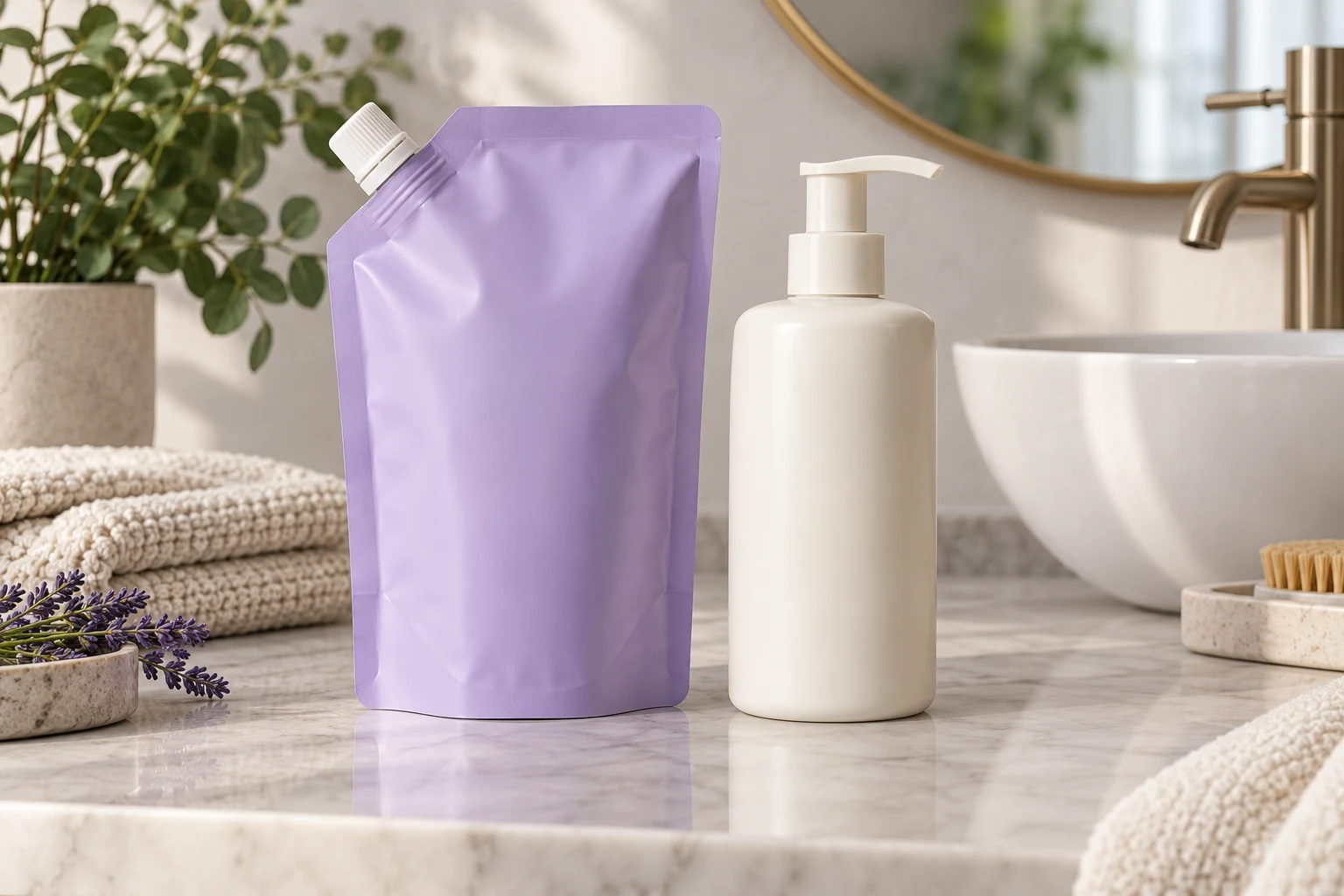
A lotion refill can leave customers with awkward squeezing, product left behind, or instructions that do not match the bottle they own.
I test body lotion refill pouches with the actual formula, receiving bottle, and intended transfer routine. I compare flow control, residual product, closure behavior, compatibility, and hygiene evidence before confirming the package specification.
I treat a refill as a transfer system. My review follows the formula from the filled pouch to the receiving bottle and keeps convenience observations separate from safety evidence.
Which Refill Routine Am I Actually Asking Customers to Follow?
A pouch may empty well into a wide jar yet frustrate a customer trying to refill a narrow bottle around a long pump stem.
I define the receiving container, transfer opening, refill quantity, customer steps, and permitted use. I check the complete sequence with the actual lotion instead of assuming a spout that works for shampoo also works for this formula.
I begin with the receiving bottle. I identify the neck opening, usable capacity, pump displacement, shoulder shape, and the steps needed to remove and replace the pump. I ask the brand whether the refill is intended for one named bottle or a broader range. A package cannot promise universal compatibility just because the spout fits inside one opening. I need a defined claim and a trial that can support it.
A Reddit user in r/AsianBeauty asked whether a moisturizer could be used directly from its refill pouch instead of an airless pump jar.1 This was a facial-moisturizer discussion, not a body-lotion performance test. It still raises a useful design question: will customers understand the refill’s intended role? I do not adopt commenters’ preservation or cleaning advice as fact. I ask the formula owner to define whether direct dispensing is allowed and to substantiate the instructions.
What should the adult transfer trial show?
I give an evaluator the proposed filled pouch, approved bottle, and draft instructions. I observe how the evaluator supports the bottle, aims the spout, starts the flow, stops it, and replaces the pump. I note any tool the evaluator reaches for. If a funnel or spoon appears necessary, I bring that finding back to the design team. I do not silently add an unvalidated household accessory to the customer instructions.
I repeat the transfer at a defined product temperature and record that condition. I also compare a full pouch with a partly emptied one. The point is to learn where control becomes awkward, not to declare that every thicker formula behaves the same way. I keep separate notes for spills, contact between the spout and bottle, pause points, and lotion remaining after the instructed routine.
The spout selection guide helps me compare the opening and grip arrangement. I use a sample approval checklist to retain the bottle and pouch revisions together. The approved pair matters more than either component’s appearance in isolation.
How Do I Separate Compatibility, Hygiene, and Flow Evidence?
A clean transfer demonstration does not establish that the formula and complete package remain suitable through storage and customer use.
I review formula compatibility, package protection, and transfer usability as separate evidence streams. I ask qualified technical staff to define storage conditions, contact-material checks, microbiological assessment, and acceptance criteria for the actual system.
I ask for the proposed film construction, inside contact layer, spout, cap, and any gasket or other contact component. I link these to the actual lotion formula and intended manufacturing conditions. I ask the technical team to identify what must be examined during storage: appearance, odor, package condition, closure behavior, and other product-specific criteria. I do not set a universal pass limit for a formula I have not tested.
FDA identifies inadequate packaging and consumer use among possible routes for microbial contamination of cosmetics.2 That supports reviewing the package and use instructions together. It does not tell me that a particular refill is unsafe, nor does it establish a cleaning method for its bottle. I ask the responsible cosmetic safety team to approve the intended refill routine and the evidence supporting it.
Which trial answers which question?
| Evidence stream | Condition I record | Question it answers |
|---|---|---|
| Formula and package compatibility | Formula lot, construction, contact time and temperature. | What changes were observed in this pairing? |
| Microbiological assessment | Qualified protocol and intended consumer routine. | Does the safety evidence support this use? |
| Transfer usability | Actual bottle, product temperature and instructions. | Can an adult refill it as intended? |
| Closure and seal assessment | Component revision and defined test setup. | How did the specified assembly perform? |
FDA’s cosmetic product-testing guidance emphasizes the manufacturer’s responsibility for product safety.3 I therefore keep the qualified safety review visible in the purchase record. A packaging supplier’s film report cannot replace that responsibility. I also avoid describing the pack as FDA approved or assigning a storage life from a similar product.
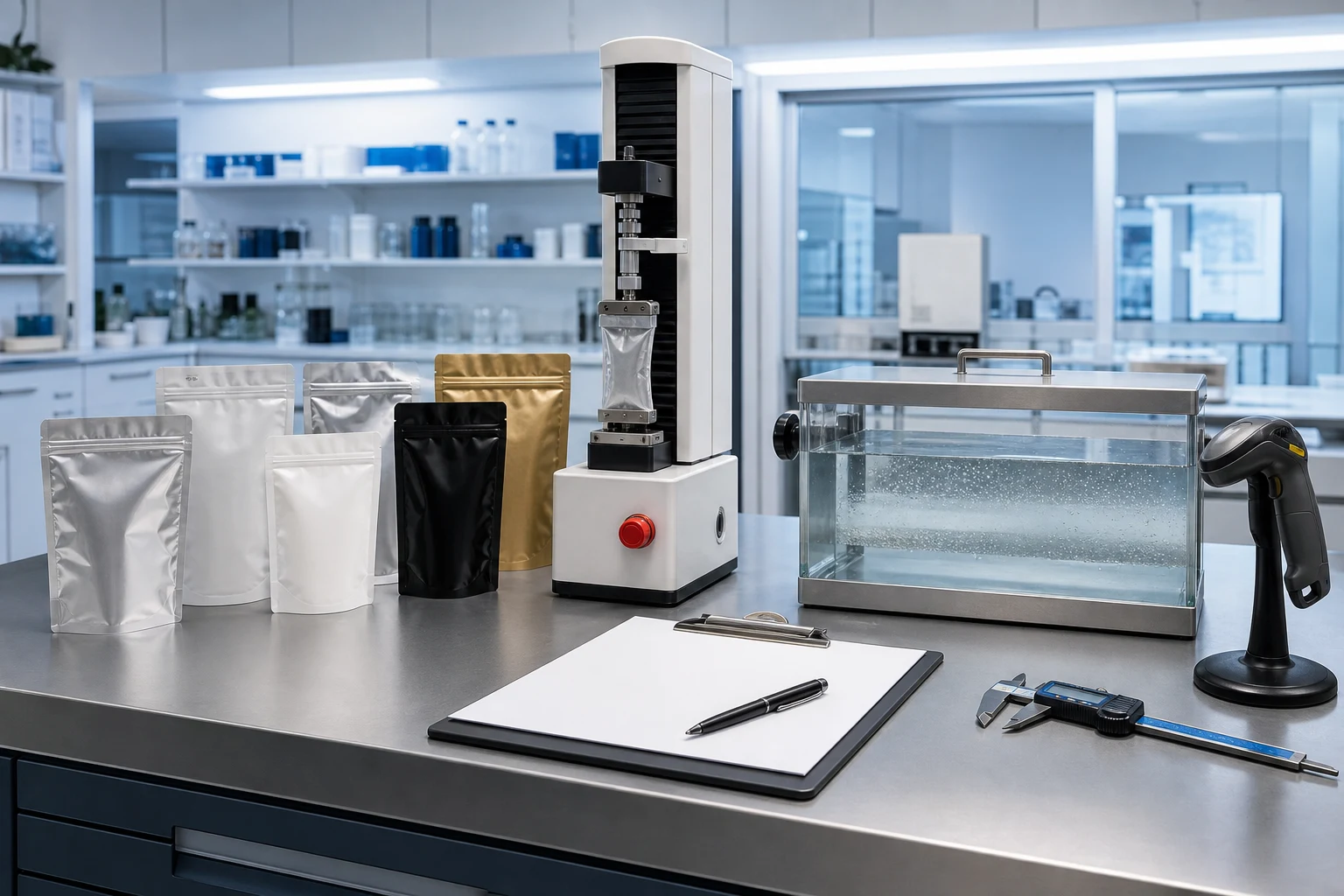
For a numerical seal comparison, ASTM F88/F88M covers seal-strength measurement in flexible barrier materials.4 I ask the laboratory to identify specimen preparation, width, technique, and failure mode. I use the packaging quality-test guide to organize the remaining questions. I require results tied to the selected material and do not treat a strong strip seal as proof of complete pouch compatibility.
How Do I Measure Residual Lotion and Write the RFQ?
A refill can appear empty while the buyer has no consistent method for comparing product left behind across pouch and spout options.
I define a repeatable emptying routine and weigh the pouch before and after transfer, accounting for its packaging mass. I record product conditions, bottle fit, observations, and approved limits before requesting quotes against the accepted specification.
I define what finished means before comparing samples. For one project it may mean following the printed instructions until transfer stops. For another, the team may approve a particular squeeze-and-fold sequence. I use the same routine for each candidate and ask the formula owner to approve it. I do not let one evaluator cut a pouch open while another stops at the first slow flow and then call the results comparable.
I weigh identified samples on a suitable balance and retain the raw readings. My record includes the filled pouch mass, its packaging mass, the post-transfer pouch mass, and any material spilled outside the receiving bottle. I ask the test owner to account for measurement uncertainty and explain how packaging mass was established. Residual product is the post-transfer mass minus the relevant packaging mass. I do not announce a percentage reduction without actual comparative measurements.
What changes should force another review?
I repeat the affected evaluation if the formula, spout geometry, pouch stiffness, fill range, bottle neck, or instructions change. I also name likely failure modes in the pilot: delayed flow followed by a surge, an unstable bottle, an overfilled receiving container, product left in corners, cap leakage, or a customer treating a transfer refill as a permanent dispenser. Each observation belongs to the stated sample and conditions.
- Formula identity, fill range, target market, and intended refill bottle.
- Film construction, contact components, pouch dimensions, and spout drawing revision.
- Manufacturing conditions, compatibility plan, and qualified safety approvals.
- Transfer instructions, product temperature, weighing method, and acceptance limits.
- Retained samples, carton arrangement, artwork revision, and reapproval triggers.
I connect the approved pilot to the written packaging specification. I then request quotations on a comparable scope, including the agreed components and evaluation work. A supplier alternative needs its own evidence rather than a quiet substitution. I make no unsupported promise about MOQ, price, timing, recyclability, or shelf life. The useful outcome is a refill the team has evaluated under conditions it can describe and repeat.
I retain the draft instructions used during each trial. If the final artwork changes the transfer steps, I check that version again. Otherwise, a useful evaluation may describe a routine the customer never sees.
Conclusion
I approve lotion refills through actual formula and bottle trials, measured residual product, qualified safety review, and a specification suppliers can quote.
Sources and Further Reading
Need a pouch specification?
I can review your product, size, quantity, artwork, and target market.