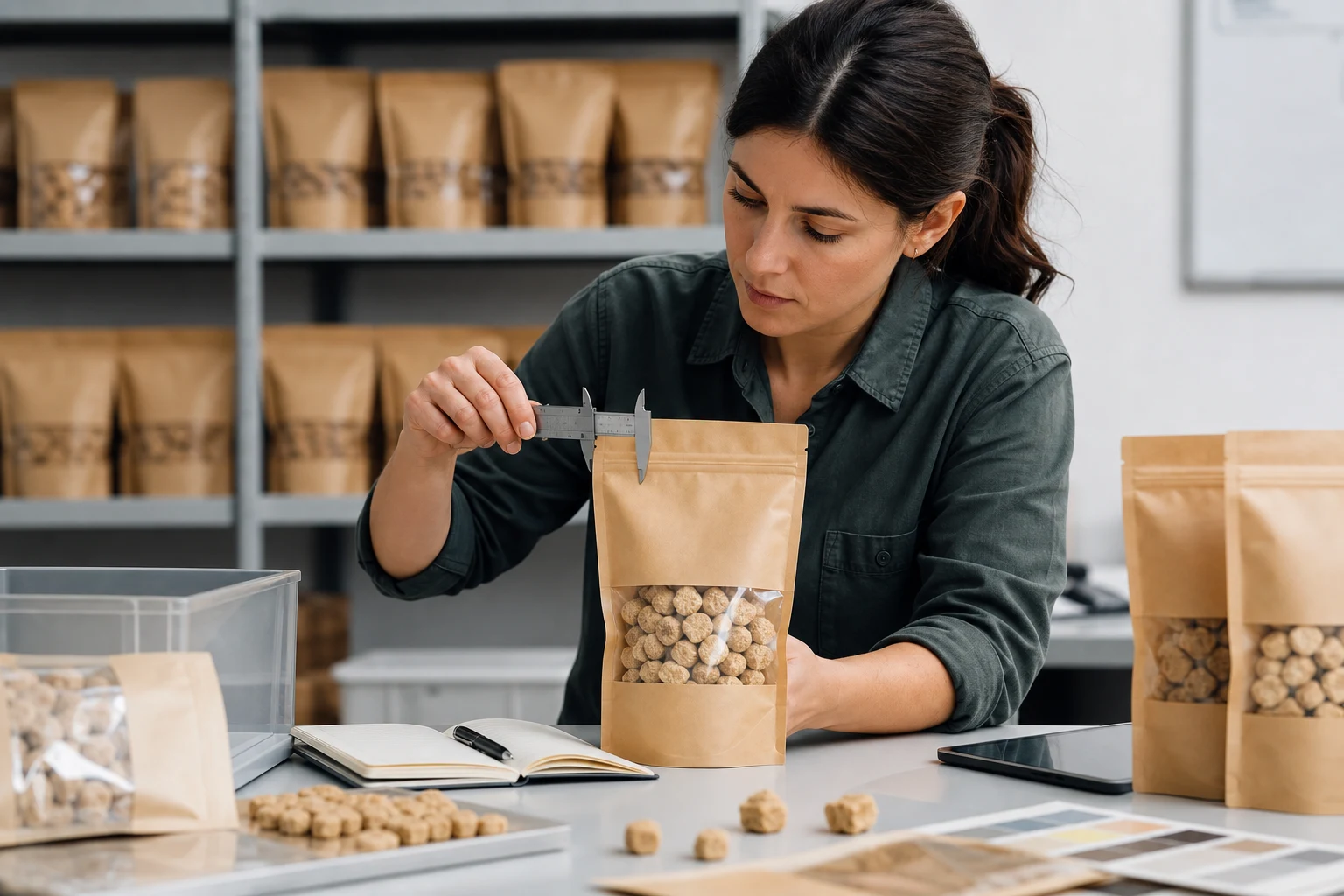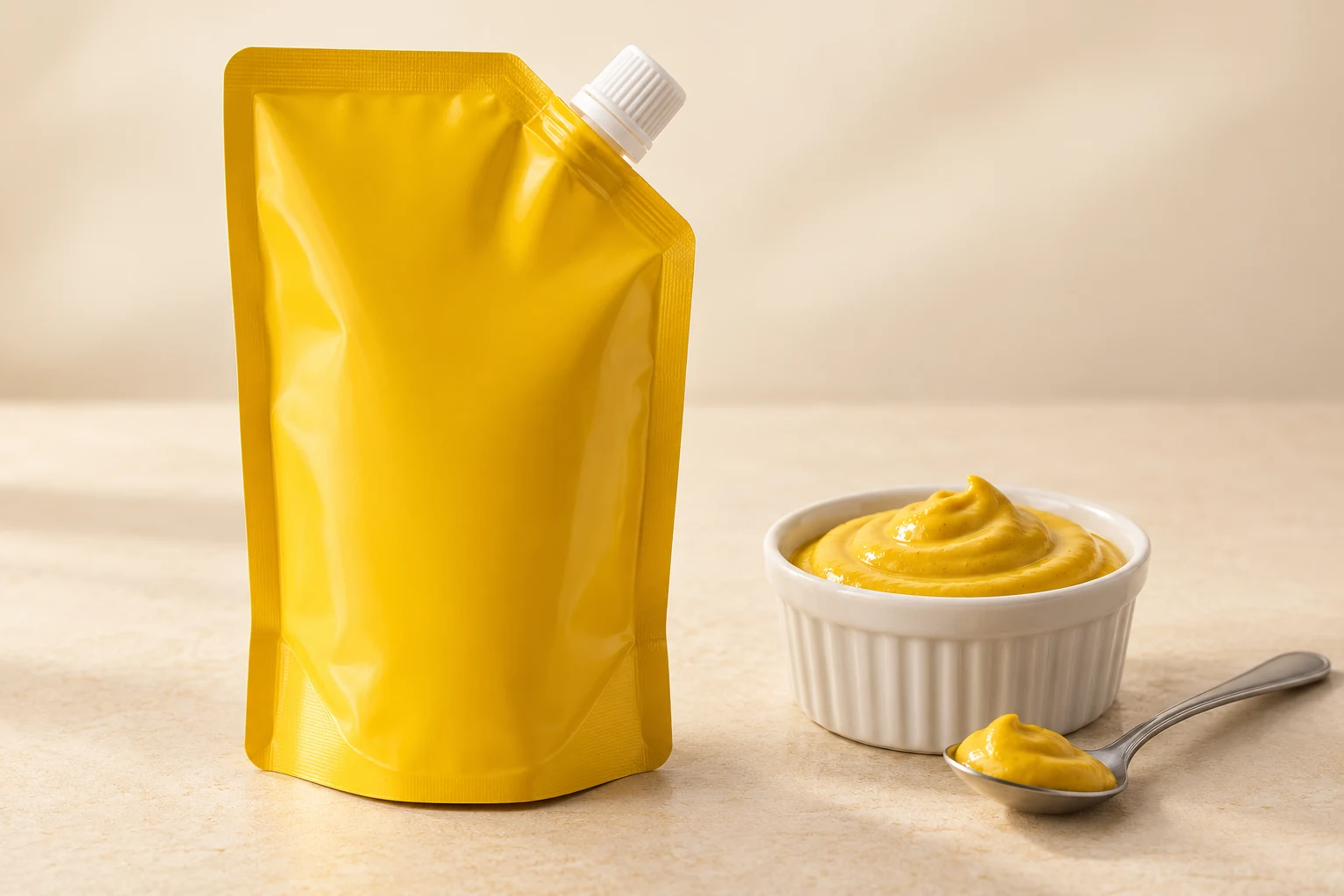
Mustard can be awkward to dispense, while a neat empty pouch says little about its fitment, filling process or behavior during repeated use.
I test mustard spout pouches with the exact recipe, intended filling conditions and chosen cap. I compare dispensing, reclosure, film-to-fitment seals and packed delivery, then confirm the approved construction and acceptance criteria before requesting a quote.
At Unique Packaging, I treat a mustard pouch as a product-and-process decision. A smooth sauce, a whole-grain recipe and a foodservice refill should not inherit the same approval by default.
Which Mustard Recipe and Filling Details Must I Confirm?
A pouch selected from a sauce photograph can fail to match the actual mustard or the packer’s process. General hot-fill language leaves important gaps.
I identify the recipe, visible particles, intended filling process, storage conditions and destination market first. The product owner and qualified process team confirm food-safety requirements; the converter documents compatibility of the exact film, fitment and cap.
I start with a representative batch of the finished mustard. I ask whether it is smooth or contains whole seeds and whether the brand plans a retail squeeze pack or a refill. I request the product owner’s handling instructions and process brief. I do not infer the necessary thermal treatment or storage conditions from the word mustard, its yellow color or another brand’s package.
The FDA food-contact tables distinguish food types and conditions such as room-temperature filling, hot filling and refrigerated storage.1 I use them to make the US-market documentation request specific. They do not establish a safe manufacturing recipe or prove that an unnamed pouch is compatible with every one of those conditions. Other destination markets require their own applicable review.
Separate packaging compatibility from process approval
I send the converter the intended fill conditions, cooling or holding steps where relevant, storage route and expected contact period. I ask which construction, fitment and cap the supplier proposes for that brief. If those details are still undecided, I request sample options rather than placing a production order under a broad hot-fill claim.
A mustard founder’s Reddit post describes difficulty finding a squeezable, hot-fill-compatible bottle and a label that does not wrinkle when squeezed.2 I use this first-person experience to frame a useful comparison between bottle and pouch prototypes. It does not prove that switching to a pouch solves filling or print durability. Those features need their own checks with the actual product.
I organize the pack choice with the spout pouch selection guide and attach a marked drawing. I record who owns process approval and who supplies component evidence. This prevents an attractive empty sample from becoming an accidental sign-off for the food process.
Before artwork is final, I confirm the orientation the filling equipment expects and how the operator will close or handle the pack. A change from filling through the open top to filling through a fitment must be discussed explicitly. I keep those decisions with the sample so that the buyer, converter and packer are reviewing one configuration.
How Do I Compare Spouts for Smooth and Whole-Grain Mustard?
A spout that works with one sauce can require awkward force with another. A cap that closes easily when clean may behave differently after dispensing.
I compare fitment options using the actual mustard at the intended use conditions. I observe starting flow, portion control, residue, reclosure and access as the pack empties, then choose an opening and cap that fit the tested task.
I begin with a dispensing task rather than a universal spout diameter. A customer may want a small amount on a sandwich, a spoonful for a recipe or a larger transfer into a foodservice container. I test the relevant task using the real mustard. For a whole-grain recipe, I watch how the actual particles pass the opening. I do not assume that a fitment approved with a smooth substitute will behave the same way.
| Application | What I observe | What I keep fixed |
|---|---|---|
| Smooth retail mustard | Starting flow and small portions | Recipe, sample temperature and fill level |
| Whole-grain mustard | Particle passage and residue | Representative seed content and fitment |
| Kitchen refill | Transfer into the intended vessel | Receiving opening and operator task |
I record whether the user grips the pouch comfortably, where the pack folds and whether a large squeeze releases more sauce than intended. I compare samples at full and partial fill. These are observations from a defined trial, not a promise of a fixed dispensing force or zero product left in every pouch.
Include the cap and the second opening
I ask the user to put the cap back after dispensing and repeat the task later under the agreed storage conditions. I inspect residue around the neck, the ability to find the threads and the condition of the closure. I keep a clean reference sample for comparison. If a cap has an intended first-open feature, I include that opening sequence in the review.
I also compare the pouch with the brand’s current package. The baseline helps identify whether a new shape improves the task the buyer actually cares about. I avoid claiming that a lighter-looking pack has a lower environmental impact or a lower delivered cost without an appropriate comparison. Functional suitability comes before those broader claims.
I take the selected fitment and panel geometry back to the written pouch specification. I mark cap type, feature position, fill orientation and the approved sample reference. If the mustard recipe, particle content or receiving container changes, I decide which dispensing checks need to be repeated before approving the change.
How Do I Validate Fitment Seals and Release the Purchase Order?
A pouch has both film seals and a fitment interface. A clean pour does not establish that either will survive the planned filling and delivery route.
I inspect and test representative filled packs, documenting film seals, fitment attachment, cap closure and carton handling. I keep test conditions and acceptance limits with the approved sample, then quote the exact construction and process assumptions.
I inspect the film-to-fitment area separately from the side and top seals. I ask the converter which sample and process established the proposed attachment. I look for visible distortion, wrinkles, inconsistent sealing and damage after the agreed handling sequence. I keep those observations distinct from the dispensing trial because an easy-to-use spout can still need a different attachment review.
ROPEX describes a specific mustard, ketchup and mayonnaise pouch project in which attaching a soft spout required controlled pressure and consistent temperature distribution.3 I cite it as an equipment supplier’s account of one sealing application. I do not transfer its machine settings, tooling dimensions, output or performance claims to another pouch. It is useful because it makes the fitment interface a separate engineering question.
Define each test and its limit
For seal-strength comparisons, ASTM F88/F88M provides a method for measuring separation force and observing specimen failure.4 I ask the converter or laboratory to specify the applicable edition, specimen geometry, conditioning and holding arrangement. I also ask which appropriate integrity checks address the cap and fitment. A film-strip result does not replace a finished-pack leakage review or product safety validation.
I run the agreed filled-pack trial through the intended packing and carton handling steps. I inspect retained upright and side-oriented samples where the trial plan calls for them. I record the starting condition, duration, observations and any failures. I do not present an informal bench hold as a certified transport test. The packaging test guide helps the team distinguish the checks.
My release checklist names recipe and process assumptions, fill quantity, pouch dimensions, film construction, fitment, cap, closure method, artwork and carton arrangement. It identifies the approved trial and the acceptance criteria. I also keep food-contact documentation linked to the configuration through the food-contact document review. A component substitution needs written review rather than a quiet catalogue update.
I then request a mustard pouch sample review and specification-based quote. I provide quantity per design and destination so commercial assumptions are visible. That sequence lets a brand compare the product, sample and price together, while keeping unverified capacity, certification, shelf-life and delivery promises out of the decision.
Conclusion
I choose packaging through evidence, filled-pack testing, and clear specifications. That process protects the product, the launch, and the customer experience.
Sources and Further Reading
Need a pouch specification?
I can review your product, size, quantity, artwork, and target market.