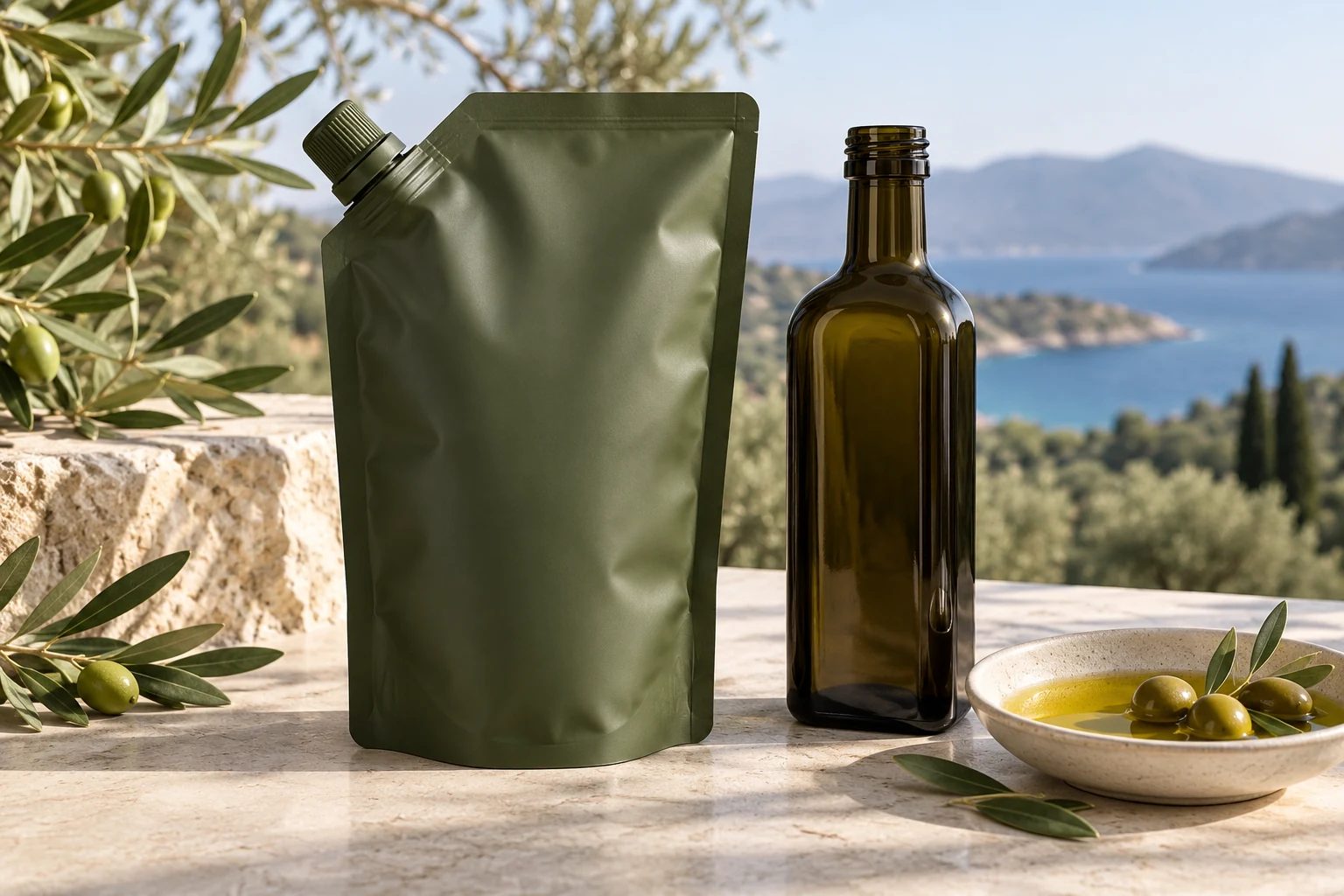
An olive oil refill can look convenient yet spill at the bottle or rely on unproven protection. A screw cap alone does not settle either question.
I test olive oil refill pouches for light and oxygen protection, actual bottle refilling, cap reclosure and fitment integrity. I distinguish a pour-and-recap pouch from a collapsing bag-in-box system, then approve the exact filled construction before requesting a quote.
At Unique Packaging, I begin with how the oil will reach the kitchen bottle. The right sample must fit both that transfer and the oil brand’s quality plan.
How Is an Olive Oil Refill Pouch Different from Bag-in-Box?
Two flexible packs may look similar while using different dispensing systems. Assuming both exclude air during use can create an unsupported product claim.
I identify whether the pack pours through an opened screw cap or dispenses through a specified tap. I evaluate the complete structure and closure rather than transferring bag-in-box evidence to every flexible refill pouch.
I draw the proposed use sequence before discussing a laminate. Will the customer empty the pouch into a bottle in one transfer, or open and recap it several times? Will a foodservice user dispense directly from a tap? Those tasks create different sample questions. I keep the bottle-refill task separate from claims about how a dispensing pack behaves as it empties.
UC Davis explains that opaque packaging limits light exposure and that oxygen, including headspace oxygen, matters to oil quality. Its packaging guidance also discusses a bag-in-box bladder that collapses during dispensing.1 I do not treat this as evidence that an arbitrary screw-cap pouch excludes air after every pour. The closure and the actual dispensing behavior need review.
| Format to compare | Intended task | Trial question |
|---|---|---|
| Corner-spout refill pouch | Transfer into a kitchen bottle | Can the user pour and stop cleanly? |
| Tap-equipped bag-in-box | Repeated direct dispensing | How does the specified system behave as it empties? |
| Existing bottle or tin | Current customer routine | What practical problem justifies changing? |
Use community concerns to define the comparison
In an r/oliveoil thread, a user asks about oil sold in a box and questions the packaging’s sustainability. Replies discuss the collapsing inner bag.2 This shows the questions buyers raise about the format. It does not establish zero oxygen exposure, universal superiority or a lower environmental footprint for a different refill pack.
I bring the actual oil, intended receiving bottle and proposed pouch together for the review. I compare use at the start and near the end of the pack. I also ask how a partially used pouch will be stored under the brand’s instructions. Those details determine what the later sample trial must include.
The spout pouch selection guide helps organize cap, fitment and fill orientation. I leave space in the decision record for unresolved quality questions. A sample can be promising for refilling while still needing a separate material assessment.
Which Material and Pouring Checks Should I Request?
A dark printed surface does not reveal the complete barrier structure. A comfortable grip also says little about oil left around the cap after refilling.
I request evidence for the exact film, cap and fitment under the intended contact conditions. I compare oxygen data at stated laboratory conditions, then test pouring with the actual oil, receiving bottle and normal handling sequence.
I ask the supplier to identify each layer, total thickness, inner contact layer, fitment and cap. I also request the light-protection evidence relevant to the complete printed pack. I do not infer performance from green ink or the word foil. If a viewing window is proposed, I ask how that changes the assessment instead of assuming the rest of the pouch compensates for it.
Citizens of Soil provides a real example of an olive oil bottle-and-refill system and identifies the pouch it uses.3 That supports the existence of this retail use case. It does not qualify our film, validate our fitment or justify copying its environmental and recycling claims. I use the example to make the buyer’s task concrete, then request evidence for our own proposed configuration.
Compare reported conditions and the real transfer
For oxygen transmission, ASTM D3985 names a method for plastic film and sheeting, including relevant layered materials.4 I ask for the method edition, specimen construction, conditioning, temperature, humidity conditions and reported units. I compare results collected under matching conditions. I keep the product owner’s filled-oil quality evaluation separate from a film test.
For the US market, FDA’s tables distinguish low-moisture fats and oils and different use conditions.5 I provide the real filling and storage brief for the food-contact review. I do not accept a generic dry-food statement as an answer for prolonged contact with oil. The responsible reviewers must confirm the applicable evidence for the intended market.
I then test the proposed transfer. I watch whether a funnel is needed, how the user supports the soft pack, and whether flow stops before the bottle overfills. I inspect oil around the neck and cap after reclosure. I compare full and partially used samples without claiming a universal drip-free result.
I use the barrier film guide to connect the laboratory questions with the use trial. If the pack needs a different spout angle or body width, I request a revised sample before artwork approval. A material result should not lock the team into awkward pouring geometry.
How Do I Release an Olive Oil Refill Pouch for Purchase?
A successful refill demonstrates one use event. It leaves the film seals, fitment attachment and packed delivery route needing their own evidence.
I approve representative filled packs through documented sealing, cap and fitment checks, carton handling and the oil owner’s quality review. I retain the accepted sample and quote against its exact construction, drawing and trial conditions.
I ask the packer how the pouch will be filled and closed. I confirm whether the selected equipment fills through the top or the fitment and how it controls oil near the sealing interface. I request samples from the intended process. I record any difference between a bench sample and a production-style trial so that an unresolved equipment question remains visible.
I inspect the film seals, fitment weld and cap as separate features. I look for distortion, folds, incomplete attachment and changes after handling. The trial record names the actual equipment settings and component references. I do not prescribe a universal cap torque or sealing temperature. The proposed components and equipment need their own agreed operating conditions and acceptance limits.
Keep quality approval attached to the filled oil
ASTM F88/F88M addresses seal-strength measurement for flexible barrier materials.6 I ask the laboratory to state the edition, specimen dimensions, conditioning, support arrangement and failure mode when that method fits the seal. I also ask the technical team to define appropriate finished-pack leakage checks for the cap and fitment. A film-strip result cannot establish all three interfaces.
I include the agreed upright and side orientations, carton arrangement and handling sequence in the filled-pack plan. I keep a reference sample and record the start condition and inspection times. The oil brand decides how its quality will be assessed over the intended storage period. I do not convert a short bench hold into a validated shelf life or a certified transport result.
My written checklist names the oil, net fill, finished pouch dimensions, layer construction, fitment, cap and fill orientation. It includes artwork, food-contact documentation, carton layout, approved sample and acceptance criteria. I also document whether the pack is intended for complete transfer or repeated opening. The specification sheet guide keeps those decisions together.
I review the packaging test plan before requesting an olive oil refill sample and specification-based quote. I give quantity per design and destination without inventing a standard minimum or lead time. A revised film or cap proposal returns to the relevant checks before I approve the commercial change.
Conclusion
I choose packaging through evidence, filled-pack testing, and clear specifications. That process protects the product, the launch, and the customer experience.
Sources and Further Reading
Need a pouch specification?
I can review your product, size, quantity, artwork, and target market.