Gas flushing can make a pouch look ready, yet an unmeasured residual-oxygen level or unplanned shelf-life study leaves the key decision unanswered.
I validate gas flushing by defining the product and safety plan, measuring the finished pack under a controlled method, and pairing those results with a product-specific shelf-life study.
I treat the pouch as a complete system. I confirm the product, material, filling, handling, and customer experience before I approve production.
What Must Be Defined Before a Gas-Flushing Trial?
A line trial creates weak evidence when the product, gas, fill, pouch, seal, storage, and safety responsibilities are not fixed before sampling.
I define the actual food, product process, gas and target atmosphere, pouch structure, fill, sealing conditions, storage, sampling plan, and acceptance decisions before the trial starts.
I begin with food and process, not the gas cylinder. I identify the product category, quality change that matters, and food-safety controls that remain necessary. I record pouch structure, dimensions, fill, headspace, gas setting, machine settings, seal parameters, and sampling time. I identify which claims the study is not designed to support. A controlled trial can compare candidate packaging systems, but it should not become a general safety or shelf-life guarantee.
How I make this decision specific
For “What Must Be Defined Before a Gas-Flushing Trial?” in this how do i validate residual oxygen and shelf life after gas flushing review, I define the actual product, pouch configuration, intended use, and decision owner before I ask a supplier or tester for evidence. I keep the selected structure, component details, sample condition, and any stated test method together, then compare the result with the buyer’s actual route rather than a catalogue promise. That record lets me use the nitrogen-flushed snack packaging guide as a decision aid and retain a specification that another team member can check.
For How Do I Validate Residual Oxygen and Shelf Life After Gas Flushing, I state what is known, the condition it applies to, and what must still be checked with the actual product. I do not transfer a number, a test result, or a feature choice from another product simply because its pouch looks similar. The result of “What Must Be Defined Before a Gas-Flushing Trial?” should give the buyer a clear next check, the supplier a precise request, and the project owner a record of the remaining uncertainty.
For How Do I Validate Residual Oxygen and Shelf Life After Gas Flushing, I request the exact pouch structure, component specification, and test conditions from the supplier. A broad material name or catalogue claim is not a production specification. The right next step is a representative filled sample, where relevant, with observations recorded before production is approved.
How Should I Measure Residual Oxygen?
A pouch can feel full, firm, or visually clean while its residual oxygen and seal behavior remain unknown.
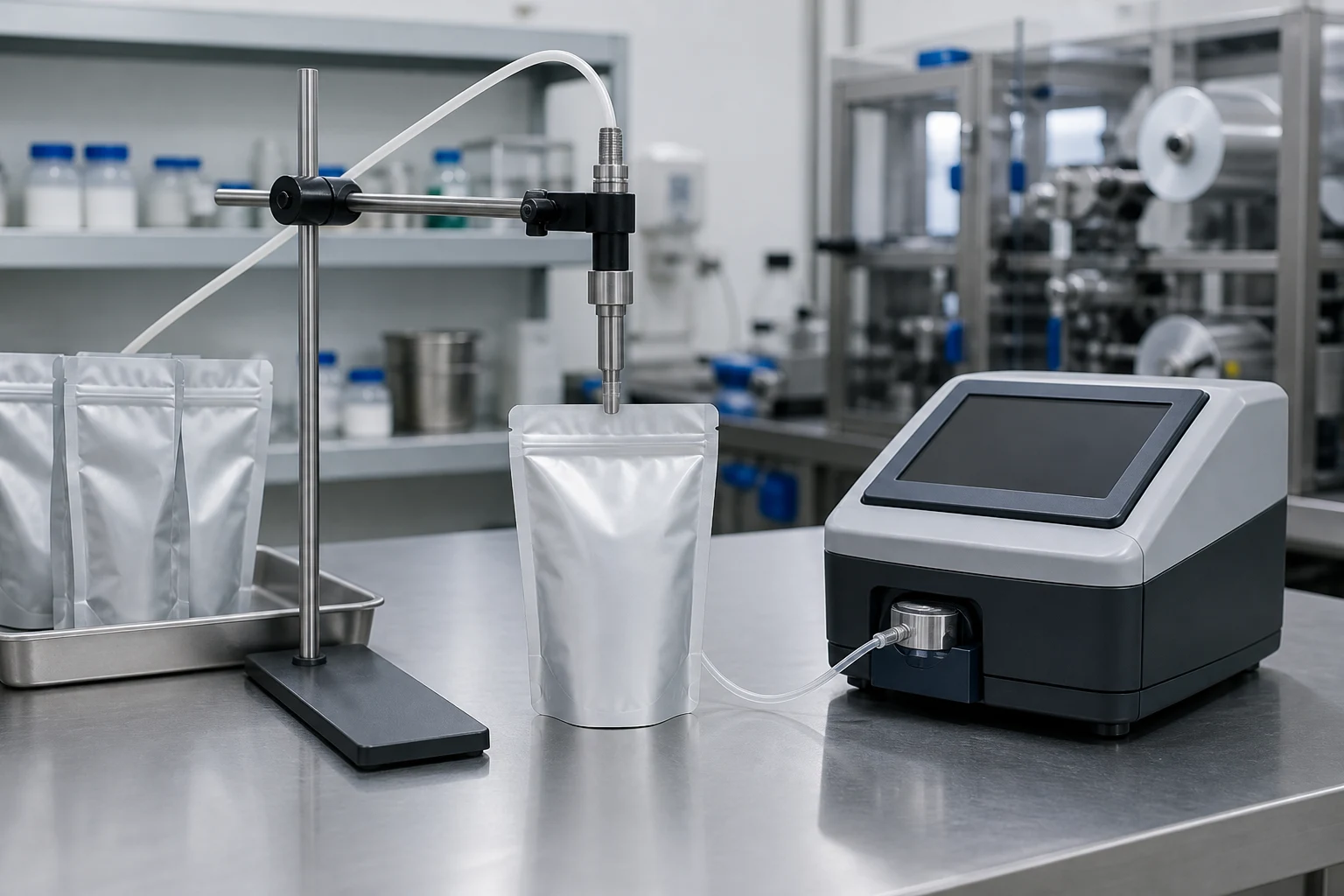
I measure residual oxygen on representative sealed packs with a documented method, timing, sample plan, instrument control, and acceptance criterion for the specific product study.
I document the method before sampling. I record when the sample was made and measured, product and fill, pouch structure, gas-flush and seal settings, instrument type, and any control checks required by the method. I take representative samples from the run instead of selecting only the best pouch. I inspect package integrity because a residual-oxygen reading can be misleading if a pack changes after sealing. The measurement is evidence for one defined configuration and time point; it does not prove eventual shelf life alone.
How I make this decision specific
For “How Should I Measure Residual Oxygen?” in this how do i validate residual oxygen and shelf life after gas flushing review, I define the actual product, pouch configuration, intended use, and decision owner before I ask a supplier or tester for evidence. I keep the selected structure, component details, sample condition, and any stated test method together, then compare the result with the buyer’s actual route rather than a catalogue promise. That record gives the buyer a decision aid and a specification that another team member can check.
For How Do I Validate Residual Oxygen and Shelf Life After Gas Flushing, I state what is known, the condition it applies to, and what must still be checked with the actual product. I do not transfer a number, a test result, or a feature choice from another product simply because its pouch looks similar. The result of “How Should I Measure Residual Oxygen?” should give the buyer a clear next check, the supplier a precise request, and the project owner a record of the remaining uncertainty.
How Do I Build a Shelf-Life Study Around the Data?
A single post-flush reading cannot show how the product, package, seal, and atmosphere will behave across the intended storage period.
I pair residual-oxygen data with a product-specific shelf-life plan that defines storage conditions, checkpoints, quality attributes, package integrity, and responsible food-safety review.
I set duration and conditions to represent the intended route. I retain samples from each candidate configuration and inspect them at planned intervals. Checks may include residual oxygen, package appearance, seal condition, product quality attributes, and other measures defined by the responsible team. I keep baseline and comparison visible. I do not treat a barrier transmission test as a finished-pack shelf-life study; ASTM D3985 explains oxygen-transmission measurement while noting it is not the only determinant of packaging protection.
How I make this decision specific
For “How Do I Build a Shelf-Life Study Around the Data?” in this how do i validate residual oxygen and shelf life after gas flushing review, I define the actual product, pouch configuration, intended use, and decision owner before I ask a supplier or tester for evidence. I keep the selected structure, component details, sample condition, and any stated test method together, then compare the result with the buyer’s actual route rather than a catalogue promise. That record gives the buyer a decision aid and a specification that another team member can check.
For How Do I Validate Residual Oxygen and Shelf Life After Gas Flushing, I state what is known, the condition it applies to, and what must still be checked with the actual product. I do not transfer a number, a test result, or a feature choice from another product simply because its pouch looks similar. The result of “How Do I Build a Shelf-Life Study Around the Data?” should give the buyer a clear next check, the supplier a precise request, and the project owner a record of the remaining uncertainty.
For How Do I Validate Residual Oxygen and Shelf Life After Gas Flushing, I treat the filled pack as a separate check from the material data. I record the fill condition, seal area, opening or closure behavior, carton arrangement, handling observations, and limits of the comparison. That prevents a favourable bench result from becoming an unsupported claim about shelf life, transport, or every product route.
What Evidence Supports a Launch Decision?
A launch decision becomes fragile when the team cannot trace a good reading back to the product, machine setting, pouch, storage condition, and acceptance standard.
I support a launch with a traceable trial record, finished-pack measurements, shelf-life observations, safety review, defined limits, and a rule to revalidate meaningful changes.
I compile the configuration and result in one release record. It identifies food and process, pouch material, dimensions, fill, gas, machine settings, seal process, residual-oxygen method, sample timing, storage conditions, product observations, carton arrangement, and acceptance decision. I include the owner of food-safety and regulatory review because a reduced-oxygen package can need controls beyond packaging performance. If product, gas, fill, laminate, sealant, line settings, storage, or route changes, I check whether the original study represents the commercial pack before reuse.
How I make this decision specific
For “What Evidence Supports a Launch Decision?” in this how do i validate residual oxygen and shelf life after gas flushing review, I define the actual product, pouch configuration, intended use, and decision owner before I ask a supplier or tester for evidence. I keep the selected structure, component details, sample condition, and any stated test method together, then compare the result with the buyer’s actual route rather than a catalogue promise. That record gives the buyer a decision aid and a specification that another team member can check.
For How Do I Validate Residual Oxygen and Shelf Life After Gas Flushing, I state what is known, the condition it applies to, and what must still be checked with the actual product. I do not transfer a number, a test result, or a feature choice from another product simply because its pouch looks similar. The result of “What Evidence Supports a Launch Decision?” should give the buyer a clear next check, the supplier a precise request, and the project owner a record of the remaining uncertainty.
For How Do I Validate Residual Oxygen and Shelf Life After Gas Flushing, I preserve the final decision in a written brief that names the approved sample, conditions, observations, open risks, and change triggers. I then use the flexible-packaging quality-test guide to keep the quotation tied to the evidence rather than to a remembered sample or a generic product name.
Conclusion
I choose packaging through evidence, filled-pack testing, and clear specifications. That process protects the product, the launch, and the customer experience.
Sources and Further Reading
- FDA Food Code, reduced oxygen and modified-atmosphere packaging definitions.
- Reddit r/foodscience, bread packaging and shelf-life community discussion.
- ASTM D3985, oxygen transmission rate through plastic film.
- ASTM F88/F88M, seal strength of flexible barrier materials.
- FDA Food Code overview.
- Unique Packaging nitrogen-flush guide.
- Unique Packaging quality-test guide.
Need a pouch specification?
I can review your product, size, quantity, artwork, and target market.