An almond flour bag can look fine while the filling and storage plan remains unclear. I resolve those gaps before choosing a pouch.
I select almond flour pouch materials and seals through a trial with the actual flour, intended storage conditions, filling equipment, and customer use. I compare candidate structures and document clean sealing, closure access, and product results before approving an order.
I treat plain almond flour as a distinct product. Baking mixes and whole almonds require their own formulation and filling records.
Which Material Options Deserve a Filled Trial?
Copying a wheat flour bag can leave the almond product brief incomplete. A familiar appearance gives little evidence about the proposed structure.
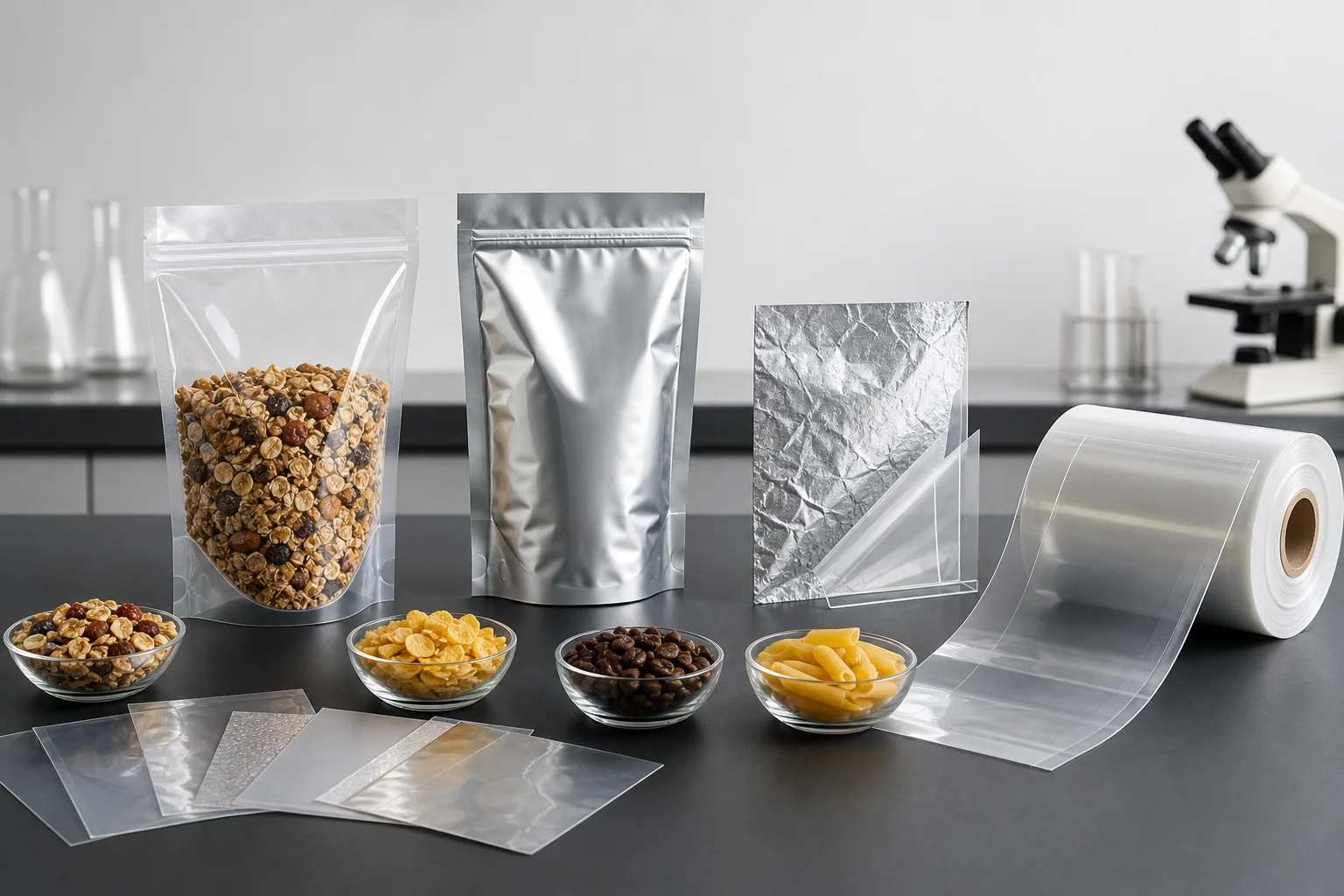
I shortlist structures using the actual almond flour, required visibility, storage instructions, and filling route. I compare complete candidates and request supporting documents rather than calling one film the universal best option.
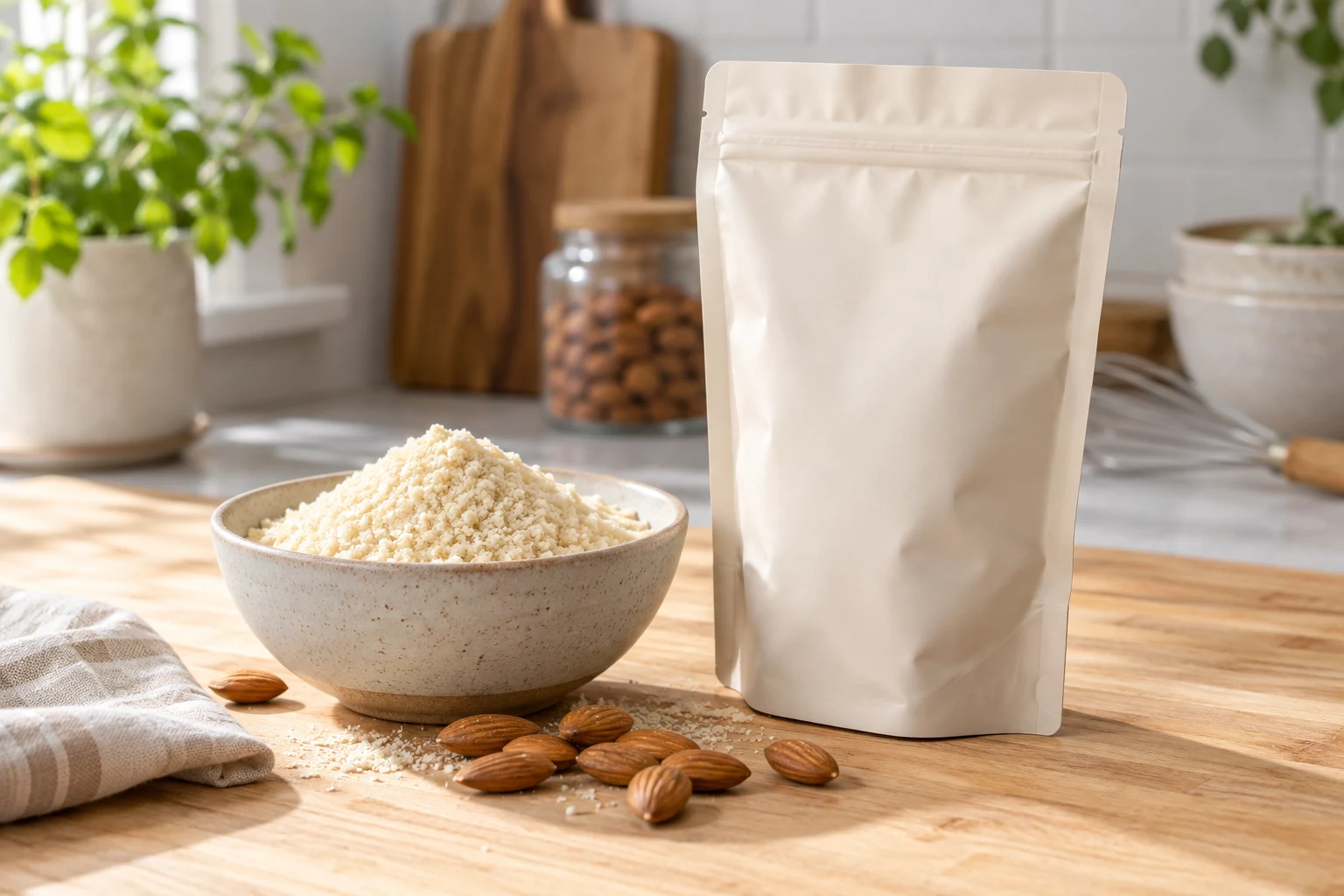
I first identify the flour. Bob’s Red Mill describes almond flour made from blanched almonds and another product made from whole almonds with the skins retained.1 Those descriptions help me ask whether my sample is blanched, skin-on, or part of a blend. I do not transfer that manufacturer’s product claims to a different brand or assume that identical names mean identical milling.
I collect the fill weight, product lot, target sales route, and the producer’s storage directions. The same manufacturer recommends refrigerated or frozen storage for its almond flour.1 That is useful product-specific context. It does not certify any pouch in this guide, establish a new ambient shelf life, or justify changing another producer’s label. I ask the project owner to approve the intended conditions explicitly.
| Candidate | Useful application | Evidence I request |
|---|---|---|
| Opaque laminate | Flour pack without a viewing requirement | Exact structure and filled-product comparison |
| Clear construction | Pack where seeing the flour matters | Barrier evidence and appearance after storage |
| Metallized candidate | Alternative submitted by the converter | Full laminate details and line-trial results |
I compare evidence within one brief
I use the food barrier material guide to organize the candidate reports. I request structure identification, thickness, specimen conditioning, units, and the stated measurement method. ASTM F1249 covers film water vapor transmission.3 I ask the supplier to provide test temperature and humidity on both sides. I leave acceptance limits to the agreed product study rather than inventing a number that looks scientific.
Food-contact suitability also belongs in this comparison. FDA lists distinct food types and conditions of use.2 I ask for documents matched to the actual almond flour and the intended route. A generic food-grade description does not explain those boundaries. I keep layer changes, adhesives, inks, and closures visible in the specification so the converter can identify what the supporting evidence covers.
I retain the same flour lot across the comparison where practical. I ask the food team to select sensory and other product endpoints, sampling intervals, and acceptance rules. Each result remains tied to its actual storage conditions. Until that work is complete, I describe the structures as candidates and the exercise as a trial, not proof of a storage promise.
How Do I Keep Filling and Seal Evidence Together?
Powder left around an opening makes a trial hard to interpret. Changing film before checking the filling process can hide the real issue.
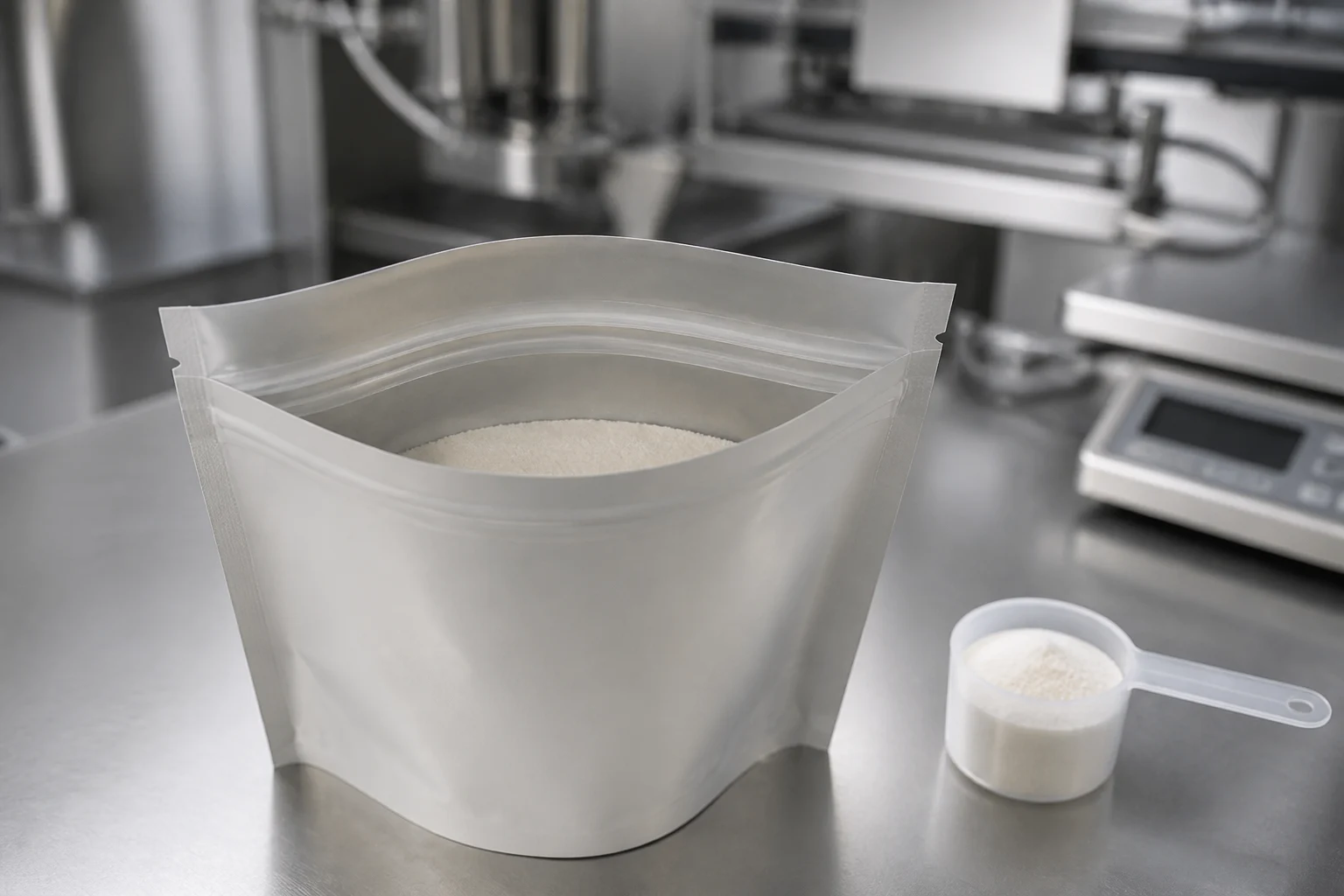
I run representative filling trials, record machine settings, inspect the seal area, and test seals under a named method. I investigate observed flour deposits, wrinkles, and handling damage before approving the finished pack.
I begin with the packer’s proposed method. I ask whether the flour is manually scooped, auger filled, or handled by another system. I record the flour lot and observed flow behavior rather than assuming every almond flour feeds the same way. I check whether a larger mouth, changed fill position, or revised handling sequence is needed before modifying the material.
The trial record contains fill weight, headspace, pouch width and height, seal margin, filling speed, temperature, pressure, and dwell time. I separate start-up samples from steady-run samples. I inspect the mouth before sealing and photograph any visible flour deposits. That shows whether the trial actually represents a clean production condition.
I measure seals without overstating the result
ASTM F88/F88M provides a method for measuring seal strength in flexible barrier materials.4 I ask the laboratory to state the version, strip width, support technique, test speed, conditioning, and observed failure behavior. I keep the reported force with those details. A single strong strip does not qualify an entire production run or prove that a finished pouch has no leakage path.
I use the powder closure and seal guide when I organize the inspection points. I look at the seal separately from the reusable zipper. I ask the packer to demonstrate its finished-pack integrity checks and to define the acceptance rules before interpreting the samples. If a pack wrinkles, leaks, or tears in the trial, I identify where and under what conditions.
I keep a retained flour sample outside the packaging comparison under the food team’s chosen reference conditions. I do not diagnose a storage complaint from its appearance alone. A product change could require a formulation, handling, or packaging investigation. Recording what was observed is more useful than declaring the material responsible without evidence.
I also inspect filled cartons after the planned handling route. I note corner damage, pouch compression, abrasion, and closure access. I ask whether those observations occurred before or after transport. The question matters because a pouch that passes the filling bench may still need a revised carton or handling plan. I approve corrective changes through a repeat trial with the affected conditions, keeping the original samples for comparison.
What Should the Reopening Trial and Specification Include?
A pouch can pass its first seal check yet frustrate customers at every scoop. Storage instructions alone do not reveal that handling problem.
I test scooping, zipper access, closure cleanliness, and the final portion with the intended pack size. I record storage conditions and written change controls, then request a quotation against the approved almond flour specification.
I ask a tester to use the intended spoon and work through a filled sample in repeated sessions. I observe whether the pouch opening supports easy scooping, whether flour reaches the zipper tracks, and whether the tester can verify closure by touch. I record the number and duration of sessions as part of the trial plan. I do not invent a universal reopening cycle count.
A Reddit r/AskBaking discussion about almond flour storage includes a participant describing a humid tropical setting and using a freezer for nut-based ingredients.5 I treat that as a specific customer context, not proof of the participant’s humidity reading, a safety conclusion, or a rule for every almond flour. It reminds me to ask where the customer keeps the pack and how long it remains open while baking.
I distinguish unopened and in-use evidence
For a cold-storage project, I ask the food team to define the full handling sequence, including removal, use, and return to storage. I record temperatures, relative humidity where relevant, and the timing of each opening. I keep in-use samples separate from unopened storage samples. That prevents a convenient household test from being presented as evidence for the full retail shelf-life claim.
I use the filled sample approval checklist to retain the accepted dimensions and closure. A photograph of an empty pouch cannot prove spoon access or the stability of a partly empty pack. I keep the representative filled sample, tester observations, and any unresolved product tests together.
- Almond flour type, lot, fill weight, and intended storage label.
- Full material structure, dimensions, thickness, and seal margin.
- Zipper location, opening width, notch, and artwork safe area.
- Food-contact evidence matched to the proposed use.
- Barrier method, humidity, temperature, units, and acceptance limits.
- Filling settings, integrity checks, reopening trial, and retained packs.
I then prepare the written flour pouch specification. I require review of a new film, altered closure, or changed filling route before treating it as equivalent. I send quantity per artwork and destination with a request for an almond flour project quote. Price, order minimum, and delivery timing must come from that current offer. I do not add unsupported commercial numbers or represent these concept images as tested packaging.
Conclusion
I choose packaging through evidence, filled-pack testing, and clear specifications. That process protects the product, the launch, and the customer experience.
Sources and Further Reading
Need a pouch specification?
I can review your product, size, quantity, artwork, and target market.