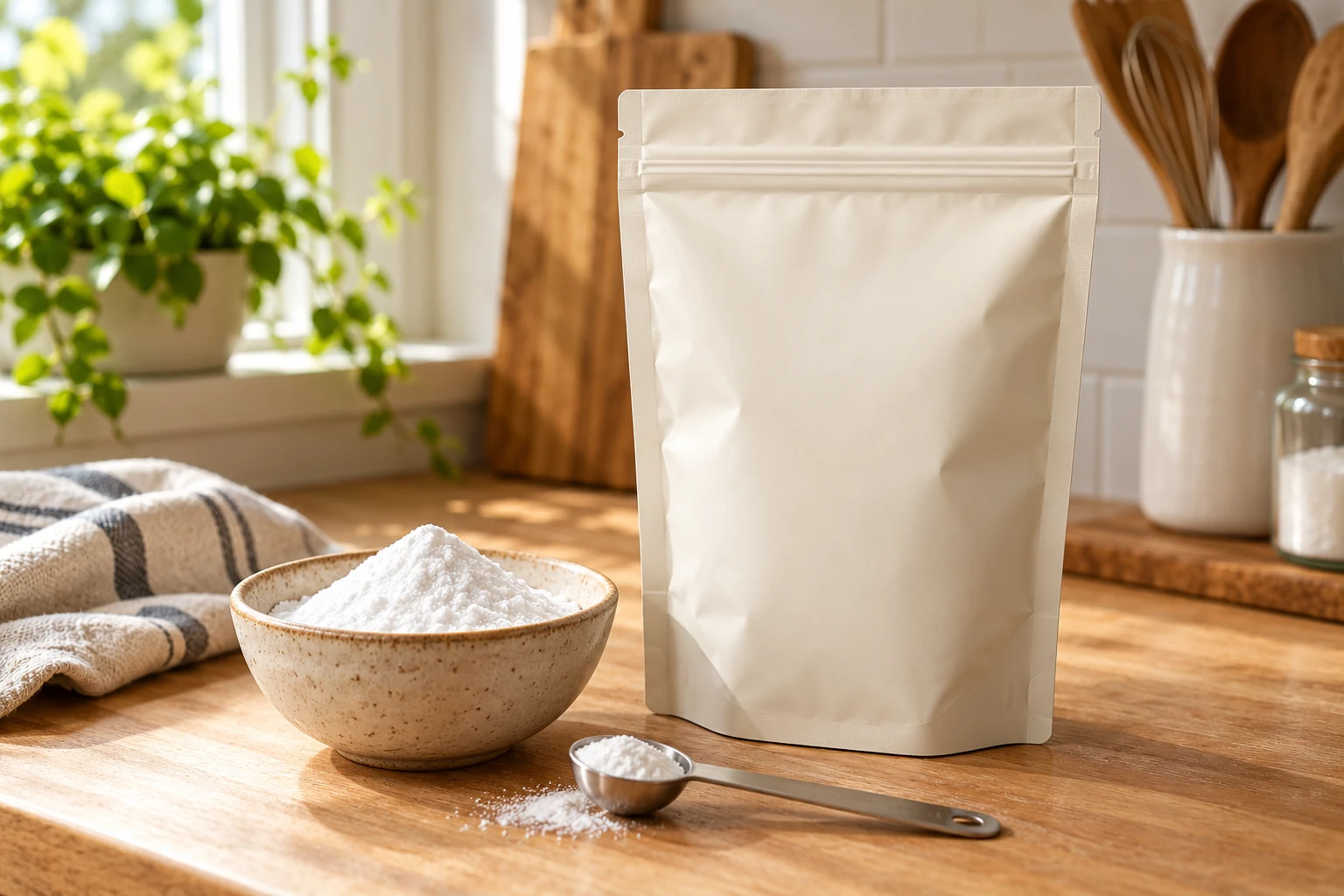
An awkward baking soda opening leaves powder on the counter and makes reclosure frustrating. A neat refill pouch needs to work beyond its first scoop.
I choose baking soda refill pouches by confirming food use, testing clean measuring and refilling, checking the exact film and zipper, and approving a representative filling trial. I quote only after the written specification matches the sample.
At Unique Packaging, I start with the baker’s task. I keep food refill packaging separate from an open odor-control pack or a household cleaning dispenser.
Which Baking Soda Use Should the Refill Pouch Serve?
A cleaning pack and a baking refill can look similar. Copying one opening format into the other can leave the real user’s task unresolved.
I define whether customers will scoop baking soda directly or refill a separate food container. I choose the mouth, closure and instructions around that task, then check the proposed pack with the actual powder.
I first ask the brand to describe one normal use. A home baker may measure a small spoonful and return the pouch to a cupboard. A refill customer may empty the whole pouch into a working container. Those are different opening and handling tasks. I use the actual receiving container or measuring spoon during sample review rather than choosing a pack only by nominal fill weight.
Bob’s Red Mill recommends an airtight container in a cool, dark, dry cupboard for baking soda and baking powder.1 I use that guidance to frame the storage brief. I do not turn the manufacturer’s advice into a shelf-life promise for an untested pouch, or assume that any zipper provides the same protection as a closed rigid container.
Make the opening match the intended job
In a Reddit discussion about baking soda boxes, one participant says they avoid a particular box for baking because of its design, while using it for cleaning.2 This is one consumer’s preference, not a finding about all boxes. It gives me a concrete sample question: can a baker reach, measure and reclose this proposed pouch without transferring the product elsewhere?
I compare the full, partly used and nearly empty sample. I watch how the mouth holds its shape and where the spoon touches the zipper. For a refill, I compare pouring into the intended jar with and without the brand’s proposed accessory. I record spills and handling problems as trial observations. I do not claim that a pouch eliminates mess before the comparison exists.
I also check where the pack will sit. A broad base may be useful on a worktop, but I still test the filled shape and storage space. The pouch sizing guide helps translate that task into finished dimensions and usable headspace. A capacity label alone does not tell me whether the opening fits a measuring spoon.
Finally, I keep the product name and intended use clear on the artwork brief. The pack should help the buyer identify the correct ingredient after opening. I review that brief with the food brand before choosing any opening instructions or storage language.
Which Film and Zipper Details Should I Compare?
A pouch can close neatly when empty and still be awkward after powder reaches the tracks. A material name alone leaves that question unanswered.
I compare the proposed film construction, moisture-transmission evidence, mouth geometry and zipper performance with actual baking soda. I keep the test conditions visible and check repeat use separately from the original heat seal.
I ask the converter to identify the actual structure and total thickness for each sample. I also request the sealing layer and closure specification. A broad description such as premium food pouch leaves too much undefined. I want to know which physical sample the proposal describes and whether the intended filling equipment has reviewed its dimensions.
For US use, the FDA tables distinguish food types and contact conditions.3 I ask the responsible supplier to document the intended food contact and actual filling and storage conditions. A generic certificate or a reference to another powder is not my basis for approving the complete printed pouch. Other markets need their own applicable review.
| Candidate feature | Useful application | What I compare |
|---|---|---|
| Wide-mouth zipper pouch | Repeated spoon measuring | Spoon access and powder in tracks |
| Narrower refill opening | Transfer into a working jar | Pour control and remaining powder |
| Alternative film structure | Specified storage route | Matched moisture data and filled trials |
For a moisture comparison, I request a named method such as ASTM F1249 and the laboratory’s reported temperature, humidity difference, specimen construction and units.4 I compare like conditions. I do not rank two structures from numbers collected under different conditions, or choose a universal transmission limit without the product owner’s validation plan.
Keep the reclosure test realistic
I deliberately include normal scooping in the user trial. I inspect where powder settles, then ask the user to close the tracks as they normally would. I repeat after the agreed cleaning step. This helps identify whether the proposed instructions and closure work together. A clean empty sample cannot answer that practical question.
I use the barrier film guide for the material assessment and the powder contamination guide for the closure and sealing review. I keep these as separate decisions. A favorable film result does not establish clean filling, easy measuring or reliable customer reclosure.
How Do I Approve a Baking Soda Pouch Before Ordering?
A hand-filled sample may hide production dust and sealing problems. Ordering before a representative line trial can leave those questions to the first shipment.
I approve the pouch through a representative powder-filling trial, documented seal settings, repeated measuring checks and agreed storage observations. I retain the approved sample and request a quote against its written dimensions, construction and acceptance criteria.
I ask the packer how it will support the mouth and keep the sealing area clear. I also ask where powder can accumulate around the filling nozzle or zipper. I want the sample trial to use the proposed powder and equipment arrangement. If a small trial uses different equipment, I write that limitation into the approval rather than treating it as a completed production-line check.
I inspect the top seal and side seals for visible powder, wrinkles and inconsistent contact. I record the actual sealing temperature, pressure and dwell settings used in the trial. Those values belong to that film and machine. I ask the converter and packer to establish an operating window instead of copying a setting from another ingredient or another pouch.
Define the evidence before the order
ASTM F88/F88M covers measuring seal strength in flexible barrier materials.5 When I request it, I ask the laboratory to identify the edition, conditioning, specimen dimensions, support technique and observed failure mode. I also ask which finished-pack integrity checks are appropriate. A strip-strength result does not by itself prove storage protection or safe product shelf life.
I carry the samples through the agreed carton handling and storage review. Then I repeat the spoon or refill task on those packs. I look for a changed opening path, powder trapped at the closure and a pouch that becomes hard to hold as it empties. I record what changed and repeat the relevant check after a correction. The quality test guide helps keep the plan focused on actual failure modes.
My purchase checklist names the food ingredient, net fill, finished width and height, gusset, film structure, zipper position, tear path and top-seal space. It includes the artwork revision, carton arrangement, contact documentation, approved sample and acceptance criteria. I also record whether customers are expected to keep using the pouch or transfer all contents to another container.
I send that record with a baking soda sample and specification-based quote request. I state quantity per design and delivery destination. The supplier can then price the defined configuration and state its commercial conditions. I review any proposed substitution against the trial evidence before it becomes part of the order.
Conclusion
I choose packaging through evidence, filled-pack testing, and clear specifications. That process protects the product, the launch, and the customer experience.
Sources and Further Reading
Need a pouch specification?
I can review your product, size, quantity, artwork, and target market.