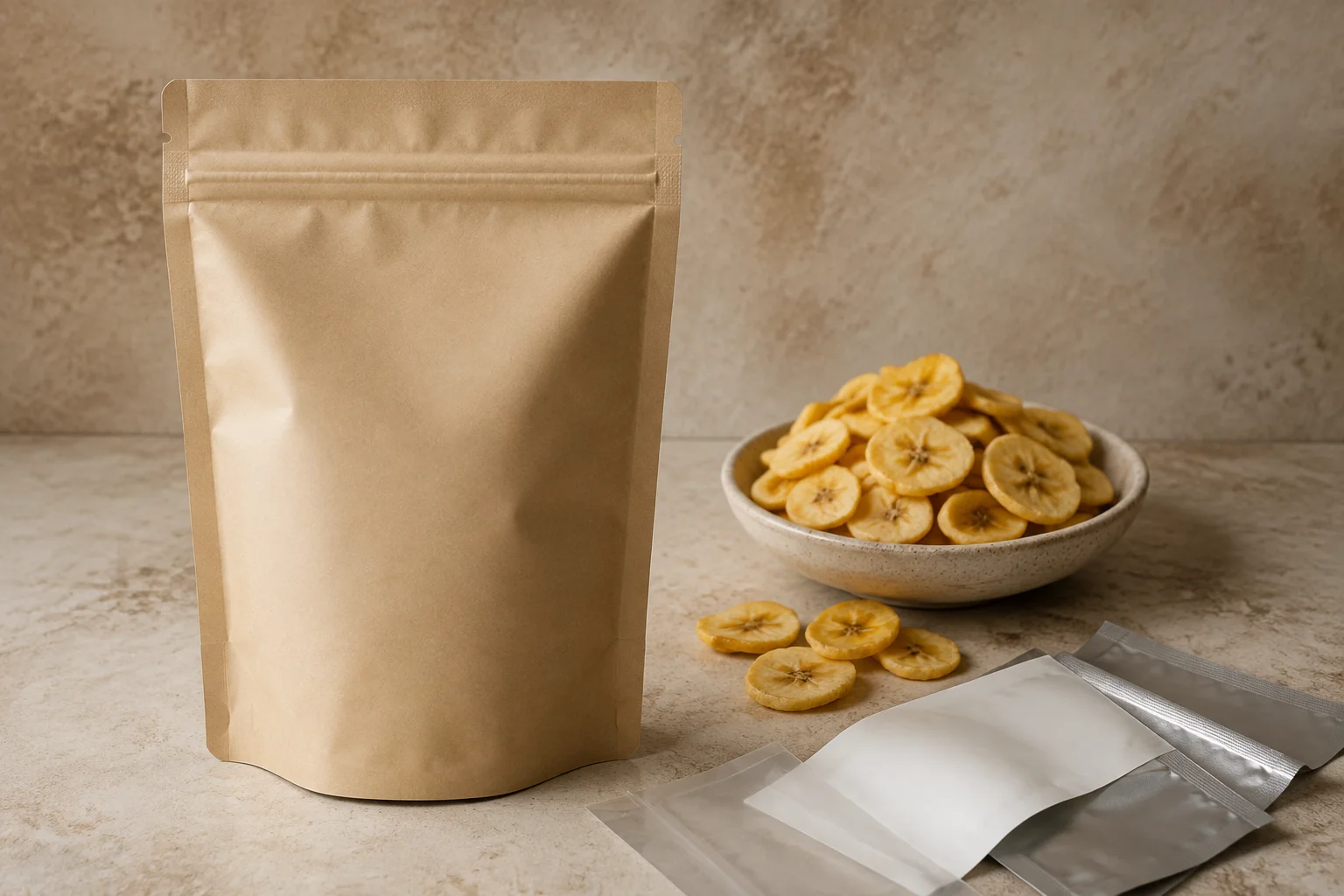
Banana chips can disappoint after packing when their real product condition, oil exposure, fill geometry, pouch construction, route, and approval evidence are never considered together.
I package banana chips by defining the actual product and route, comparing the specified pouch on representative filled samples, then retaining a written release record before I request a quote.
I treat the pouch as a complete system. I confirm the product, material, filling, handling, and customer experience before I approve production.
What Banana-Chip Conditions Should I Define First?
A request for a “banana-chip pouch” remains incomplete when it omits whether the chips are fried or dried, their approved packing condition, seasoning, oil contact, fill, market, and carton route.
I define the actual banana-chip product, approved packing condition, fill range, food-contact market, storage and distribution route, carton plan, and customer use before I compare pouches.
I start by identifying the actual product. I record whether the chips are fried or dried, their formulation and seasoning, whether free oil is present, product condition at packing, pack size, intended market, storage route, carton arrangement, and customer opening routine. FDA food-contact tables distinguish dry solids with and without free oil or fat and identify conditions of use, so I ask for material documentation for the selected construction and project context.1 The Reddit post is useful because it records a real small-maker question about a later oil odour. It does not prove cause, establish safety, choose a structure, or set a shelf life for a different product.4 I use it only to insist that product condition, packing conditions, and project evidence remain connected.
How I make this decision specific
For “What Banana-Chip Conditions Should I Define First?” in this how do i package banana chips in a flexible pouch review, I define the actual product, pouch configuration, intended use, and decision owner before I ask a supplier or tester for evidence. I keep the selected structure, component details, sample condition, and any stated test method together, then compare the result with the buyer’s actual route rather than a catalogue promise. That record lets me use the food barrier-film guide as a decision aid and retain a specification that another team member can check.
For How Do I Package Banana Chips in a Flexible Pouch, I state what is known, the condition it applies to, and what must still be checked with the actual product. I do not transfer a number, a test result, or a feature choice from another product simply because its pouch looks similar. The result of “What Banana-Chip Conditions Should I Define First?” should give the buyer a clear next check, the supplier a precise request, and the project owner a record of the remaining uncertainty.
For How Do I Package Banana Chips in a Flexible Pouch, I request the exact pouch structure, component specification, and test conditions from the supplier. A broad material name or catalogue claim is not a production specification. The right next step is a representative filled sample, where relevant, with observations recorded before production is approved.
Which Pouch Construction and Film Data Should I Evaluate?
A generic claim about a “snack barrier pouch” cannot reveal the actual layer sequence, sealant, test conditions, closure, light exposure, and finished-pack details the buyer must review.
I evaluate the proposed format, layer sequence, sealant, seal zones, opening feature, food-contact documentation, physical samples, and named test conditions before I accept a construction.
I request the current physical pouch and a written construction description. I review dimensions, stand-up geometry, layer sequence, sealant, top seal, tear feature, optional zipper, product-contact market, and carton orientation. ASTM F1249 covers water-vapor transmission through flexible barrier materials and says that agreed sampling procedures, test conditions, and acceptance criteria matter when data is used as a referee method.2 I use that to ask for the exact tested material and conditions rather than importing a value from an unrelated laminate. The food barrier-film guide helps align data with the selected pouch. I do not call a pouch suitable for a particular shelf life, aroma outcome, or texture result without relevant filled-pack evidence.
How I make this decision specific
For “Which Pouch Construction and Film Data Should I Evaluate?” in this how do i package banana chips in a flexible pouch review, I define the actual product, pouch configuration, intended use, and decision owner before I ask a supplier or tester for evidence. I keep the selected structure, component details, sample condition, and any stated test method together, then compare the result with the buyer’s actual route rather than a catalogue promise. That record lets me use the food barrier-film guide as a decision aid and retain a specification that another team member can check.
For How Do I Package Banana Chips in a Flexible Pouch, I state what is known, the condition it applies to, and what must still be checked with the actual product. I do not transfer a number, a test result, or a feature choice from another product simply because its pouch looks similar. The result of “Which Pouch Construction and Film Data Should I Evaluate?” should give the buyer a clear next check, the supplier a precise request, and the project owner a record of the remaining uncertainty.
How Do I Check Filled Banana-Chip Pouches and Cartons?
An empty pouch cannot show breakage, pack fit, sealing effects, opening control, carton rub, or how the real chips respond during the handling route they will face.
I inspect representative filled, sealed, cartoned, handled, opened, and reclosed samples under documented project conditions before I approve the selected configuration.
I fill samples at the agreed range and inspect pouch footprint, panel tension, chip breakage, seal appearance, product distribution, opening sequence, optional reclosure, carton orientation, and visible surface change. I record both observations and what the comparison did not evaluate. When distribution evidence is needed, I select a procedure that matches the decision. ISTA describes 1-Series tests as screening tools and 3-Series tests as general simulations for a specific shipment type.3 I therefore keep a bench or office handling screen separate from a transport-performance statement. The filled-pouch distribution-testing guide provides a useful path to a defined testing plan.
How I make this decision specific
For “How Do I Check Filled Banana-Chip Pouches and Cartons?” in this how do i package banana chips in a flexible pouch review, I define the actual product, pouch configuration, intended use, and decision owner before I ask a supplier or tester for evidence. I keep the selected structure, component details, sample condition, and any stated test method together, then compare the result with the buyer’s actual route rather than a catalogue promise. That record lets me use the food barrier-film guide as a decision aid and retain a specification that another team member can check.
For How Do I Package Banana Chips in a Flexible Pouch, I state what is known, the condition it applies to, and what must still be checked with the actual product. I do not transfer a number, a test result, or a feature choice from another product simply because its pouch looks similar. The result of “How Do I Check Filled Banana-Chip Pouches and Cartons?” should give the buyer a clear next check, the supplier a precise request, and the project owner a record of the remaining uncertainty.
For How Do I Package Banana Chips in a Flexible Pouch, I treat the filled pack as a separate check from the material data. I record the fill condition, seal area, opening or closure behavior, carton arrangement, handling observations, and limits of the comparison. That prevents a favourable bench result from becoming an unsupported claim about shelf life, transport, or every product route.
What Should a Banana-Chip Pouch Specification Include?
A favorable sample cannot be repeated when the purchase brief records artwork and nominal capacity but not product condition, construction, filled-pack observations, acceptance limits, and change triggers.
I specify the product and fill, pouch construction and features, market documentation, approved filled sample, carton plan, observations, acceptance criteria, and reapproval triggers together in one brief.
I use a clear procurement sequence: assess the material against the actual banana-chip product and route, run a representative filled-pack review, document the accepted configuration, and request a quote on that same specification. The brief identifies product type, formulation context, packing condition, fill range, dimensions, layer description, sealant, opening feature, artwork revision, food-contact market, carton arrangement, sample condition, observations, limits, and acceptance status. I name realistic failure modes: chip breakage, seal stress, tear problems, reclosure difficulty, carton abrasion, and documents that do not match actual use. I do not invent MOQ, price, timing, certification, shelf life, aroma protection, or material performance. The specification-sheet guide makes supplier answers comparable.
How I make this decision specific
| Specification item | Evidence I retain | Decision it supports |
|---|---|---|
| Product and fill | Product type, condition, oil context, fill range and market. | Relevant pouch comparison. |
| Pouch construction | Dimensions, layer description, seal and opening details. | Comparable physical sample. |
| Filled-pack review | Product, carton, handling observations and limits. | Conditional approval. |
| Change control | Named product, material and route triggers. | Specification-based quote. |
For “What Should a Banana-Chip Pouch Specification Include?” in this how do i package banana chips in a flexible pouch review, I define the actual product, pouch configuration, intended use, and decision owner before I ask a supplier or tester for evidence. I keep the selected structure, component details, sample condition, and any stated test method together, then compare the result with the buyer’s actual route rather than a catalogue promise. That record lets me use the food barrier-film guide as a decision aid and retain a specification that another team member can check.
For How Do I Package Banana Chips in a Flexible Pouch, I state what is known, the condition it applies to, and what must still be checked with the actual product. I do not transfer a number, a test result, or a feature choice from another product simply because its pouch looks similar. The result of “What Should a Banana-Chip Pouch Specification Include?” should give the buyer a clear next check, the supplier a precise request, and the project owner a record of the remaining uncertainty.
For How Do I Package Banana Chips in a Flexible Pouch, I preserve the final decision in a written brief that names the approved sample, conditions, observations, open risks, and change triggers. I then use the packaging specification-sheet guide to keep the quotation tied to the evidence rather than to a remembered sample or a generic product name.
Conclusion
I choose packaging through evidence, filled-pack testing, and clear specifications. That process protects the product, the launch, and the customer experience.
Sources and Further Reading
- FDA, Food Types and Conditions of Use for Food Contact Substances.
- ASTM F1249, Water Vapor Transmission Rate Through Plastic Film and Sheeting.
- ISTA, packaged-product test procedure categories.
- Reddit r/foodscience, banana-chip small-maker community discussion.
- Unique Packaging oily-food guide.
- Unique Packaging specification-sheet guide.
Need a pouch specification?
I can review your product, size, quantity, artwork, and target market.