Couscous can spill before the first meal. I check the opening, pour, and closure before a tidy package becomes a daily frustration.
I choose dry couscous pouches by identifying the actual product, measuring loose fill, testing controlled pouring and resealing, and comparing documented films. I approve representative filled samples and a written specification before requesting production quotations.
At Unique Packaging, I use this review for uncooked dry couscous. A cooked ready-to-eat product requires its own food process and packaging assessment.
How Do I Match the Opening to the Actual Couscous?
A narrow mouth or awkward tear can scatter small granules. I test the customer task before copying the dimensions of another dry-food bag.
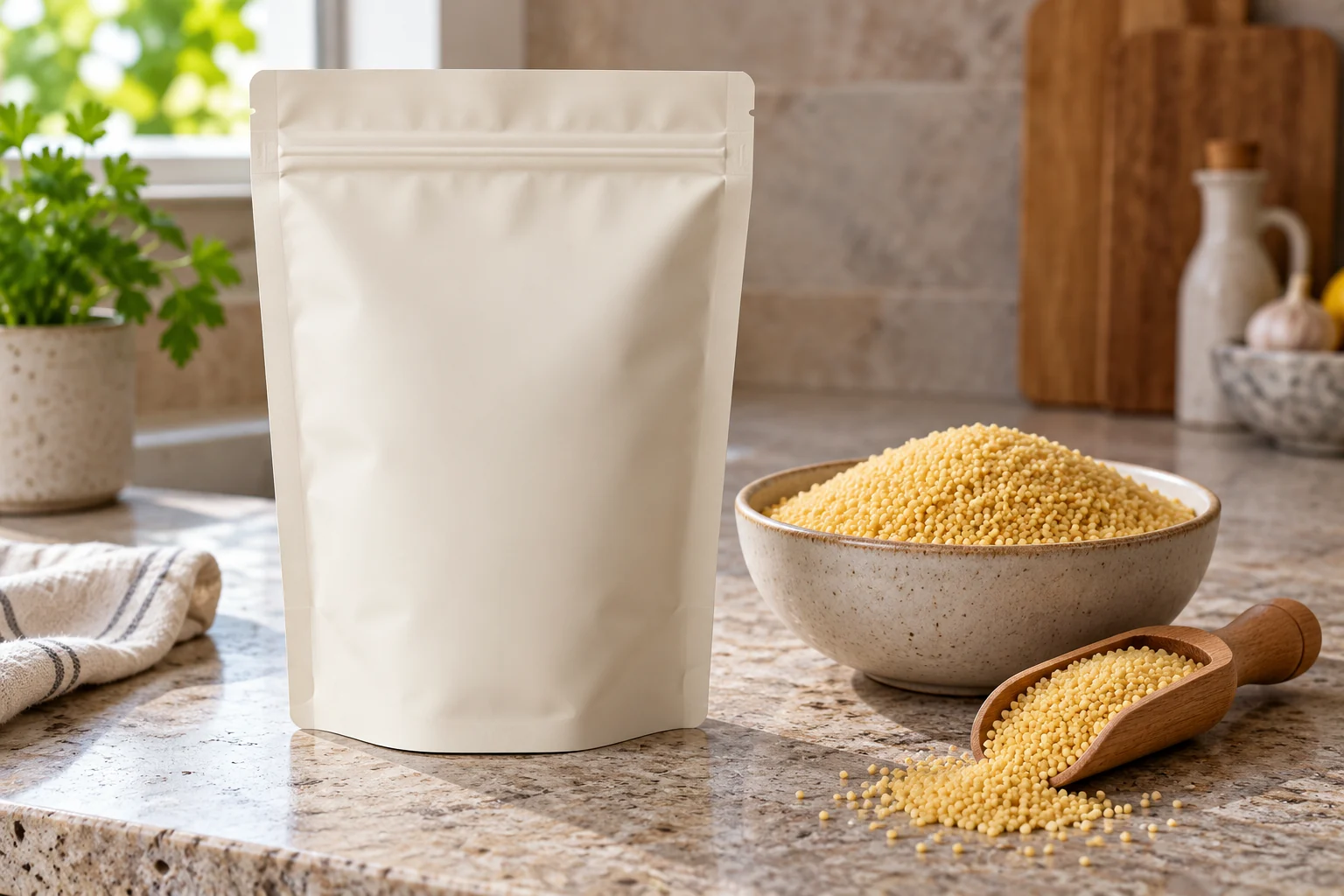
I identify the couscous type, measure the intended weight and volume, and try the complete opening sequence. I compare pouring and spoon access at full, half-full, and nearly empty fill levels.
I start with the food owner’s product description. Near East describes its Original Plain Couscous as small semolina-wheat pasta granules. That identifies one commercial product; it does not establish that every product sold as couscous has the same size, composition, preparation, or density. I ask which exact grade and recipe we are packing.1
The distinction matters to my sample request. A fine plain couscous, a larger pearl-style product, and a seasoned mix are separate briefs. I record the distribution of particle sizes and any loose seasoning. I also ask whether there is a separate sachet inside the pack. That component needs its own space and must not make the customer pull through a restricted opening.
A customer in an r/traderjoes discussion reported difficulty opening a couscous box. Another described granules catching near the inner flap and a messy transfer to a jar. I treat those comments as specific user experiences, not a comparison trial proving that every pouch outperforms every carton. They give me a useful task to observe: open, measure, pour, and close.2
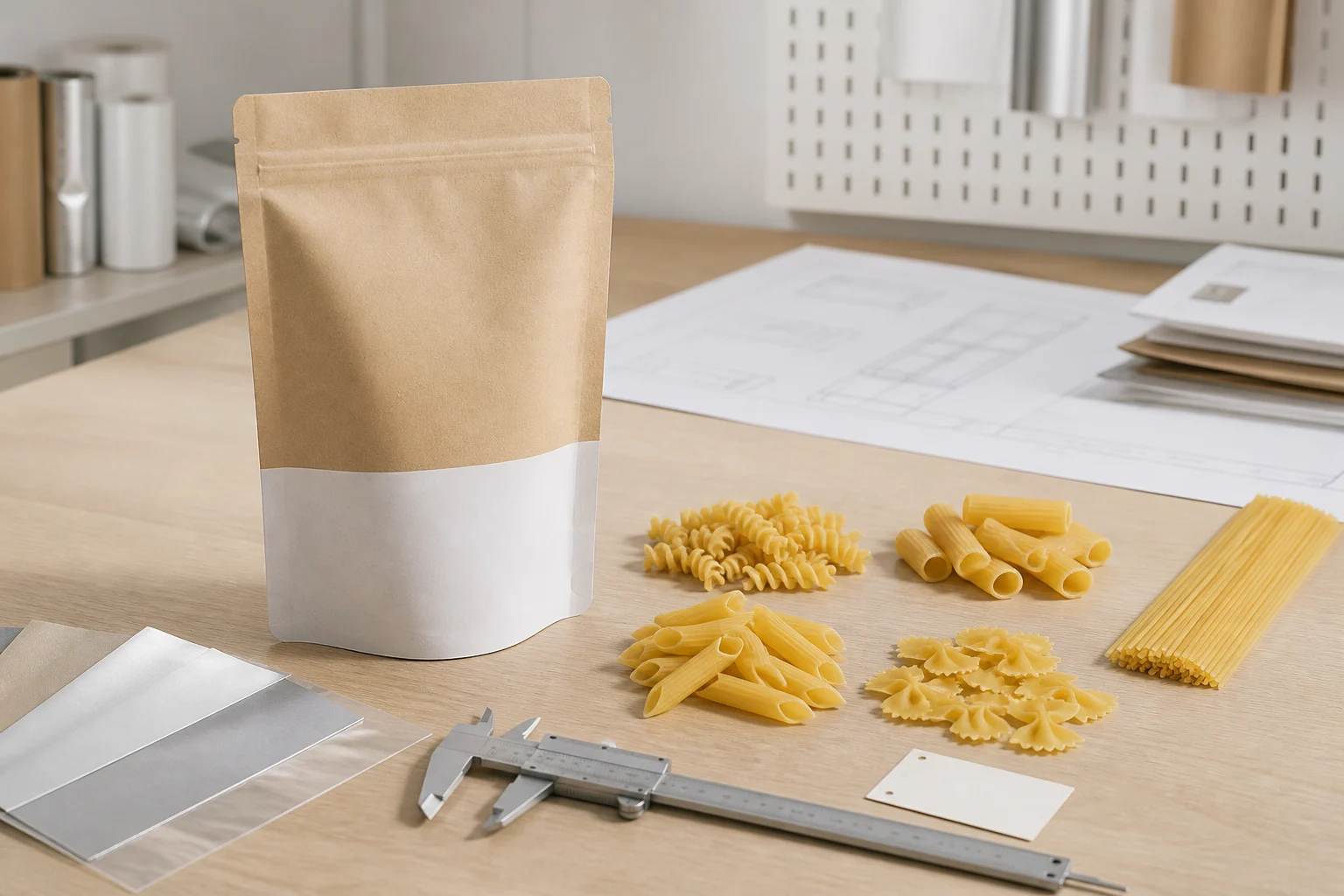
I use the pouch sizing guide to turn actual fill measurements into candidate dimensions. I weigh several representative portions, measure loose volume, and observe settling without forcing the product down. I reserve room for the top seal and zipper. The finished usable opening matters more than the outside width printed on a sample request.
How I compare first opening with repeat use
I ask a user to open a sealed sample without coaching. I note where the tear travels, whether it leaves a narrow lip, and whether the zipper remains easy to grasp. I then ask them to pour a normal cooking portion into a measuring cup. I collect spills on a clean tray so the team can compare candidates under the same task.
I repeat at lower fill levels. A tall pouch can be easy to fill yet awkward when the remaining couscous sits below a deep mouth. I observe whether the user folds the bag, squeezes the side seams, or reaches into the pack. These observations help choose a shape; they do not justify a universal claim about accessibility or spill prevention.
Which Film Evidence Should I Compare for Dry Couscous?
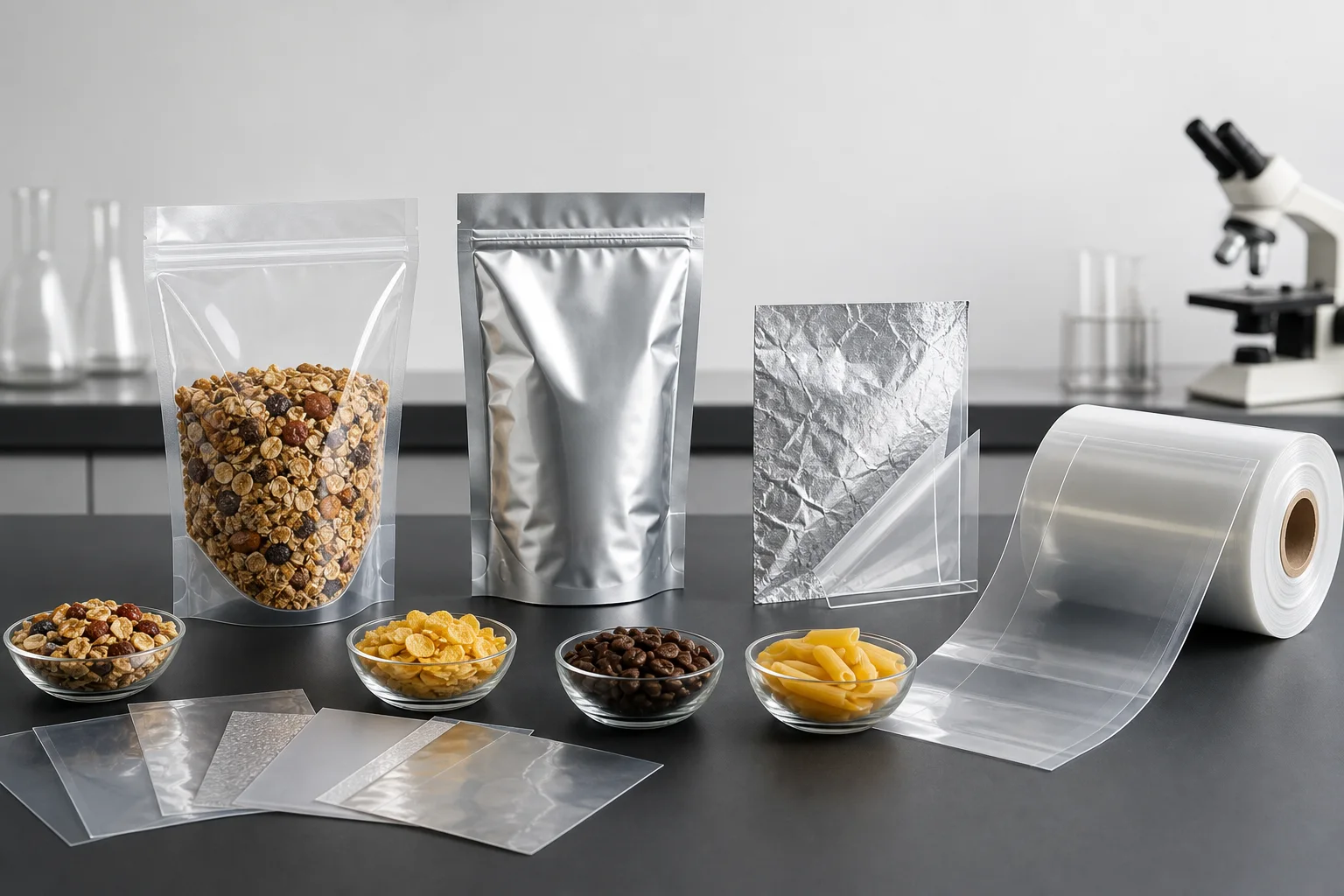
A transparent window or metallic surface can distract from the actual structure. I ask what each candidate is made from and how it was measured.
I compare complete constructions, including any window, using transmission reports with stated conditions. I keep product storage validation separate from film tests and request food-contact evidence for the intended market and use.
I list the full construction of each candidate: outer layer, print arrangement, any barrier layer, adhesive, contact sealant, thickness, zipper, and window. A broad name such as clear film or metallized pouch is only a starting description. I need enough information to match the report, converter sample, and eventual order without guessing which version was supplied.
| Candidate or check | Decision | Evidence I request |
|---|---|---|
| Clear candidate | Is visibility useful for this granule grade? | Exact construction and filled display sample |
| Opaque candidate | Does the structure meet our agreed storage brief? | Identified transmission report and filled storage study |
| Windowed candidate | Has the window been assessed with the surrounding film? | Window dimensions, construction and finished sample |
The food barrier-film guide helps organize questions about oxygen and moisture transmission. Intertek lists ASTM F1249 for water-vapor transmission and ASTM D3985 for oxygen transmission. These method names identify different measurements. Neither supplies an automatic acceptance limit or a shelf-life prediction for this couscous project.3
For a water-vapor report, I request the test temperature, humidity conditions, units, specimen thickness, and sample identity. For oxygen transmission, I ask for that method’s conditions separately. I do not rank two numbers until the laboratory confirms they can be compared. A lower reported number under one condition does not settle the entire buying decision.
I ask the food team to define the storage endpoints and schedule for representative filled packs. An illustrative reference might be 23°C and 50% relative humidity, with a second condition chosen from the actual route. Those are proposed project settings, not a prescribed couscous standard. The agreed protocol must state duration, controls, sampling, and the owner of the food-quality decision.
For US food contact, FDA explains that the status of the finished article depends on its components and their applicable authorizations and use limits. I therefore request documents linked to the proposed materials and intended contact conditions. I do not turn a generic food-grade statement into a claim that every ingredient, temperature, or market is covered.4
I keep the comparison focused on what remains uncertain. The chosen film still has to fill, seal, open, and close on the intended line. If a candidate needs a different zipper or a larger seal margin, I put that change back into the brief before asking for prices. Material assessment and package usability should reach one coordinated decision.
What Filled Trial and Purchase Specification Do I Need?
A clean empty pouch cannot show granules in a seal or a difficult second opening. I keep the pilot and approval record tied together.
I run the actual fill, inspect seal cleanliness, compare repeated pours, and examine packed cartons. I confirm the construction, dimensions, closure, process window, test records, and change rules in writing before ordering.
I begin with the intended couscous lot and the selected sample revision. I record net weight, pouch dimensions, filling method, operator, and the order of operations. I watch whether fine material collects at the mouth or zipper before sealing. If the filler requires shaking or wiping the seal area, I record that intervention rather than presenting the sample as an effortless production result.
I ask the filler and converter to agree the sealing process. I retain samples from the proposed operating settings and identify the jaw temperature, dwell time, pressure setting where available, and cooling arrangement. I inspect folds and thickness transitions as well as the straight top seam. I do not prescribe a universal sealing temperature without the selected material and equipment.
Through the packaging test guide, I separate seal strength from leak detection and product storage. Intertek lists ASTM F88 for seal strength. I ask for specimen conditioning, support arrangement, pull speed, and failure description in the test record. A strong peel result alone does not establish that every filled pack is leak-free.3
I repeat the pouring task after the agreed handling sequence. I place the pouches in the proposed carton layout and inspect for abrasion, hard creases, opened seams, and granules outside the bag. I retain an unhandled reference. The distribution team selects an appropriate transport protocol; I do not claim that an informal bench drop represents every delivery route.
What belongs in the final order brief
My written specification identifies the food grade, approved construction, thickness and tolerances, finished dimensions, zipper position, tear feature, top seal, artwork revision, batch-code area, and carton arrangement. I attach the retained sample identifier and the agreed inspection examples. The record also names who approves substitutions and which checks a change will reopen.
I then request a quotation against that specification. I ask suppliers to identify assumptions rather than quietly choosing alternatives. Minimum quantity, timing, pricing, certification, and storage claims require current evidence for the actual order. This sequence connects material assessment, a representative filled trial, written confirmation, and purchasing while keeping the customer’s simple pouring task visible throughout.
Conclusion
I approve couscous pouches through measured fill, clean pouring, documented film evidence, repeated closure trials, and a written order tied to the retained sample.
Sources and Further Reading
Need a pouch specification?
I can review your product, size, quantity, artwork, and target market.