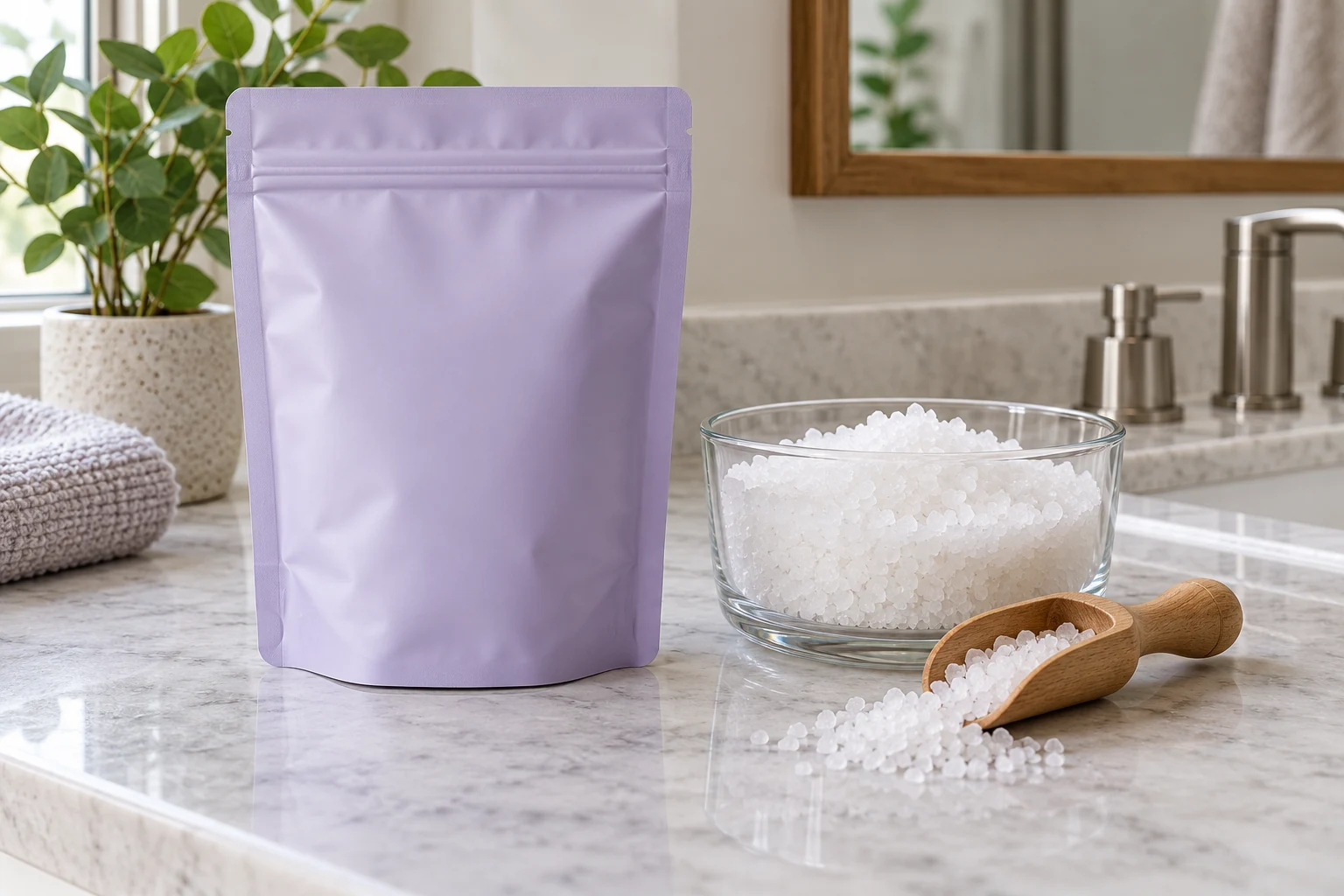
A heavy bath salt bag that is hard to reseal can turn a simple routine into spilled crystals and repeated transfers. I test the opening first.
I specify Epsom bath salt refill pouches around the actual formula, fill weight, grip area, wide accessible closure, and repeated dry handling. I compare material evidence and filled-pack trials before confirming the purchase specification.
This guide covers packaging usability for bath products. Formula claims, directions, and market-specific label review remain with the product owner.
What Formula and Fill Should the Pouch Actually Hold?
A plain crystal product and a scented blend can look similar in a photograph. Their packaging briefs should not be copied without review.
I identify the exact bath product, intended market, crystal distribution, additives, fill weight, and use pattern. I then compare constructions with the formula owner and converter using representative filled samples.
Formula identity and candidate structures
I start by naming the contents rather than specifying a generic salt pouch. The Epsom Salt Council identifies Epsom salt as magnesium sulfate and distinguishes grades for different applications. I use that source for product identity only. It does not establish the suitability, certification, or labeling status of our finished pack.1
My brief states whether the product is plain or blended and includes the ingredient supplier’s current specifications. If there are fragrances, oils, colors, or other additives, I ask the formula owner to identify the compatibility questions. I do not assume that a pouch used for plain crystals has already been assessed for every blend. The trial sample must contain the actual intended formula.
SaltWorks describes private-label work across bath salt varieties and lists packaging operations such as impulse sealing and case packing. That is a useful example of a real processing chain. It is not evidence that our converter has identical equipment or that any particular film will pass a compatibility trial.2
| Candidate choice | What I want to learn | What I retain |
|---|---|---|
| Wide zipper pouch | Can users grip and close the full opening? | Observed closure task and sample code |
| Smaller refill pack | Does it suit the customer’s container and lifting routine? | Measured filled dimensions and transfer observations |
| Different film construction | Does the actual blend suit the selected pack? | Written structure and formula-specific trial results |
I measure the filled pouch, not just the empty width and height. I check where a hand can grip without pressing directly on a seam or sharp fold. I also ask how the pack will be stored between uses. A tall empty sample can be easy to hold while the same shape at the planned fill weight becomes awkward.
The pouch sizing review helps me translate those observations into dimensions and usable headspace. I keep a small amount of space for handling only when the trial supports it. I do not set a universal headspace percentage or assume that a thicker film solves a difficult lifting task.
Before artwork, I agree which instructions and warnings the product owner requires for the intended market. I keep therapeutic, ingestion, and certification claims outside this packaging comparison. The useful purchasing question is whether the proposed construction and opening work for the stated bath product and customer routine.
How Do I Test Grip and Zipper Access Without Guessing?
A closure may work for the designer but frustrate the buyer. A narrow lip or stiff track can make a heavy pouch hard to manage.
I observe first opening, grip, controlled transfer, and resealing with representative users and fill levels. I record the task, spills, grip changes, and closure feedback before choosing the zipper and top layout.
Hand comfort and clean closure tracks
A user in r/ChronicIllness says cheaper Epsom salt bags are difficult to close again, and that this discourages use. I treat that as an individual account of closure friction. I do not infer how common it is, confirm a medical limitation, or endorse the remedies suggested in the thread.3
It gives me a concrete question for a packaging session: can a user find, align, and press the zipper without needing an unusually strong grip? I ask participants to perform the intended routine and describe where they struggle. If the product is intended for a group with specific access needs, I involve that group rather than asking a colleague to imitate them.
I test the first tear separately from resealing. I check the distance between the top seal, notch, and zipper, then observe whether the torn edge leaves a usable grip lip. A notch that opens neatly on an empty sample may behave differently after shipping. I retain both the unhandled and handled samples so the team can compare the action.
For transfer, I use a clean dry receiving container chosen for the intended routine. I do not ask users to hold the pouch over bathwater during a bench test. I record how the base folds, whether crystals collect at the mouth, and whether the operator can stop the flow. If the pack is too heavy for that task, a smaller refill or another format deserves comparison.
I then ask users to close the entire track and explain how they know it is shut. I look for crystals in the closure and areas that remain partly engaged. I repeat at several fill levels with an agreed number of cycles, recorded in the protocol. This is a project usability study, not a claim of universal accessibility or a certified zipper lifetime.
The sample approval checklist helps me keep observations tied to a specific version. If I change zipper type, track position, film stiffness, or grip space, I issue a revised sample code. I avoid mixing results from two versions and calling the combination approved.
My final choice should reduce the observed difficulty without adding unnecessary features. A larger grip lip may answer the problem more directly than a decorative finish. I retain the reasons for the choice in plain language so purchasing, the converter, and the product owner understand which details must stay fixed.
Which Material and Filled-Pack Checks Belong in the Order?
An empty bag cannot show formula contact, crystal residue, or stress from a full case. A quote without these details is hard to compare.
I record the exact structure, formula contact, closure, seal settings, storage conditions, and carton handling. I approve representative filled samples and written change limits before requesting production pricing.
Storage observations and procurement record
I ask for the proposed material construction in writing, including layers, thickness, tolerances, sealant, zipper, dimensions, and the converting revision. I keep the formula sample code beside it. I do not accept a familiar material abbreviation as proof that the finished pouch has already been tested for this bath product. The converter and formula owner need the same brief.
If water-vapor transmission is part of the comparison, I ask for the reported method, temperature, humidity gradient, units, film thickness, and specimen identity. Intertek lists ASTM F1249 as a film water-vapor method and F88 as a seal-strength method. Those method names do not provide a universal target for an Epsom salt pouch.4
For our own storage trial, I define recorded conditions, time points, filled sample count, and the observations the product owner wants. I compare appearance, free pouring, closure residue, film condition, and any formulation-specific concerns. I keep an agreed reference sample. I do not attribute every visible change to incoming moisture or claim a mechanism without evidence.
The packaging quality test guide supports a separate integrity plan. I inspect the top seal and gusset after filling. For laboratory seal work, I request specimen preparation, strip width, support method, conditioning, pull speed, and the observed failure mode. A strong peel result alone does not answer every leak or handling question.
I place filled packs into the proposed shipper and record the arrangement and gross weight. I inspect corners and seams after the handling sequence agreed for the project. If the pack slips, develops a hard fold, or puts crystals into the seal area, I document where it occurs. I then change the relevant dimension or process and repeat the affected checks. I do not call an informal drop a certified transport test.
My written pouch specification includes the approved sample, artwork, date or lot marking area, storage wording supplied by the product owner, packing method, inspection plan, and change triggers. It also states which questions remain open. That prevents an attractive prototype from being treated as a complete production release.
Once the material assessment and filled-pack trial support the choice, I request a quote against that specification. I ask the supplier to state any substitution explicitly. Minimum quantity, price, production timing, and certification are project matters requiring current evidence; I do not invent them for a general guide. The useful outcome is a reproducible pack and a clear record of who approved each requirement.
Conclusion
I approve Epsom bath salt refill pouches through formula-specific samples, accessible closure trials, recorded handling, and written specifications that match the quoted pack.
Sources and Further Reading
Need a pouch specification?
I can review your product, size, quantity, artwork, and target market.