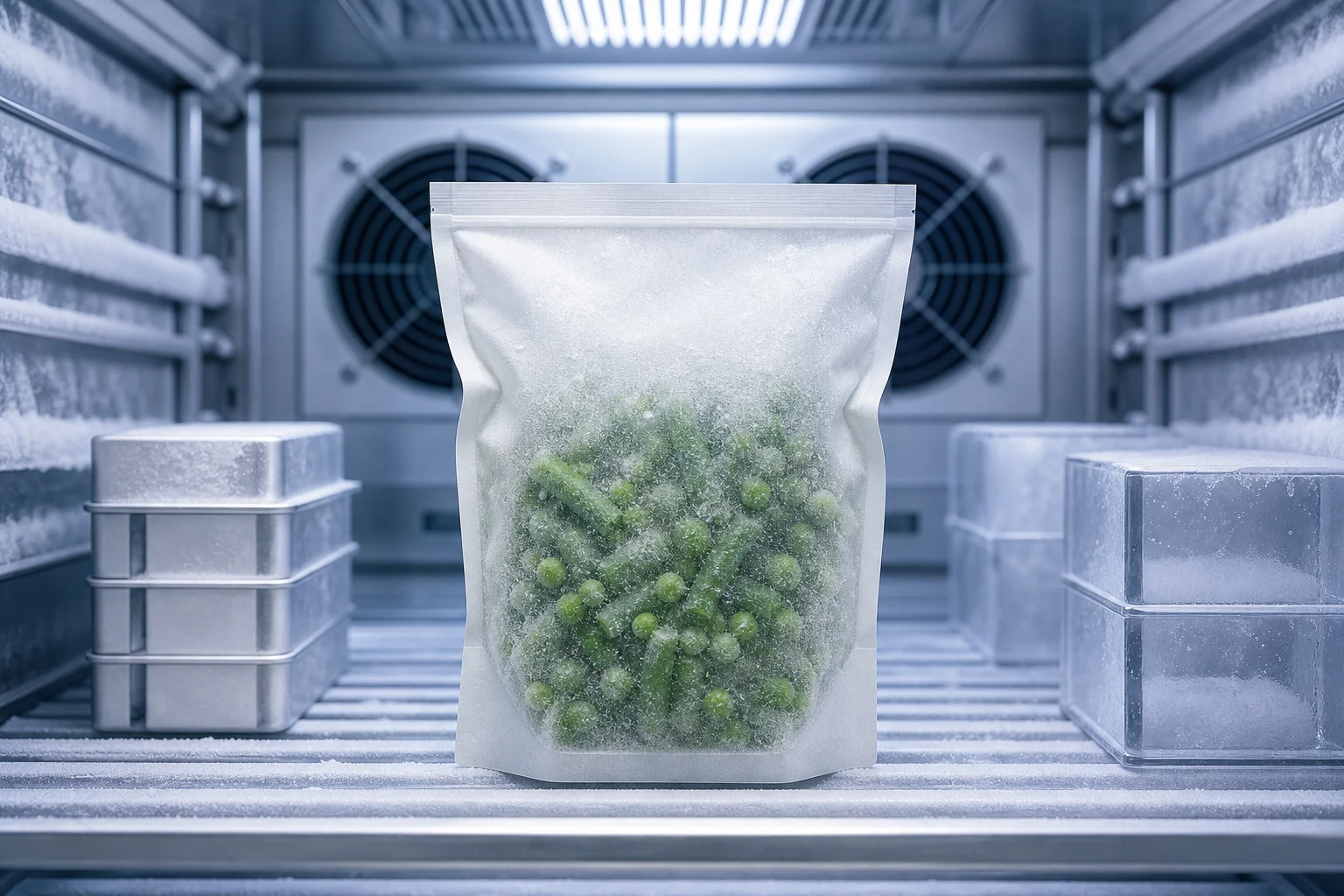
A pouch can seal well at room temperature yet leak after freezing when flexing, sharp product edges, seals, and cold-chain handling were never tested together.
I package frozen food by defining the product and freezer route, selecting a structure for the relevant cold conditions, then validating filled pouches through flexing, seals, carton handling, and repeat inspection.
I treat the pouch as a complete system. I confirm the product, material, filling, handling, and customer experience before I approve production.
Why Do Frozen Pouches Crack or Leak?
A frozen pouch sees bending, impacts, sharp inclusions, seal stress, and temperature changes that an empty room-temperature sample never experiences.
I investigate frozen-pack failures by separating film flex damage, puncture, seal weakness, filling contamination, and cold-chain handling, then testing the filled configuration that will actually ship.
I ask what is inside the pack, how sharp or hard the pieces become, how it is filled, and how the bag is handled after freezing. A pouch can fail through a flex-formed pinhole, a puncture, a weak seal, or damage introduced by a carton edge. I do not diagnose from one photo. I retain the failed unit when possible, inspect its location, and compare it with an intact control from the same configuration.
How I make this decision specific
| Observed issue | What I check first | Useful comparison |
|---|---|---|
| Leak at seal | Seal area and contamination. | Filled vs. empty samples. |
| Pinholes | Flex route and film layers. | Before/after conditioning. |
| Corner damage | Product edges and carton fit. | Packed handling trial. |
| Loose pack | Integrity and product state. | Controlled inspection. |
For “Why Do Frozen Pouches Crack or Leak?” in this how do i package frozen food without flex cracks or leaks review, I define the actual product, pouch configuration, intended use, and decision owner before I ask a supplier or tester for evidence. I keep the selected structure, component details, sample condition, and any stated test method together, then compare the result with the buyer’s actual route rather than a catalogue promise. That record lets me use the custom frozen food packaging page as a decision aid and retain a specification that another team member can check.
For How Do I Package Frozen Food Without Flex Cracks or Leaks, I state what is known, the condition it applies to, and what must still be checked with the actual product. I do not transfer a number, a test result, or a feature choice from another product simply because its pouch looks similar. The result of “Why Do Frozen Pouches Crack or Leak?” should give the buyer a clear next check, the supplier a precise request, and the project owner a record of the remaining uncertainty.
For How Do I Package Frozen Food Without Flex Cracks or Leaks, I request the exact pouch structure, component specification, and test conditions from the supplier. A broad material name or catalogue claim is not a production specification. The right next step is a representative filled sample, where relevant, with observations recorded before production is approved.
Which Film and Seal Details Matter at Low Temperature?
A material description does not reveal whether the selected pouch will preserve seal integrity and useful flexibility after freezing.
I compare the specific structure, thickness, sealant, pouch geometry, product edges, and low-temperature test conditions rather than selecting a frozen-food pouch from a generic material label.
I ask the supplier for the exact construction and identify the sealant, barrier layer if needed, dimensions, and relevant performance evidence. Then I make samples with the actual product and target fill weight. I inspect top, side, and bottom seals because each can see different stress. I also look at pouch corners and folds. A change in product cut size, fill height, or carton count can change the failure mode even if the laminate name stays the same.
How I make this decision specific
For “Which Film and Seal Details Matter at Low Temperature?” in this how do i package frozen food without flex cracks or leaks review, I define the actual product, pouch configuration, intended use, and decision owner before I ask a supplier or tester for evidence. I keep the selected structure, component details, sample condition, and any stated test method together, then compare the result with the buyer’s actual route rather than a catalogue promise. That record lets me use the custom frozen food packaging page as a decision aid and retain a specification that another team member can check.
For How Do I Package Frozen Food Without Flex Cracks or Leaks, I state what is known, the condition it applies to, and what must still be checked with the actual product. I do not transfer a number, a test result, or a feature choice from another product simply because its pouch looks similar. The result of “Which Film and Seal Details Matter at Low Temperature?” should give the buyer a clear next check, the supplier a precise request, and the project owner a record of the remaining uncertainty.
How Should Filling and Freezing Be Controlled?
Small filling differences can create trapped product in a seal, overstretch the pouch, or turn a stable layout into a difficult frozen shape.
I set the fill level, seal-clearance rule, product orientation, freezing step, and inspection points with production-style samples before I approve the pouch and line settings.
I watch the real fill. Product fragments, frost, oil, powder, and moisture can reach the seal area, while a high fill can remove the space needed for a stable top seal. I check whether the product settles into sharp corners after freezing and whether the pouch shape still fits the planned carton. I document the fill height and target condition so a later line shift does not silently change a package that had passed testing.
How I make this decision specific
For “How Should Filling and Freezing Be Controlled?” in this how do i package frozen food without flex cracks or leaks review, I define the actual product, pouch configuration, intended use, and decision owner before I ask a supplier or tester for evidence. I keep the selected structure, component details, sample condition, and any stated test method together, then compare the result with the buyer’s actual route rather than a catalogue promise. That record lets me use the custom frozen food packaging page as a decision aid and retain a specification that another team member can check.
For How Do I Package Frozen Food Without Flex Cracks or Leaks, I state what is known, the condition it applies to, and what must still be checked with the actual product. I do not transfer a number, a test result, or a feature choice from another product simply because its pouch looks similar. The result of “How Should Filling and Freezing Be Controlled?” should give the buyer a clear next check, the supplier a precise request, and the project owner a record of the remaining uncertainty.
For How Do I Package Frozen Food Without Flex Cracks or Leaks, I treat the filled pack as a separate check from the material data. I record the fill condition, seal area, opening or closure behavior, carton arrangement, handling observations, and limits of the comparison. That prevents a favourable bench result from becoming an unsupported claim about shelf life, transport, or every product route.
How Do I Validate the Cold Chain?
A freezer-only test misses the route where cartons are stacked, moved, dropped, opened, and exposed to ordinary handling stress.
I validate cold-chain performance with filled frozen pouches in their planned carton, using defined handling, inspection, and acceptance steps that match the actual route.
I freeze filled samples, pack them in the intended carton, and inspect after the movements the product is likely to see. I look for corner rub, seal stress, trapped product, and any loss of integrity. ASTM F392/F392M describes conditioning flexible barrier materials for flex durability and notes its use in evaluating flex-formed pinhole failures; I use relevant methods and project conditions rather than assume that a generic cold claim is enough. If a result changes, I trace it back to the configuration and repeat the test before release.
How I make this decision specific
For “How Do I Validate the Cold Chain?” in this how do i package frozen food without flex cracks or leaks review, I define the actual product, pouch configuration, intended use, and decision owner before I ask a supplier or tester for evidence. I keep the selected structure, component details, sample condition, and any stated test method together, then compare the result with the buyer’s actual route rather than a catalogue promise. That record lets me use the custom frozen food packaging page as a decision aid and retain a specification that another team member can check.
For How Do I Package Frozen Food Without Flex Cracks or Leaks, I state what is known, the condition it applies to, and what must still be checked with the actual product. I do not transfer a number, a test result, or a feature choice from another product simply because its pouch looks similar. The result of “How Do I Validate the Cold Chain?” should give the buyer a clear next check, the supplier a precise request, and the project owner a record of the remaining uncertainty.
For How Do I Package Frozen Food Without Flex Cracks or Leaks, I preserve the final decision in a written brief that names the approved sample, conditions, observations, open risks, and change triggers. I then use the seal-leak prevention guide to keep the quotation tied to the evidence rather than to a remembered sample or a generic product name.
Conclusion
I choose packaging through evidence, filled-pack testing, and clear specifications. That process protects the product, the launch, and the customer experience.
Sources and Further Reading
- FDA, Food Types and Conditions of Use for Food Contact Substances.
- Reddit r/Cooking, frozen vacuum-pack experience community discussion.
- ASTM F392/F392M, flex durability of flexible barrier materials.
- ASTM F88/F88M, seal strength of flexible barrier materials.
- Unique Packaging frozen food packaging.
- Unique Packaging seal-leak prevention guide.
Need a pouch specification?
I can review your product, size, quantity, artwork, and target market.