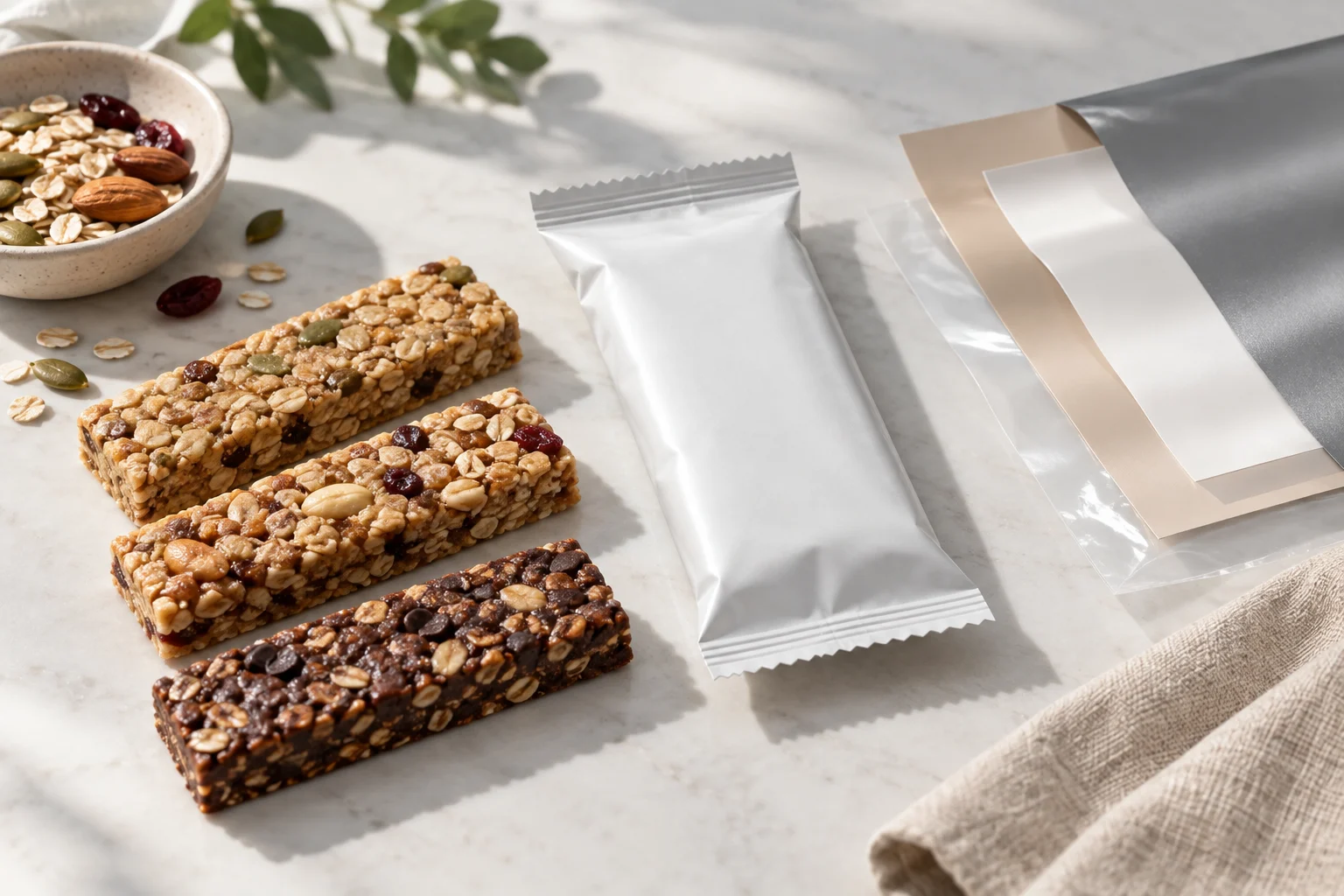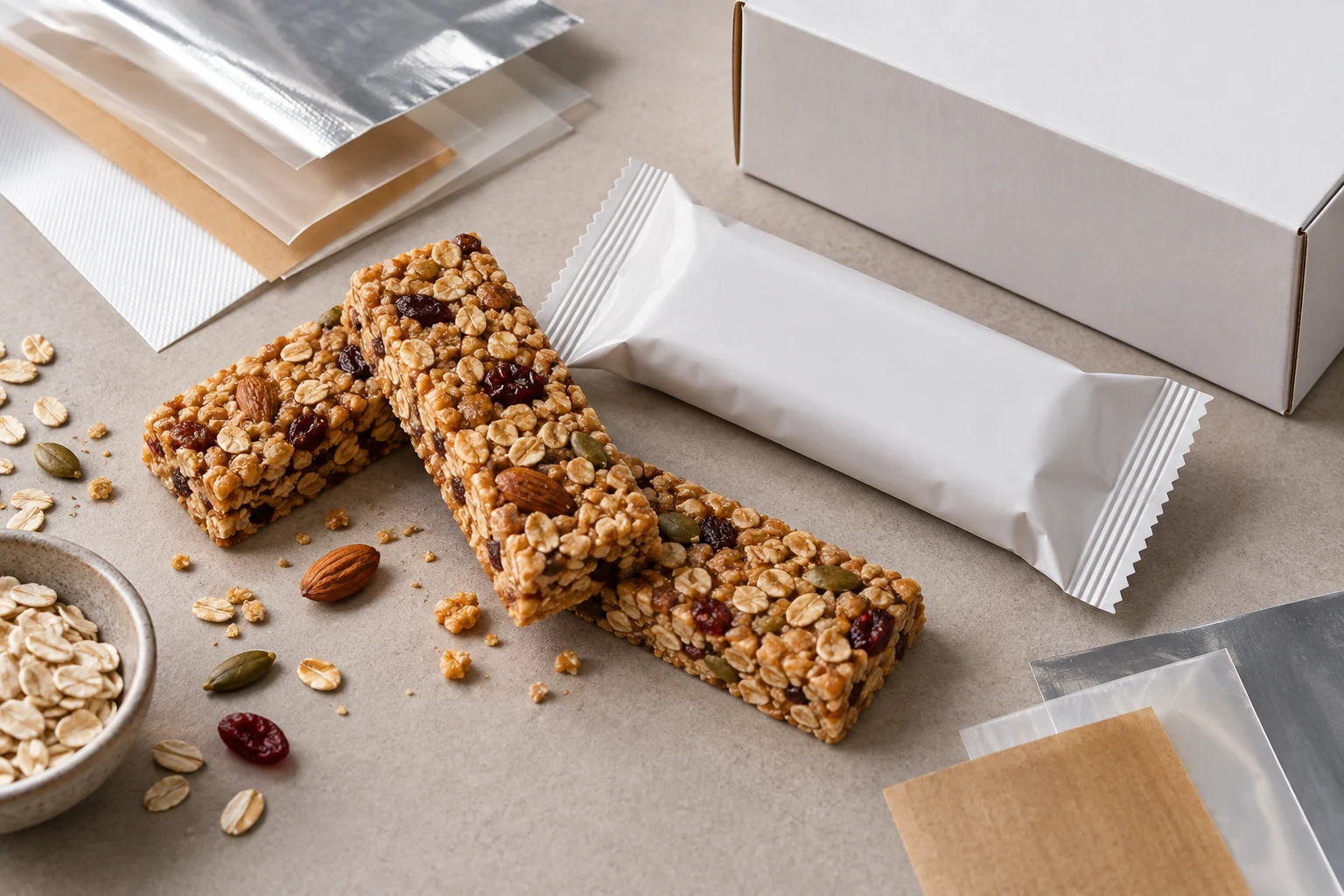
A granola-bar wrapper can split, open too hard, crush the bar, or fail inside a carton when the product, web, seals, line, and route are never reviewed as one system.
I package granola bars in flexible packaging by defining the bar and route, comparing the wrapper construction and seals, checking packed bars, and documenting the approved configuration before quotation.
I treat the pouch as a complete system. I confirm the product, material, filling, handling, and customer experience before I approve production.
What Granola-Bar Conditions Should I Define First?
A bar-wrapper request is incomplete when it omits bar dimensions, texture, coating, crumbs, packing temperature, market, route, carton design, and expected opening experience.
I define the bar dimensions and condition, coating and crumb profile, packing temperature, market, storage and distribution route, carton plan, and customer opening routine before I compare wrapper structures.
I identify the actual bar length, height, width, edge shape, inclusion profile, coating if present, crumb tendency, packing temperature, fill condition, carton arrangement, and opening expectation. A shopper reported an unopened retail box in which bars were unsealed at both wrapper ends.5 That is a community observation, not a diagnosis of its material or line. I use it to make seal geometry and packed-bar inspection explicit. FDA explains that food packaging and its components are food-contact substances evaluated according to intended use.1
How I make this decision specific
For “What Granola-Bar Conditions Should I Define First?” in this how do i package granola bars in flexible packaging review, I define the actual product, pouch configuration, intended use, and decision owner before I ask a supplier or tester for evidence. I keep the selected structure, component details, sample condition, and any stated test method together, then compare the result with the buyer’s actual route rather than a catalogue promise. That record lets me use the barrier-film guide as a decision aid and retain a specification that another team member can check.
For How Do I Package Granola Bars in Flexible Packaging, I state what is known, the condition it applies to, and what must still be checked with the actual product. I do not transfer a number, a test result, or a feature choice from another product simply because its pouch looks similar. The result of “What Granola-Bar Conditions Should I Define First?” should give the buyer a clear next check, the supplier a precise request, and the project owner a record of the remaining uncertainty.
For How Do I Package Granola Bars in Flexible Packaging, I request the exact pouch structure, component specification, and test conditions from the supplier. A broad material name or catalogue claim is not a production specification. The right next step is a representative filled sample, where relevant, with observations recorded before production is approved.
Which Wrapper Structure and Seal Geometry Should I Compare?
A generic bar wrapper cannot identify the film sequence, sealant, web width, overlap, fin or end seal geometry, food-contact scope, and test conditions a buyer needs.
I compare the bar dimensions, wrapper web, layer sequence, sealant, fin and end-seal geometry, physical samples, named test conditions, and packing-line fit before approving a structure.
I request a written construction and a production-style blank. I inspect how the bar sits within the web, the head clearance at each end, overlap or fin-seal geometry, seal width, tear direction, and the room available for printing and codes. ASTM F1249 describes a method for determining water-vapor transmission through flexible barrier materials, with conditions and sampling relevant to comparisons.2 I retain the exact material and test conditions rather than treating one result as a claim about a finished bar. The barrier-film guide gives the material discussion a useful structure.
How I make this decision specific
For “Which Wrapper Structure and Seal Geometry Should I Compare?” in this how do i package granola bars in flexible packaging review, I define the actual product, pouch configuration, intended use, and decision owner before I ask a supplier or tester for evidence. I keep the selected structure, component details, sample condition, and any stated test method together, then compare the result with the buyer’s actual route rather than a catalogue promise. That record gives the buyer a decision aid and a specification that another team member can check.
For How Do I Package Granola Bars in Flexible Packaging, I state what is known, the condition it applies to, and what must still be checked with the actual product. I do not transfer a number, a test result, or a feature choice from another product simply because its pouch looks similar. The result of “Which Wrapper Structure and Seal Geometry Should I Compare?” should give the buyer a clear next check, the supplier a precise request, and the project owner a record of the remaining uncertainty.
How Do I Check Wrapped Granola Bars Before Production?
An empty wrapper cannot show end-seal integrity, crushed edges, product transfer, carton friction, opening behavior, or the way a real bar moves through packing and handling.
I inspect representative wrapped, cartoned, handled, opened, and sampled bars under documented project conditions before I approve the wrapper or request a quote.
I run bars at the planned condition and examine end seals, fin seals, bar position, wrapper tension, edges, crumbs or coating near seals, carton fit, surface rub, and the opening path. ASTM F88/F88M provides a controlled method for measuring seal strength and failure mode in flexible barrier materials.3 I use it for a named comparison, not as a shortcut to a freshness, food-safety, or transport claim. ISTA describes test categories that range from screening to shipment-specific simulation.4 I use the filled-pack distribution-testing guide when the route requires a defined plan.
How I make this decision specific
| Decision | What I check | Evidence I retain |
|---|---|---|
| Bar fit | Dimensions, edges, crumbs, and wrapper tension. | Production-style wrapped samples. |
| Seal geometry | Fin, end-seal width, and failure mode. | Named material and seal comparison. |
| Opening use | Tear direction and clean access to the bar. | Observed opening checks. |
| Carton route | Orientation, rub, compression, and limits. | Trial record and retained carton. |
For “How Do I Check Wrapped Granola Bars Before Production?” in this how do i package granola bars in flexible packaging review, I define the actual product, pouch configuration, intended use, and decision owner before I ask a supplier or tester for evidence. I keep the selected structure, component details, sample condition, and any stated test method together, then compare the result with the buyer’s actual route rather than a catalogue promise. That record gives the buyer a decision aid and a specification that another team member can check.
For How Do I Package Granola Bars in Flexible Packaging, I state what is known, the condition it applies to, and what must still be checked with the actual product. I do not transfer a number, a test result, or a feature choice from another product simply because its pouch looks similar. The result of “How Do I Check Wrapped Granola Bars Before Production?” should give the buyer a clear next check, the supplier a precise request, and the project owner a record of the remaining uncertainty.
For How Do I Package Granola Bars in Flexible Packaging, I treat the filled pack as a separate check from the material data. I record the fill condition, seal area, opening or closure behavior, carton arrangement, handling observations, and limits of the comparison. That prevents a favourable bench result from becoming an unsupported claim about shelf life, transport, or every product route.
What Should a Granola-Bar Wrapper Specification Include?
A wrapper sample becomes hard to repeat when the purchase record omits bar condition, web and seal details, carton plan, packed-bar evidence, acceptance limits, and change triggers.
I specify the bar and packing condition, wrapper construction and seal geometry, market scope, approved packed sample, carton plan, observations, acceptance criteria, and reapproval triggers in one brief.
I keep the purchasing path explicit: assess the wrapper against the defined bar and route, run a representative packed-bar review, document the accepted configuration, and request a quote on that same basis. The brief records bar dimensions and condition, coating or crumb profile, web and layer description, sealant, seal geometry, artwork revision, market, carton plan, sample condition, observations, and limits. I list possible failures: split or incomplete seals, crushing, product at a seal, hard opening, carton abrasion, and undocumented web or line changes. I do not invent MOQ, price, lead time, certification, shelf life, or material performance. The protein-bar packaging guide provides a related but separate wrapper decision path.
How I make this decision specific
For “What Should a Granola-Bar Wrapper Specification Include?” in this how do i package granola bars in flexible packaging review, I define the actual product, pouch configuration, intended use, and decision owner before I ask a supplier or tester for evidence. I keep the selected structure, component details, sample condition, and any stated test method together, then compare the result with the buyer’s actual route rather than a catalogue promise. That record gives the buyer a decision aid and a specification that another team member can check.
For How Do I Package Granola Bars in Flexible Packaging, I state what is known, the condition it applies to, and what must still be checked with the actual product. I do not transfer a number, a test result, or a feature choice from another product simply because its pouch looks similar. The result of “What Should a Granola-Bar Wrapper Specification Include?” should give the buyer a clear next check, the supplier a precise request, and the project owner a record of the remaining uncertainty.
For How Do I Package Granola Bars in Flexible Packaging, I preserve the final decision in a written brief that names the approved sample, conditions, observations, open risks, and change triggers. I then use the packaging specification-sheet guide to keep the quotation tied to the evidence rather than to a remembered sample or a generic product name.
Conclusion
I choose packaging through evidence, filled-pack testing, and clear specifications. That process protects the product, the launch, and the customer experience.
Sources and Further Reading
- FDA, Food Packaging and Other Substances that Come in Contact with Food.
- ASTM F1249, Water Vapor Transmission Rate Through Flexible Barrier Materials.
- ASTM F88/F88M, Seal Strength of Flexible Barrier Materials.
- ISTA, packaged-product test procedure categories.
- Reddit r/midlyinteresting, unsealed granola-bar wrapper discussion.
- Unique Packaging protein-bar packaging guide.
Need a pouch specification?
I can review your product, size, quantity, artwork, and target market.