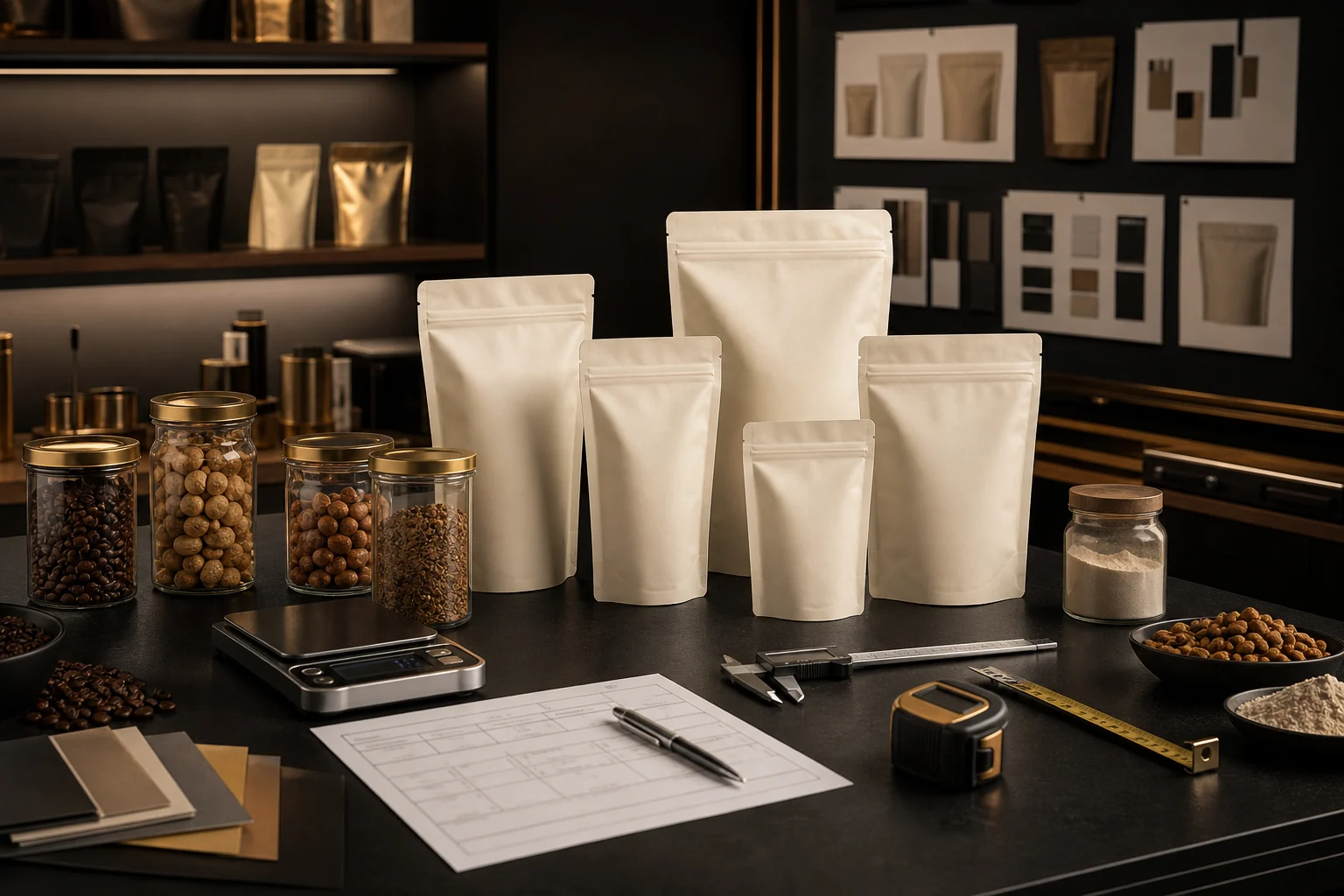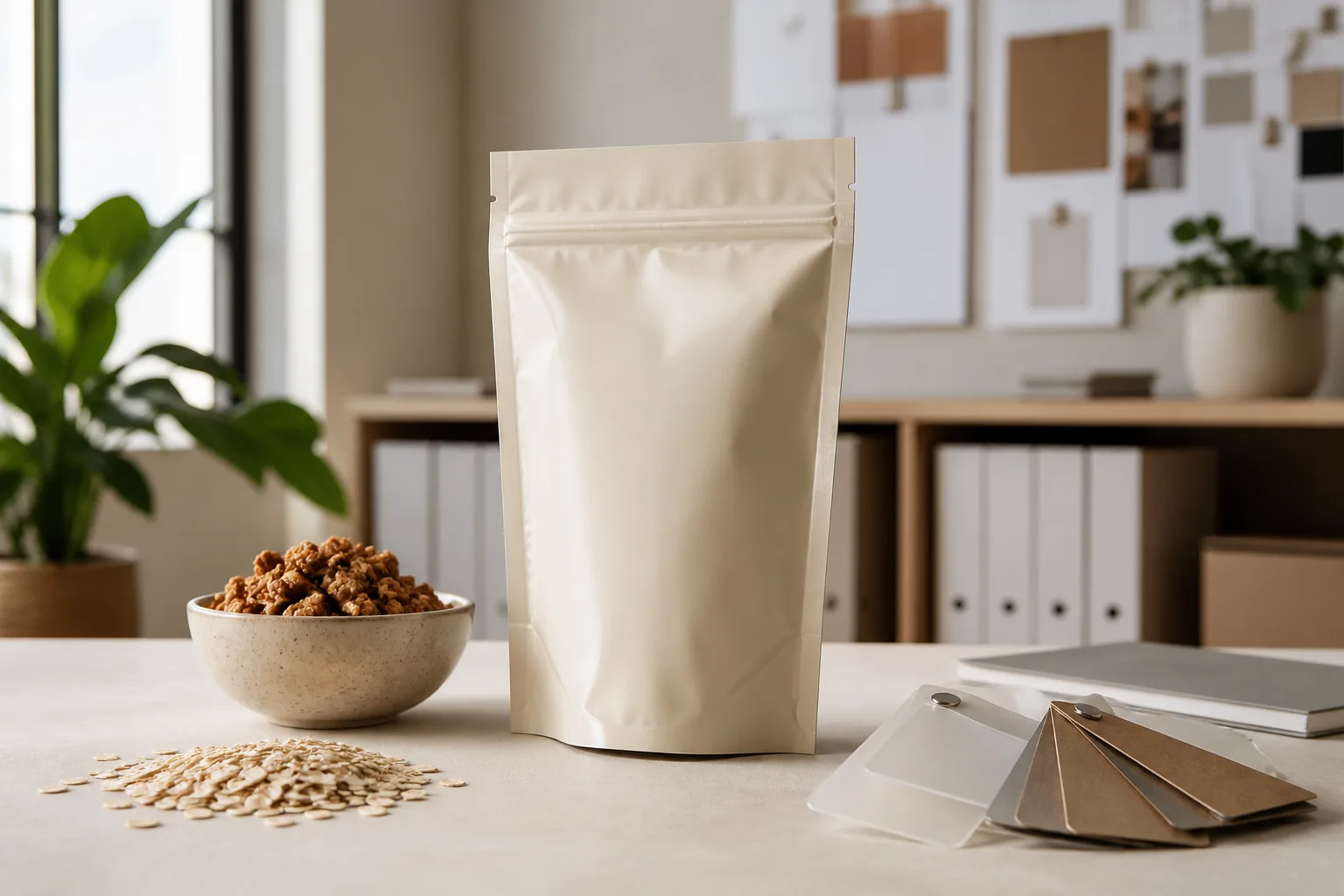
A pouch can make granola look ready for sale yet fail the buying decision when format, product handling, opening, reclosure, and carton fit were never checked together.
I choose granola pouch packaging after I define the product and route, compare the format and closure on filled samples, and confirm a written specification before quotation.
I treat the pouch as a complete system. I confirm the product, material, filling, handling, and customer experience before I approve production.
Should I Start with a Pouch, a Box, or Both?
A format decision goes wrong when a buyer copies a familiar cereal package without defining the product, use moment, production route, and information space needed.
I compare pouch and box systems around the actual granola, fill, customer use, product protection needs, carton route, artwork panels, and manufacturing constraints before selecting a format.
I begin with the product and route. I ask about cluster size, crumbs, inclusions, fill weight, headspace, desired serving behavior, shelf presentation, e-commerce handling, and whether a secondary box has a defined purpose. The Reddit discussion makes the trade-off visible: an industry commenter named material cost, process, distribution, shelf life, and brand recognition as interacting factors.2 I treat that as an operator perspective, not a selection rule. I make a simple comparison with real samples, not a verbal preference. The size guide helps me separate nominal size from usable filled volume and standing footprint.
How I make this decision specific
For “Should I Start with a Pouch, a Box, or Both?” in this how do i choose pouch packaging for granola review, I define the actual product, pouch configuration, intended use, and decision owner before I ask a supplier or tester for evidence. I keep the selected structure, component details, sample condition, and any stated test method together, then compare the result with the buyer’s actual route rather than a catalogue promise. That record lets me use the stand-up pouch size guide as a decision aid and retain a specification that another team member can check.
For How Do I Choose Pouch Packaging for Granola, I state what is known, the condition it applies to, and what must still be checked with the actual product. I do not transfer a number, a test result, or a feature choice from another product simply because its pouch looks similar. The result of “Should I Start with a Pouch, a Box, or Both?” should give the buyer a clear next check, the supplier a precise request, and the project owner a record of the remaining uncertainty.
For How Do I Choose Pouch Packaging for Granola, I request the exact pouch structure, component specification, and test conditions from the supplier. A broad material name or catalogue claim is not a production specification. The right next step is a representative filled sample, where relevant, with observations recorded before production is approved.
What Pouch and Closure Details Change the Customer Experience?
A zipper can appear helpful in a specification while the filled pouch is hard to open, hard to reclose, or awkward to pour from after the first use.
I evaluate the pouch geometry, top seal, tear feature, zipper position, fill height, product crumbs, and user-opening sequence together on the selected sample.
I review the pouch as a complete customer interaction. I decide how the package opens, where the zipper sits below the top seal, how much headspace is available, whether product particles approach the closure, and whether customers can pour and reclose the pouch. I do not promise resealability merely because a zipper is specified. FDA notes that packaging components can be food-contact substances, so I request documentation for the selected construction and intended use.1 I also use the dieline guide to keep text and codes clear of folds, seals, tear zones, and functional features.
How I make this decision specific
For “What Pouch and Closure Details Change the Customer Experience?” in this how do i choose pouch packaging for granola review, I define the actual product, pouch configuration, intended use, and decision owner before I ask a supplier or tester for evidence. I keep the selected structure, component details, sample condition, and any stated test method together, then compare the result with the buyer’s actual route rather than a catalogue promise. That record gives the buyer a decision aid and a specification that another team member can check.
For How Do I Choose Pouch Packaging for Granola, I state what is known, the condition it applies to, and what must still be checked with the actual product. I do not transfer a number, a test result, or a feature choice from another product simply because its pouch looks similar. The result of “What Pouch and Closure Details Change the Customer Experience?” should give the buyer a clear next check, the supplier a precise request, and the project owner a record of the remaining uncertainty.
How Do I Check Granola in the Filled Pack and Carton?
An empty pouch can stand perfectly on a desk while filled granola changes its footprint, crumb location, seal cleanliness, carton fit, and opening behavior.
I inspect representative filled, sealed, cartoned, handled, opened, poured, and reclosed pouches under stated project conditions before I approve a format or feature.
I fill the proposed pouch with the real product and inspect the top seal, zipper access, product placement, standing footprint, panel appearance, carton orientation, and customer use. I ask people to open and pour without coaching, then record their observations. When a project needs comparable seal data, ASTM F88/F88M provides a method for measuring seal strength of flexible barrier materials and identifying failure mode.3 That does not establish total package performance by itself. I retain samples with their fill condition and carton details, and use the line-trial guide when the next decision needs controlled process observations.
How I make this decision specific
For “How Do I Check Granola in the Filled Pack and Carton?” in this how do i choose pouch packaging for granola review, I define the actual product, pouch configuration, intended use, and decision owner before I ask a supplier or tester for evidence. I keep the selected structure, component details, sample condition, and any stated test method together, then compare the result with the buyer’s actual route rather than a catalogue promise. That record gives the buyer a decision aid and a specification that another team member can check.
For How Do I Choose Pouch Packaging for Granola, I state what is known, the condition it applies to, and what must still be checked with the actual product. I do not transfer a number, a test result, or a feature choice from another product simply because its pouch looks similar. The result of “How Do I Check Granola in the Filled Pack and Carton?” should give the buyer a clear next check, the supplier a precise request, and the project owner a record of the remaining uncertainty.
For How Do I Choose Pouch Packaging for Granola, I treat the filled pack as a separate check from the material data. I record the fill condition, seal area, opening or closure behavior, carton arrangement, handling observations, and limits of the comparison. That prevents a favourable bench result from becoming an unsupported claim about shelf life, transport, or every product route.
What Belongs in a Granola-Pouch Purchase Specification?
A successful sample becomes hard to repeat when the purchase brief records only a pouch size and artwork while omitting the product, closure, sample evidence, and acceptance criteria.
I specify the product and fill condition, pouch format and dimensions, construction, food-contact market, opening and closure features, artwork safe zones, filled-pack evidence, carton plan, and reapproval triggers.
I record the actual product and fill, pouch format, dimensions, structure, product-contact market, zipper and tear features, required panels, artwork revision, test sample, carton configuration, observations, acceptance decision, and re-test triggers. I name likely failure modes such as seal contamination, poor opening, zipper interference, unstable footprint, crumbs at the closure, cartoning damage, and code placement conflict. The procurement path remains practical: assess the materials, run a representative filled-pack trial, confirm the written specification, and request a quote on that basis. The specification-sheet guide ensures that the approved sample is traceable rather than just memorable.
How I make this decision specific
| Specification item | Evidence I request | Decision it supports |
|---|---|---|
| Product and fill | Granola sample, fill condition, and headspace review. | Useful pouch geometry. |
| Opening and closure | Tear path, zipper position, and user check. | Repeat-use experience. |
| Construction and market | Written supplier documentation. | Material evaluation. |
| Filled-pack evidence | Seals, carton, observations, and retained reference. | Specification-based quote. |
For “What Belongs in a Granola-Pouch Purchase Specification?” in this how do i choose pouch packaging for granola review, I define the actual product, pouch configuration, intended use, and decision owner before I ask a supplier or tester for evidence. I keep the selected structure, component details, sample condition, and any stated test method together, then compare the result with the buyer’s actual route rather than a catalogue promise. That record gives the buyer a decision aid and a specification that another team member can check.
For How Do I Choose Pouch Packaging for Granola, I state what is known, the condition it applies to, and what must still be checked with the actual product. I do not transfer a number, a test result, or a feature choice from another product simply because its pouch looks similar. The result of “What Belongs in a Granola-Pouch Purchase Specification?” should give the buyer a clear next check, the supplier a precise request, and the project owner a record of the remaining uncertainty.
For How Do I Choose Pouch Packaging for Granola, I preserve the final decision in a written brief that names the approved sample, conditions, observations, open risks, and change triggers. I then use the packaging specification-sheet guide to keep the quotation tied to the evidence rather than to a remembered sample or a generic product name.
Conclusion
I choose packaging through evidence, filled-pack testing, and clear specifications. That process protects the product, the launch, and the customer experience.
Sources and Further Reading
Need a pouch specification?
I can review your product, size, quantity, artwork, and target market.