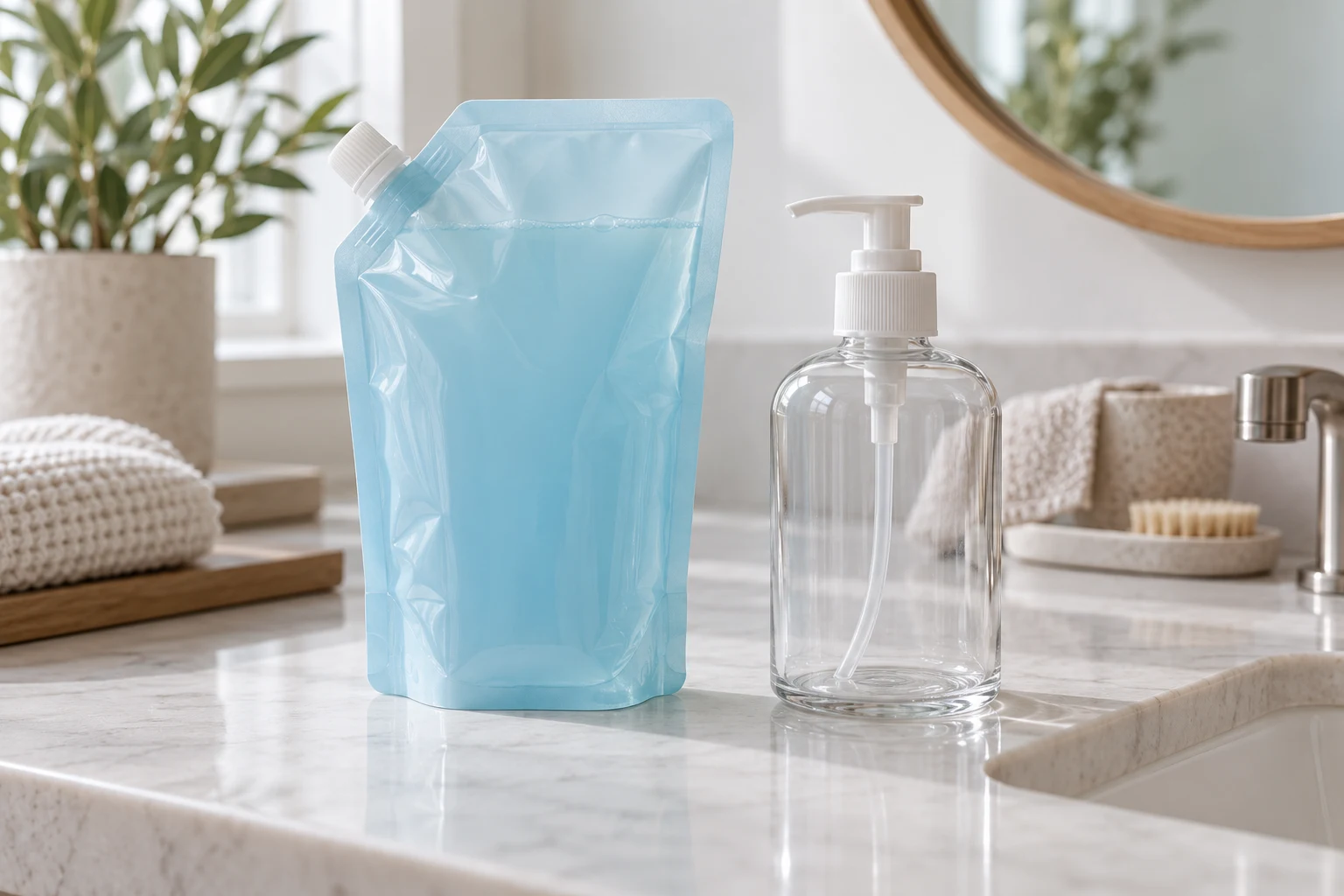
A larger soap refill can reduce repeated purchases yet become awkward to lift and aim. A small spill can undo the convenience a family expected.
I specify a hand soap refill spout pouch around the exact formulation, receiving bottle, usable capacity and pour routine. I validate closure compatibility, handling and storage with the product team before approving the complete pack.
At Unique Packaging, I review the transfer task as closely as the sealed pouch. This guide concerns cosmetic hand washes; antiseptic claims and other product classifications need separate review.
How Large Should My Hand Soap Refill Pouch Be?
A refill sized around a marketing claim may leave customers holding a heavy pack over a small bottle. Capacity needs a real transfer check.
I choose capacity by the actual receiving bottle, available space, handling ability and expected refill routine. I compare filled samples instead of assuming the largest pouch gives the best experience.
A Netherlands household in r/ZeroWaste described going through small hand-soap bottles and refill pouches quickly.1 That is a specific family’s experience, not a market-size estimate or evidence that every buyer wants a larger refill. I use it to ask a better design question: how can a family refill comfortably without buying a pack that is difficult to store or control?
I request the intended bottle and pump before choosing the pouch capacity. I record the bottle’s usable receiving volume, opening shape and the headspace needed when the pump is replaced. Then I ask users how they normally refill. Some wait until the bottle is empty. Others reach for a refill when it is partly used. The product team must provide the approved instructions; the sample exercise checks whether people can follow them without guessing.
I compare capacity with handling, not only refill counts
I prepare candidate filled pouches using the actual hand-wash formulation. I ask users to lift each pack, open the cap and aim at the receiving bottle. I record grip changes, hesitation and any need for a second supporting hand. I also check whether the remaining pouch stands securely in the planned storage space. These are proposed usability observations. I do not turn them into a universal weight limit or accessibility claim.
| Choice | What I compare | Evidence to retain |
|---|---|---|
| Smaller refill | Grip and storage convenience | Observed transfer routine |
| Larger refill | Support needed while pouring | Filled handling sample |
| Multi-refill pack | Reclosure and remainder storage | Approved instructions and repeat trial |
A claimed refill count needs its own arithmetic and a defined receiving quantity. I keep the bottle capacity, intended fill and pouch contents explicit rather than rounding to a more attractive number. If the brand changes the bottle, I repeat the comparison. I use the spout pouch selection guide to organize these format decisions. The goal is a pack that fits a documented household task, not a generic promise that bigger is more economical or sustainable.
Which Spout and Cap Fit the Soap Transfer Task?
A spout can clear the bottle opening yet still pour awkwardly. A cap can look familiar without matching the selected neck or product.
I compare the actual spout, cap, bottle opening and formulation as one system. I check aiming, start-stop control, drips and reclosure through a defined filled-pouch trial.
I start with a physical bottle, not a neck dimension copied from a photograph. I note the opening, shoulder shape and position where a user can support the refill. I ask the converter to identify the spout assembly, cap and sealing components by their actual codes. I then compare their fit with the filled pouch and receiving bottle. A component drawing supports the discussion, but I still need the complete sample in my hands.
I use the product at the conditions agreed with the formulation team. I record the condition before pouring so the comparison can be repeated. I watch how the flow starts, how the user stops it and what remains on the outside of the spout. I weigh the pouch before and after if the project needs a transfer-loss comparison. Until that exercise is performed, I do not publish an emptying percentage or claim a drip-free result.
I separate cleaning instructions from improvised fixes
I do not recommend adding water to make an awkward refill pour faster. For cosmetic products, FDA explains that added water can introduce microorganisms and dilute preservatives.2 I refer cleaning, drying, refilling and storage instructions to the product safety team. The pouch should support the approved routine. It should not require the customer to invent a dilution recipe or mix unidentified leftovers to make the pack usable.
I compare corner and other proposed spout placements only when samples are available for the intended format. I record where the grip falls as the pouch empties and whether the user needs to fold the body to reach the remaining contents. I also check cap replacement without coaching. I keep observations about a slippery grip, awkward reach or residual product separate from any laboratory compatibility result. They answer different questions.
The line-trial data guide helps me retain a consistent observation record. I also use the sample approval checklist to record the exact bottle and closure. If a cap, neck or pouch geometry changes, I repeat the affected transfer checks before approving the revision.
What Compatibility and Production Evidence Should I Request?
A successful first pour does not establish storage compatibility or shipment integrity. Approving from that moment alone leaves the product team without the evidence it needs.
I request formulation-specific compatibility, preservation and filled-package checks from the responsible teams. I tie the approved film, spout, cap, sealing process and carton arrangement to the written procurement specification.
I give the supplier the exact formulation identifier and intended filling and storage conditions. I ask which product-contact film and closure materials are proposed, and which evidence applies to those components. I do not infer compatibility from a broad resin name or a pouch previously used for another soap. Fragrance, color and other formula changes go back to the product team for a decision about additional checks.
For cosmetic products, FDA’s GMP checklist includes controls for packaging materials and examination of finished products and retained samples. It also addresses preservation under foreseeable storage and use.3 I use that guidance to frame requests to the responsible manufacturer. A converter’s leak check cannot establish a cosmetic formulation’s microbiological safety. The brand must obtain and approve the product evidence through competent personnel.
I keep mechanical and product checks traceable
I label filled samples by formulation lot, film structure, spout assembly, cap code and trial date. I record the filling temperature actually used, machine settings and the method of closing the cap. I inspect samples for visible leakage or changes during the agreed storage and handling plan. These observations do not replace appropriate analytical testing. If an issue appears, I retain the complete pack rather than discarding the evidence and merely tightening another cap.
Intertek lists ASTM F88 among its seal methods and other package-integrity methods for film applications.4 I ask the laboratory which checks suit the selected pouch body and spout assembly. I record specimen conditioning, test setup and acceptance criteria agreed by the project team. I do not invent a universal cap torque, seal force or storage period from a general test-method listing.
My order checklist includes the formulation reference, target contents, finished dimensions, film structure and thickness, spout position, closure codes, opening instructions, fill process, carton arrangement and sample revision. The written specification guide keeps those details connected. I close open trial items before requesting a quotation against that specification. Any proposed component substitution needs a recorded review, so procurement and production refer to the same approved package.
Conclusion
I approve hand soap refills through bottle-fit, pouring and compatibility trials. I keep the formulation, closure and pouch revision together in the final specification.
Sources and Further Reading
Need a pouch specification?
I can review your product, size, quantity, artwork, and target market.