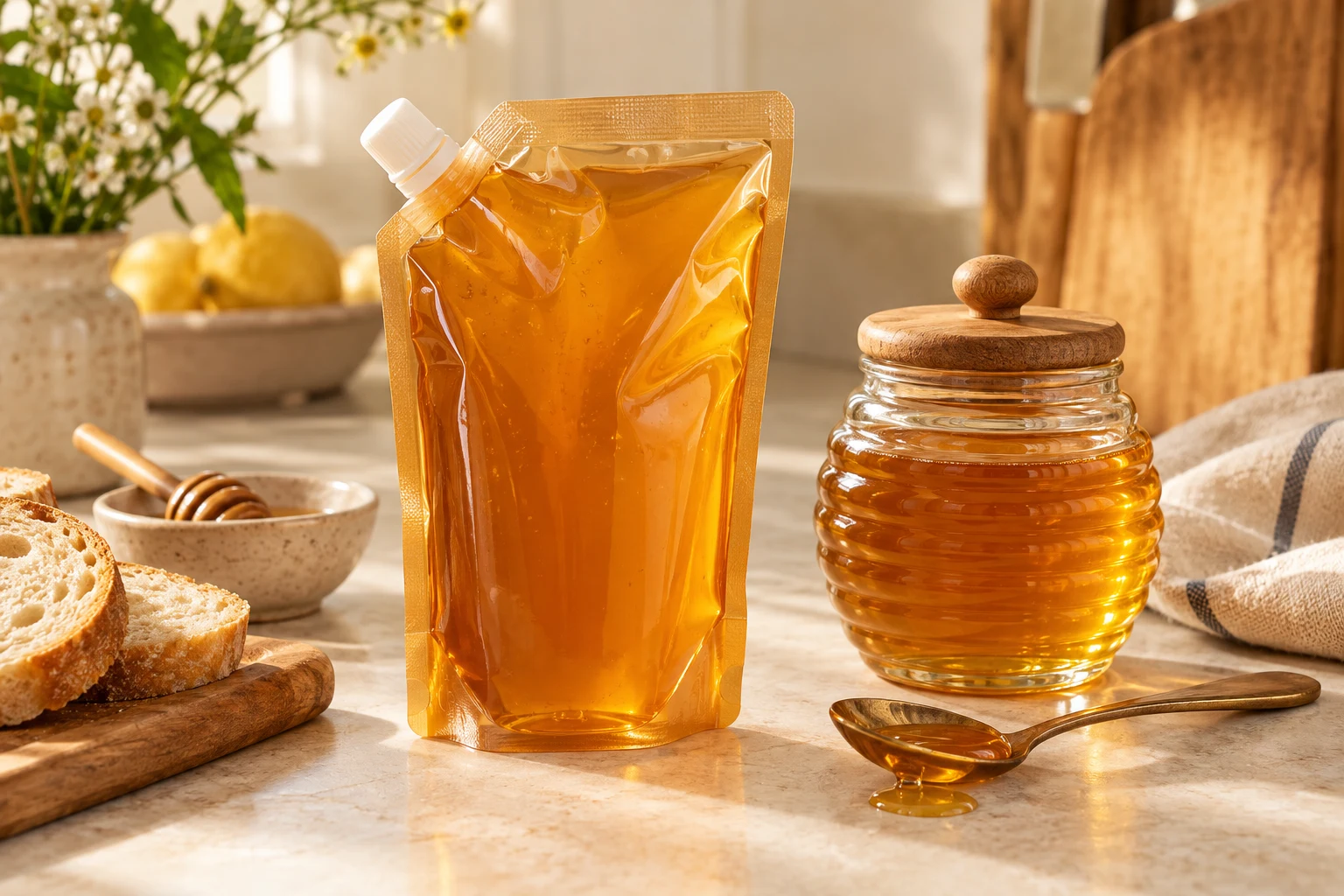
Honey can stop flowing before a package is empty. I test the product through the spout before making the format switch.
I test honey spout pouch packaging with the actual honey, intended temperatures, and partly empty packs. I compare flow, crystallized product access, residue, cap use, fitment integrity, and filling conditions against a jar before locking the material and buying specification.
I separate a convenient squeeze from long-term product access. The same package must work after storage, opening, and repeated use.
Does My Honey Still Suit a Spout After Storage?
A liquid sample can hide an access problem later. I include the expected product texture in the first package comparison.
I compare the actual honey in a spout pouch, squeeze bottle, and wide-mouth jar. I consider crystallized product access as well as liquid flow, and I avoid treating the spout as proof that the honey will stay liquid.
I ask the honey producer how the product is expected to change during storage. Ohio State Extension's honey response explains that crystallization is a natural process and is not itself an indicator of spoilage.1 I use this narrow point to separate product condition from package access. It does not establish the safety or shelf life of every honey formulation, nor does it prove that one container prevents crystals.
I then ask which experience the brand promises. A liquid honey intended for a measured drizzle is a different brief from a spreadable honey intended for a knife. A narrow spout may serve the first job at the tested condition. A wide-mouth container lets me assess access with a spoon when the product no longer pours. I compare the whole product cycle before choosing the package format.
I include the current jar as the reference
| Format | Main trial question | Limitation to investigate |
|---|---|---|
| Spout pouch | Can users control a serving at the expected product condition? | Blocked outlet, residue, and hard squeezing |
| Squeeze bottle | Does the present dispensing method remain usable? | Product stranded around the outlet or shoulders |
| Wide-mouth jar | Can the product be scooped after texture changes? | Different serving method and closure cleanup |
In a Reddit honey thread, a user described product becoming impossible to squeeze out. Another commenter preferred transferring honey to a jar for spoon access.4 I treat these as specific use experiences. I do not repeat the thread's theories that a bottle shape causes crystallization or its unverified heating and microplastics advice.
I ask for samples of the actual honey lot, not water or a decorative display fill. I record the condition before each trial. I use the spout-selection guide to discuss bore, fitment position, cap, and panel handling. I leave the final dimensions open until the product passes a dispensing comparison. The decision is conditional: if the product becomes inaccessible through the candidate outlet, I reconsider the format rather than making unsupported claims about keeping it liquid.
How Do I Test Dispensing, Residue, and Cap Use?
A strong squeeze can hide poor flow control. I measure the serving task and check the mess left around the cap.
I test starting and stopping a serving at full, middle, and nearly empty fill levels. I record product temperature, texture, grip, time, delivered mass, residue, and cap reclosure so candidate outlets can be compared fairly.
I define a serving task before handling the samples. For example, I may ask a tester to place a portion onto a spoon over a tray. The brand owner chooses the portion and acceptable range. I use the same task for each candidate outlet and the current bottle or jar. I do not invent a universal flow rate for honey because the exact product and temperature belong in the test record.
I record the honey's temperature with a suitable instrument and note the observed texture. I test at temperatures selected from the real distribution and use brief. If I use a room-temperature screening point such as 23°C, I mark it as a proposed project condition rather than an industry requirement. A successful result there does not approve a colder cupboard or a different honey lot.
I look at the last serving and the next opening
I weigh the package before and after dispensing and note how the tester holds it. I record whether the flow begins abruptly, whether it stops when pressure is released, and whether honey remains on the outer spout. I photograph the outlet before recapping. I then reopen it during the next cycle to see whether residue affects the grip or threads. This creates a comparison record without claiming a pouch automatically eliminates drips.
I repeat the procedure as the pack empties. I observe folds that trap product, the need to roll or compress panels, and whether the user can hold the cap while controlling the serving. I record remaining product separately from delivered portions. My team agrees what residue is acceptable for this product and use case. I also include a sample with the expected texture change so liquid-only testing does not hide the main access concern.
I keep the cap and primary seal questions separate. A cap that can be reopened comfortably still needs its specified closing process and fitment checks. I connect those manufacturing questions to the packaging test guide. I use the pouch-size guide only when the candidate's grip and usable fill space are part of the problem.
I do not add instructions to microwave or immerse the pouch merely because a honey source discusses warming a jar. FDA's conditions-of-use table distinguishes room-temperature storage from heated uses.2 Any proposed warming instruction requires its own review of the complete package and use conditions before it appears on the label.
What Should the Honey Pouch Purchase Brief Lock?
A pouch, spout, and cap create several interfaces. I confirm each one before treating a successful serving test as production approval.
I lock the honey identity, fill conditions, full construction, spout and cap details, and approved trial sample. I agree seal and fitment checks under named conditions, then ask for a quote tied to the confirmed specification.
I start the written brief with the honey product and process. I identify the actual formulation, intended fill temperature, storage conditions, target markets, and serving method. I ask the producer to approve the process and label instructions. I do not assume that a liquid-food pouch is suitable simply because its shape resembles an existing sauce or drink pack.
FDA's food-contact framework distinguishes food categories and use conditions.2 I request evidence for the pouch contact layer, spout, and cap under the intended use. I also retain the laminate, adhesive, and component identities in the bill of materials. If the filling process or a consumer instruction adds heat, I include that specific condition in the review. An unqualified food-grade claim is not my finished-package specification.
I separate the body seal from the fitment
ASTM's packaging standards list F88/F88M as a seal-strength method for flexible barrier materials.3 I use it where appropriate for the pouch body seals, asking the laboratory to state specimen width, support technique, conditioning, test speed, and failure mode. I do not present that measurement as a complete spout-leak test. I ask the supplier and packer to agree appropriate fitment, cap, and filled-pack checks for the actual design.
I record closing torque targets from the approved component and process evidence rather than inventing a value. I retain the cap's opening observations alongside the production closing record. I inspect the fitment joint, cap threads, and seal area after handling the filled pack in its planned carton. I also watch for contamination around interfaces during filling. These checks answer different questions from whether a tester enjoyed squeezing one sample.
- Honey identity, lot, observed texture, serving task, and storage route.
- Fill temperature, line method, handling instructions, and contact-evidence scope.
- Layer structure, nominal thickness, dimensions, fitment position, spout, and cap.
- Seal method, component-specific closing record, laboratory conditions, and acceptance criteria.
- Approved filled sample, dispensing and residue results, carton checks, and change triggers.
I organise the record with the specification-sheet guide and the food-contact document guide. I move through material assessment, representative samples, a filled-pack trial, and written confirmation before a specification-based quotation. If crystallized product access remains unresolved, I keep the jar in the comparison. I omit unsupported promises about shelf life, barrier performance, minimum quantities, delivery, certification, and price.
Conclusion
I choose packaging through evidence, filled-pack testing, and clear specifications. That process protects the product, the launch, and the customer experience.
Sources and Further Reading
Need a pouch specification?
I can review your product, size, quantity, artwork, and target market.