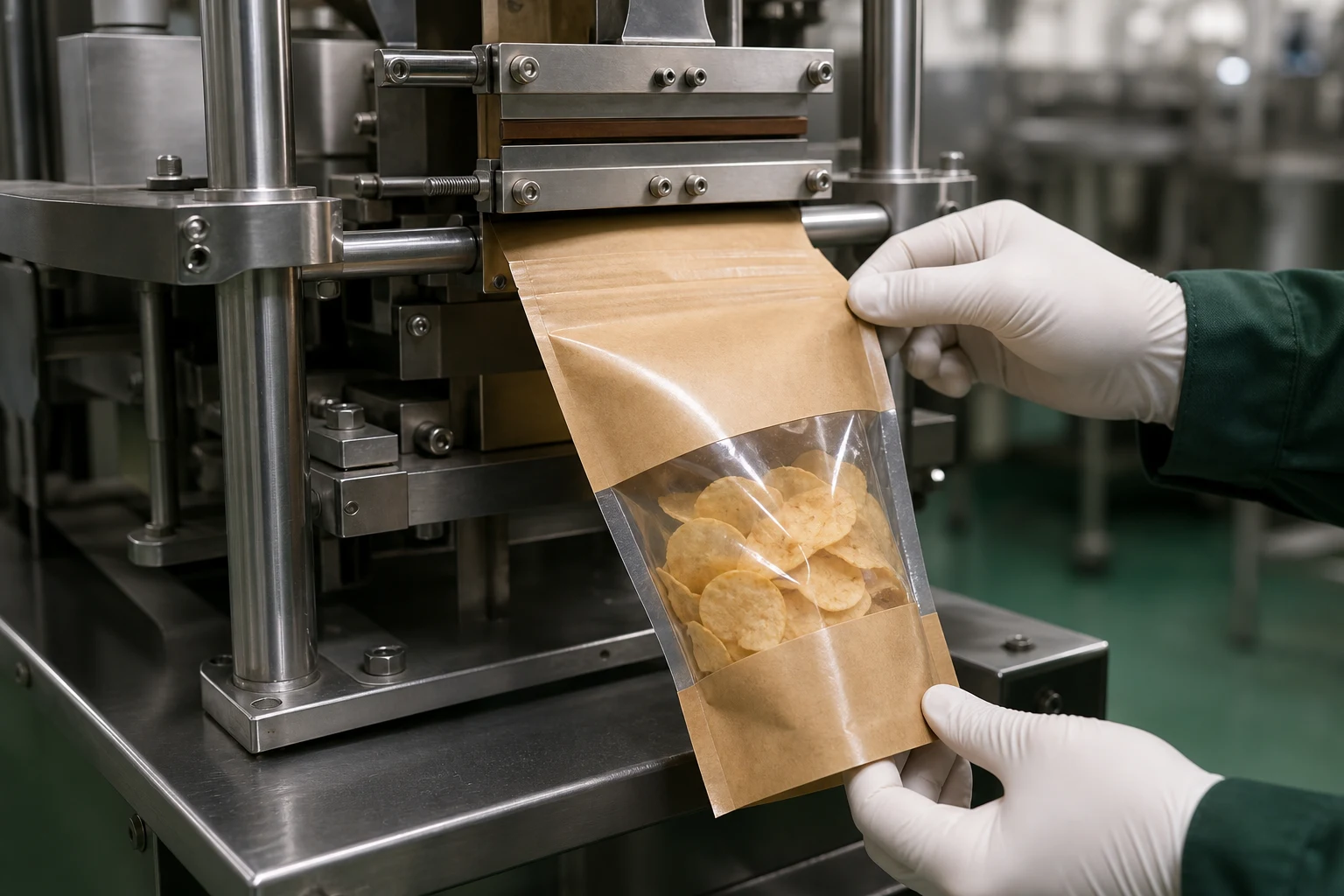
A pouch can look sealed at the jaws yet split seconds later when it is still hot, handled quickly, or stressed before the seal has cooled.
Hot tack is the resistance of a freshly made hot seal to disruption before it cools, so I test it when line handling can pull, squeeze, or move a pouch immediately after sealing.
I treat the pouch as a complete system. I confirm the product, material, filling, handling, and customer experience before I approve production.
What Does Hot Tack Measure?
A cooled seal result can hide the short interval when a new pouch is still warm and most exposed to line forces.
I use hot tack to assess the seal during the warm handling window, while ordinary seal-strength work helps assess the seal only after cooling.
I define the exact time between the sealing jaws and the first disruptive event. That could be a pull from a belt, a guide rail, a transfer, a carton load, or the pouch’s own weight. I then compare samples at the selected seal temperature, dwell, pressure, and delay. Hot tack is not a generic material score. It is a test of a specific sealing surface and a specific process window. I record the sample structure and conditions so the result remains useful when the pouch, filling speed, or product changes.
How I make this decision specific
For “What Does Hot Tack Measure?” in this what is hot tack and why does it matter on filling lines review, I define the actual product, pouch configuration, intended use, and decision owner before I ask a supplier or tester for evidence. I keep the selected structure, component details, sample condition, and any stated test method together, then compare the result with the buyer’s actual route rather than a catalogue promise. That record lets me use the seal-leak prevention guide as a decision aid and retain a specification that another team member can check.
For What Is Hot Tack and Why Does It Matter on Filling Lines, I state what is known, the condition it applies to, and what must still be checked with the actual product. I do not transfer a number, a test result, or a feature choice from another product simply because its pouch looks similar. The result of “What Does Hot Tack Measure?” should give the buyer a clear next check, the supplier a precise request, and the project owner a record of the remaining uncertainty.
For What Is Hot Tack and Why Does It Matter on Filling Lines, I request the exact pouch structure, component specification, and test conditions from the supplier. A broad material name or catalogue claim is not a production specification. The right next step is a representative filled sample, where relevant, with observations recorded before production is approved.
Which Line Conditions Change Hot Tack Risk?
A stable seal setting can become unreliable when a faster line, a fuller pouch, product residue, or a different transfer path adds force before cooling.
I review seal temperature, dwell, pressure, cooling time, web speed, pouch weight, headspace, product contamination, and every contact point after sealing.
I map the pouch path immediately after the jaws open. I watch whether guides press the seal, whether a gripper pulls the pouch, and whether a heavy fill amplifies the force. I also inspect the seal area for powder, oil, moisture, crumbs, or product fragments. Those observations do not replace a standardized test, but they tell me which conditions the production-style sample must represent. A target window should include the normal variation that an operator sees, not only a single ideal trial.
How I make this decision specific
For “Which Line Conditions Change Hot Tack Risk?” in this what is hot tack and why does it matter on filling lines review, I define the actual product, pouch configuration, intended use, and decision owner before I ask a supplier or tester for evidence. I keep the selected structure, component details, sample condition, and any stated test method together, then compare the result with the buyer’s actual route rather than a catalogue promise. That record lets me use the seal-leak prevention guide as a decision aid and retain a specification that another team member can check.
For What Is Hot Tack and Why Does It Matter on Filling Lines, I state what is known, the condition it applies to, and what must still be checked with the actual product. I do not transfer a number, a test result, or a feature choice from another product simply because its pouch looks similar. The result of “Which Line Conditions Change Hot Tack Risk?” should give the buyer a clear next check, the supplier a precise request, and the project owner a record of the remaining uncertainty.
How Do I Separate Hot Tack from Other Seal Checks?
Calling every seal test “hot tack” can confuse a warm-line failure with a cooled-pack failure, a leak-path issue, or damage later in distribution.
I use hot-tack evidence for warm disruption, cooled seal-strength evidence for finished seals, and filled-pack handling checks for the product, pouch, carton, and route together.
I write the acceptance plan in stages. First, I confirm that the pouch can form a seal at the intended settings. Next, I assess how the seal behaves during the hot interval. Then I inspect the cooled pouch after filling, cartoning, drops, compression, and opening. Each stage can reveal a different failure. If a pouch passes a bench pull but fails at a transfer point, I review the line force and cooling delay. If it passes hot handling but leaks after storage, I inspect product contact, seal geometry, and the broader structure.
How I make this decision specific
For “How Do I Separate Hot Tack from Other Seal Checks?” in this what is hot tack and why does it matter on filling lines review, I define the actual product, pouch configuration, intended use, and decision owner before I ask a supplier or tester for evidence. I keep the selected structure, component details, sample condition, and any stated test method together, then compare the result with the buyer’s actual route rather than a catalogue promise. That record lets me use the seal-leak prevention guide as a decision aid and retain a specification that another team member can check.
For What Is Hot Tack and Why Does It Matter on Filling Lines, I state what is known, the condition it applies to, and what must still be checked with the actual product. I do not transfer a number, a test result, or a feature choice from another product simply because its pouch looks similar. The result of “How Do I Separate Hot Tack from Other Seal Checks?” should give the buyer a clear next check, the supplier a precise request, and the project owner a record of the remaining uncertainty.
For What Is Hot Tack and Why Does It Matter on Filling Lines, I treat the filled pack as a separate check from the material data. I record the fill condition, seal area, opening or closure behavior, carton arrangement, handling observations, and limits of the comparison. That prevents a favourable bench result from becoming an unsupported claim about shelf life, transport, or every product route.
How Do I Set a Practical Hot Tack Validation Plan?
A one-time machine trial can miss the start-up, temperature drift, operator adjustments, and product variability that make a launch fragile.
I validate hot tack with defined line settings, filled samples, timing, observations, acceptance criteria, and repeat checks around the conditions most likely to vary.
I start with the actual pouch, product, fill weight, and line sequence. I capture the settings and sample delay, then compare a planned range rather than treating one trial as permanent proof. I inspect the seal appearance and failure mode, retain representative samples, and identify who can release a change. A revised pouch structure, sealant, product, fill height, or speed deserves a new review. This creates a practical handoff between packaging, operations, and quality rather than leaving the failure to be discovered after a full run.
How I make this decision specific
For “How Do I Set a Practical Hot Tack Validation Plan?” in this what is hot tack and why does it matter on filling lines review, I define the actual product, pouch configuration, intended use, and decision owner before I ask a supplier or tester for evidence. I keep the selected structure, component details, sample condition, and any stated test method together, then compare the result with the buyer’s actual route rather than a catalogue promise. That record lets me use the seal-leak prevention guide as a decision aid and retain a specification that another team member can check.
For What Is Hot Tack and Why Does It Matter on Filling Lines, I state what is known, the condition it applies to, and what must still be checked with the actual product. I do not transfer a number, a test result, or a feature choice from another product simply because its pouch looks similar. The result of “How Do I Set a Practical Hot Tack Validation Plan?” should give the buyer a clear next check, the supplier a precise request, and the project owner a record of the remaining uncertainty.
For What Is Hot Tack and Why Does It Matter on Filling Lines, I preserve the final decision in a written brief that names the approved sample, conditions, observations, open risks, and change triggers. I then use the flexible-packaging quality-tests guide to keep the quotation tied to the evidence rather than to a remembered sample or a generic product name.
Conclusion
I choose packaging through evidence, filled-pack testing, and clear specifications. That process protects the product, the launch, and the customer experience.
Sources and Further Reading
Need a pouch specification?
I can review your product, size, quantity, artwork, and target market.