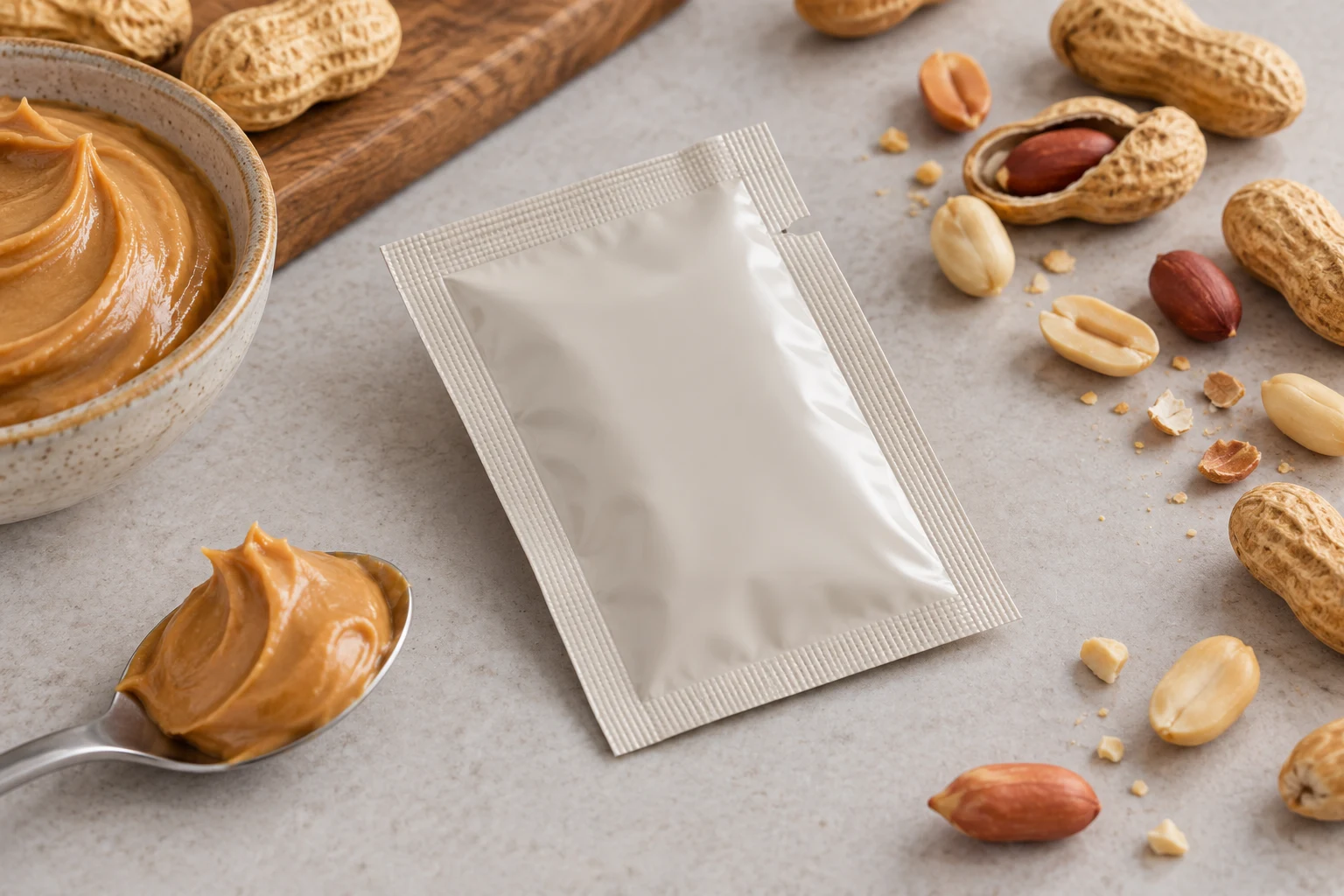
A peanut butter sachet can be portable yet frustrating to empty. I test the filled product before a neat design turns into messy hands and discarded food.
I test peanut butter sachets for filling, clean seals, controlled tearing, squeeze effort, and product left inside. I compare the actual formulation and intended serving with spout pouches or jars, then confirm food-contact scope and a written specification before ordering.
I focus on a flat, tear-open single-serving sachet. A capped pouch is a different packaging job.
When Does a Tear-Open Sachet Fit Better than a Spout Pack?
Different squeeze formats solve different serving jobs. I define the portion and use location before paying for a closure the customer may not need.
I consider a tear-open sachet for one portion, a capped spout pouch for repeated dispensing, and a jar for spoon access. I compare them with the actual peanut butter, intended use, and disposal routine.
I begin with the serving task. Will someone squeeze the product onto a cracker, stir it into a meal, or eat it directly? Is the pack used at a kitchen table, during cycling, or inside a lunch kit? I do not combine these situations into a general claim about convenience. I ask which job the proposed pack must perform and what the user will do with it after opening.
A manufacturer example helps establish that squeeze packs are a real commercial format. JUSTIN'S discusses its nut butters in jars and squeeze packs, including differences in thickening and oil separation behavior.1 I use that as evidence of format and formulation questions. I do not copy its product shelf life, ingredients, or handling instructions into a new private-label project.
I compare the closure with the serving job
| Format | Useful scenario | Decision to validate |
|---|---|---|
| Flat tear-open sachet | One portion without a cap | Tear direction and complete dispensing |
| Capped spout pouch | Several dispensing occasions | Flow, cap handling, and post-opening instructions |
| Wide-mouth jar | Repeated spoon access | Access, portioning, and transport plan |
In a Reddit r/CampingGear discussion, users recognized existing peanut butter squeeze packs, while one reusable-tube user described filling and cleaning as inconvenient for a short trip.5 That is a concrete handling trade-off. It is not a representative survey or proof that one option is best. I translate the comment into a trial: compare ready-filled access, refill work, cleanup, and what remains to carry home.
I keep refillable use outside a disposable sachet specification. Repeated cleaning, repeated filling, and one-time commercial filling have different requirements. I also avoid making a biodegradability claim merely because campers ask for it. Any disposal statement needs evidence for the actual construction and destination market.
For a repeated-use product, I review the spout pouch selection guide before choosing a fitment. For a single serving, I start with a simple sachet sample. I confirm fill weight, usable internal volume, seal margins, and tear position with the packer. A small pack that looks efficient on a drawing can still be difficult to fill or squeeze in practice.
How Do I Test Squeezing, Tearing, and Product Residue?
A sachet that opens badly can spread oil before the customer reaches the food. I test handling with real peanut butter instead of an empty film sample.
I fill candidate sachets with the actual formulation, condition them for the intended route, and compare opening effort, squeeze control, leaks, and residue. I keep tear-off pieces with the pack during the use trial.
I ask the product developer to identify the formulation, particle size, and normal filling condition. Smooth and crunchy products need separate trials. I do not assume a sample filled with another spread predicts the behavior of this peanut butter. If mixing or kneading is proposed, the brand must approve those instructions for its formulation. I observe the pack during that step rather than casually telling users to squeeze harder.
I condition filled samples at the storage and use temperatures defined by the product team. I label each condition and the time spent there. I compare them with an unhandled reference. I do not invent a temperature range as a universal consumer requirement. A cool outdoor use case and a warm lunch kit may lead to different trial questions, so the route and intended customer determine the plan.
I measure what the user can actually do
I ask testers to open the pack using the proposed notch. I record whether the tear stays controlled, whether it creates a useful opening, and whether the small corner becomes detached. I keep the corner on the tray and include disposal handling in the task. I then observe whether the user can guide the spread onto food without reaching for scissors or wiping peanut butter from the outer seal.
I weigh the filled pack before opening and the remaining pack after the serving task. That gives a consistent way to compare residue among candidates at the same fill weight. I record squeeze effort and where the product remains, including corners and seal margins. I treat these as trial measurements. They are not an extraction percentage or performance claim until the actual project has repeatable evidence.
I examine the seals after handling and transport simulation. Product in the top seal, an uncontrolled tear toward the side seam, or leakage during kneading each requires a different correction. I review the laminate through the oily-food packaging guide and keep seal-zone cleanliness in the filling plan. A thicker-looking pouch is not a substitute for that evidence.
I also distinguish usability from product stability. A sachet may be easy to empty while its storage study is unfinished. Conversely, a product can remain within the food specialist's criteria while its tear behavior is poor. I approve those questions separately. The sample approval checklist helps preserve the selected geometry, opening position, and retained reference when artwork moves toward production.
Which Sachet Specification Should I Confirm Before Ordering?
A fast quote may describe a generic laminate rather than the sachet tested with your spread. I lock the contact scope and trial record before buying.
I confirm construction, dimensions, fill process, contact conditions, seal settings, opening design, and acceptance limits. I request the relevant barrier and seal reports, then quote the approved filled-pack specification and quantity per design.
I send the supplier a product brief before asking for commercial terms. It includes the formulation identity, smooth or crunchy texture, target serving, fill weight, filling temperature, storage route, and intended use. I state whether the customer will consume one portion or retain an opened pack. A tear-open sachet should not silently inherit repeated-use instructions from a capped pouch.
I ask the responsible supplier to confirm food-contact evidence for the proposed inner layer and complete construction. FDA lists food categories and contact conditions, including distinctions relevant to fatty foods and temperature.2 I do not accept a dry-powder reference as confirmation for peanut butter. I also do not claim that a packaging material approves the food manufacturing process. The product team owns that separate validation.
For seal strength, I request a defined comparison using ASTM F88 where suitable.4 I want specimen width, conditioning, test speed, support technique, and failure mode in the report. I record the filling-line temperature, pressure, dwell time, and speed alongside it. I agree project limits before the trial rather than choosing a force value after seeing the results.
I connect material evidence to the filled pack
If the product assessment calls for water vapor data, I request ASTM F1249 results with temperature, humidity, units, and laminate thickness.3 Oxygen transmission needs its own named method and conditions. Neither report replaces a filled-product storage study or seal integrity checks. I use the barrier material guide to organize candidate comparisons, without assigning a universal shelf-life target.
- Peanut butter identity, texture, fill weight, and contact conditions.
- Complete layer structure, thickness, pack dimensions, and seal margins.
- Tear notch location, opening target, and artwork safe areas.
- Relevant barrier methods, temperature, humidity, units, and limits.
- Seal process settings, sampling, and recorded failure modes.
- Dispensing trial, residual product, transport checks, and retained samples.
I then confirm the approved fields in the written pouch specification. I attach the filled sample record and identify any unfinished product testing. A construction change, new notch position, or altered seal margin needs an explicit review. I do not treat a visually similar sachet as automatically equivalent to the trial pack.
Finally, I request a quote against the approved peanut butter sachet specification. I provide quantity per artwork, destination, and packer requirements. The supplier states MOQ, timing, and price for that actual project. Until those terms and supporting evidence exist, I keep such numbers out of the article and avoid presenting a concept sample as a proven commercial result.
Conclusion
I choose packaging through evidence, filled-pack testing, and clear specifications. That process protects the product, the launch, and the customer experience.
Sources and Further Reading
- JUSTIN'S — manufacturer questions about nut butter jars and squeeze packs.
- FDA — food types and conditions of use for food-contact substances.
- ASTM F1249-25 — water vapor transmission through film and sheeting.
- ASTM F88/F88M-23 — seal strength of flexible barrier materials.
- Reddit r/CampingGear — users compare squeeze packs and reusable tubes.
Need a pouch specification?
I can review your product, size, quantity, artwork, and target market.