A packaging format can look economical until powder reaches the zipper, moisture causes caking, a seal leaks in transit, or customers cannot close the pack after the first scoop.
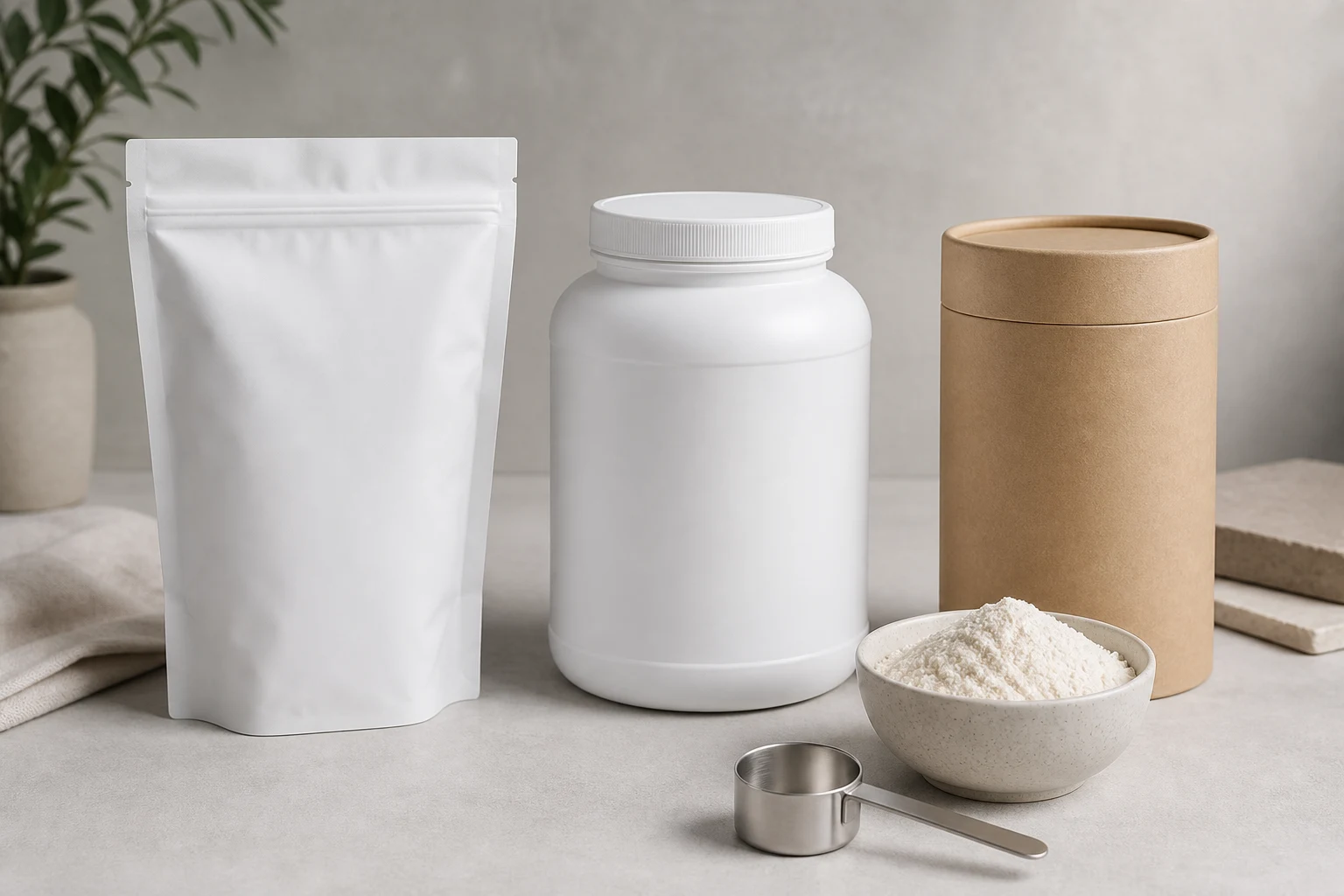
I choose between a pouch, tub, and canister by the powder’s moisture sensitivity, fill weight, customer use, filling line, shipping route, tamper-evidence plan, and filled-pack tests.
I treat the pouch as a complete system. I confirm the product, material, filling, handling, and customer experience before I approve production.
What Risks Does Protein Powder Packaging Need to Control?
A format decision is weak when it starts with a container shape rather than the powder’s moisture response, fill level, shelf target, use pattern, and shipping conditions.
I begin with the product’s failure modes: moisture uptake, caking, oxidation where relevant, dust contamination of the seal, leakage, tamper concerns, and the customer’s repeated opening routine.
I ask the food team for the powder type, moisture or water-activity target where available, particle behaviour, fat content where relevant, target shelf life, fill weight, and the expected storage route. Milk-powder research describes moisture-proof structures used to limit water-vapour transmission and explains why unwanted moisture can affect quality and shelf life.3 That does not select a package by itself. I still test the actual formulation, because a flavoured blend, whey powder, plant protein, and a protein-plus-creatine product may handle differently. I also plan how customers will scoop, close, store, and travel with the pack.
How I make this decision specific
For “What Risks Does Protein Powder Packaging Need to Control?” in this which protein powder packaging format is best: pouch, tub, or canister review, I define the actual product, pouch configuration, intended use, and decision owner before I ask a supplier or tester for evidence. I keep the selected structure, component details, sample condition, and any stated test method together, then compare the result with the buyer’s actual route rather than a catalogue promise. That record lets me use the food packaging barrier-film guide as a decision aid and retain a specification that another team member can check.
For Which Protein Powder Packaging Format Is Best: Pouch, Tub, or Canister, I state what is known, the condition it applies to, and what must still be checked with the actual product. I do not transfer a number, a test result, or a feature choice from another product simply because its pouch looks similar. The result of “What Risks Does Protein Powder Packaging Need to Control?” should give the buyer a clear next check, the supplier a precise request, and the project owner a record of the remaining uncertainty.
For Which Protein Powder Packaging Format Is Best: Pouch, Tub, or Canister, I request the exact pouch structure, component specification, and test conditions from the supplier. A broad material name or catalogue claim is not a production specification. The right next step is a representative filled sample, where relevant, with observations recorded before production is approved.
When Is a Pouch, Tub, or Canister the Better Format?
A single “best” format does not exist when a small direct-to-consumer trial, a warehouse club pack, and a premium retail launch have different fill, shelf, and logistics needs.
I select the format that meets the product and route: pouches can reduce empty-space volume, tubs can offer familiar access, and canisters can support a different shelf presence, but each needs validation.
I compare formats in a decision table with the same inputs: filled weight, headspace, barrier requirement, closure usability, tamper-evidence method, carton efficiency, drop and compression exposure, merchandising plan, and target cost. I do not promise that a pouch is lower impact, a tub is safer, or a canister is more premium without evidence for that program. The point is a controlled trade-off. For a flexible pouch, I confirm that the zipper stays clear of powder and that the top seal has enough room. For a tub or canister, I confirm the liner, lid, seal, and tamper system with the actual filling process.
How I make this decision specific
For “When Is a Pouch, Tub, or Canister the Better Format?” in this which protein powder packaging format is best: pouch, tub, or canister review, I define the actual product, pouch configuration, intended use, and decision owner before I ask a supplier or tester for evidence. I keep the selected structure, component details, sample condition, and any stated test method together, then compare the result with the buyer’s actual route rather than a catalogue promise. That record lets me use the food packaging barrier-film guide as a decision aid and retain a specification that another team member can check.
For Which Protein Powder Packaging Format Is Best: Pouch, Tub, or Canister, I state what is known, the condition it applies to, and what must still be checked with the actual product. I do not transfer a number, a test result, or a feature choice from another product simply because its pouch looks similar. The result of “When Is a Pouch, Tub, or Canister the Better Format?” should give the buyer a clear next check, the supplier a precise request, and the project owner a record of the remaining uncertainty.
How Do I Test a Resealable Powder Pouch?
An empty zipper can feel smooth, then become difficult when powder dust, a full fill line, a top seal, and repeated customer use meet the real pack.
I test resealable pouches with the actual powder at the intended fill, checking first opening, zipper alignment, powder clearance, reclosure, leakage, transport, and ordinary user handling.
I make filled samples at the planned weight and ask people who did not design the pack to open, scoop, close, reopen, and store it. I record the hesitation points and whether powder enters the zipper tracks. In the cited community thread, customers reported difficulty resealing a protein bag when powder interfered with the closure.2 I treat that as a usability prompt. I do not use it to declare that any particular zipper is defective. I also check the seal geometry, because a zipper is not a substitute for a dependable primary top seal.
How I make this decision specific
For “How Do I Test a Resealable Powder Pouch?” in this which protein powder packaging format is best: pouch, tub, or canister review, I define the actual product, pouch configuration, intended use, and decision owner before I ask a supplier or tester for evidence. I keep the selected structure, component details, sample condition, and any stated test method together, then compare the result with the buyer’s actual route rather than a catalogue promise. That record lets me use the food packaging barrier-film guide as a decision aid and retain a specification that another team member can check.
For Which Protein Powder Packaging Format Is Best: Pouch, Tub, or Canister, I state what is known, the condition it applies to, and what must still be checked with the actual product. I do not transfer a number, a test result, or a feature choice from another product simply because its pouch looks similar. The result of “How Do I Test a Resealable Powder Pouch?” should give the buyer a clear next check, the supplier a precise request, and the project owner a record of the remaining uncertainty.
For Which Protein Powder Packaging Format Is Best: Pouch, Tub, or Canister, I treat the filled pack as a separate check from the material data. I record the fill condition, seal area, opening or closure behavior, carton arrangement, handling observations, and limits of the comparison. That prevents a favourable bench result from becoming an unsupported claim about shelf life, transport, or every product route.
What Should I Validate Before Protein Powder Production?
A finished pack can appear ready on a desk yet fail after filling, closing, cartoning, transport, first opening, and a customer’s repeated use at home.
Before production, I validate the complete filled configuration: food-contact scope, material and closure specification, seal integrity, tamper evidence, carton fit, handling, and the customer opening experience.
I retain the approved sample, pouch or container drawing, material record, closure and tamper specification, fill weight, carton arrangement, and acceptance criteria. ASTM D3078 describes a bubble-emission method for determining gross leaks in flexible packages with a headspace gas, while noting that test sensitivity and applicability depend on the product and parameters.4 I choose a method that matches the actual risk and do not claim a test proves more than it does. A change in formula, powder density, material, zipper, liner, lid, supplier, or route starts another focused review.
How I make this decision specific
For “What Should I Validate Before Protein Powder Production?” in this which protein powder packaging format is best: pouch, tub, or canister review, I define the actual product, pouch configuration, intended use, and decision owner before I ask a supplier or tester for evidence. I keep the selected structure, component details, sample condition, and any stated test method together, then compare the result with the buyer’s actual route rather than a catalogue promise. That record lets me use the food packaging barrier-film guide as a decision aid and retain a specification that another team member can check.
For Which Protein Powder Packaging Format Is Best: Pouch, Tub, or Canister, I state what is known, the condition it applies to, and what must still be checked with the actual product. I do not transfer a number, a test result, or a feature choice from another product simply because its pouch looks similar. The result of “What Should I Validate Before Protein Powder Production?” should give the buyer a clear next check, the supplier a precise request, and the project owner a record of the remaining uncertainty.
For Which Protein Powder Packaging Format Is Best: Pouch, Tub, or Canister, I preserve the final decision in a written brief that names the approved sample, conditions, observations, open risks, and change triggers. I then use the flexible packaging seal-leak guide to keep the quotation tied to the evidence rather than to a remembered sample or a generic product name.
Conclusion
I choose packaging through evidence, filled-pack testing, and clear specifications. That process protects the product, the launch, and the customer experience.
Sources and Further Reading
- PMC, moisture content in milk powder and moisture-proof packaging materials.
- Reddit r/Supplements, protein-powder bag closure community discussion.
- PMC, milk-powder moisture protection and packaging materials.
- ASTM D3078, gross-leak testing by bubble emission.
- FDA, food-contact substance conditions of use.
- Unique Packaging barrier-film guide.
- Unique Packaging seal-leak guide.
Need a pouch specification?
I can review your product, size, quantity, artwork, and target market.