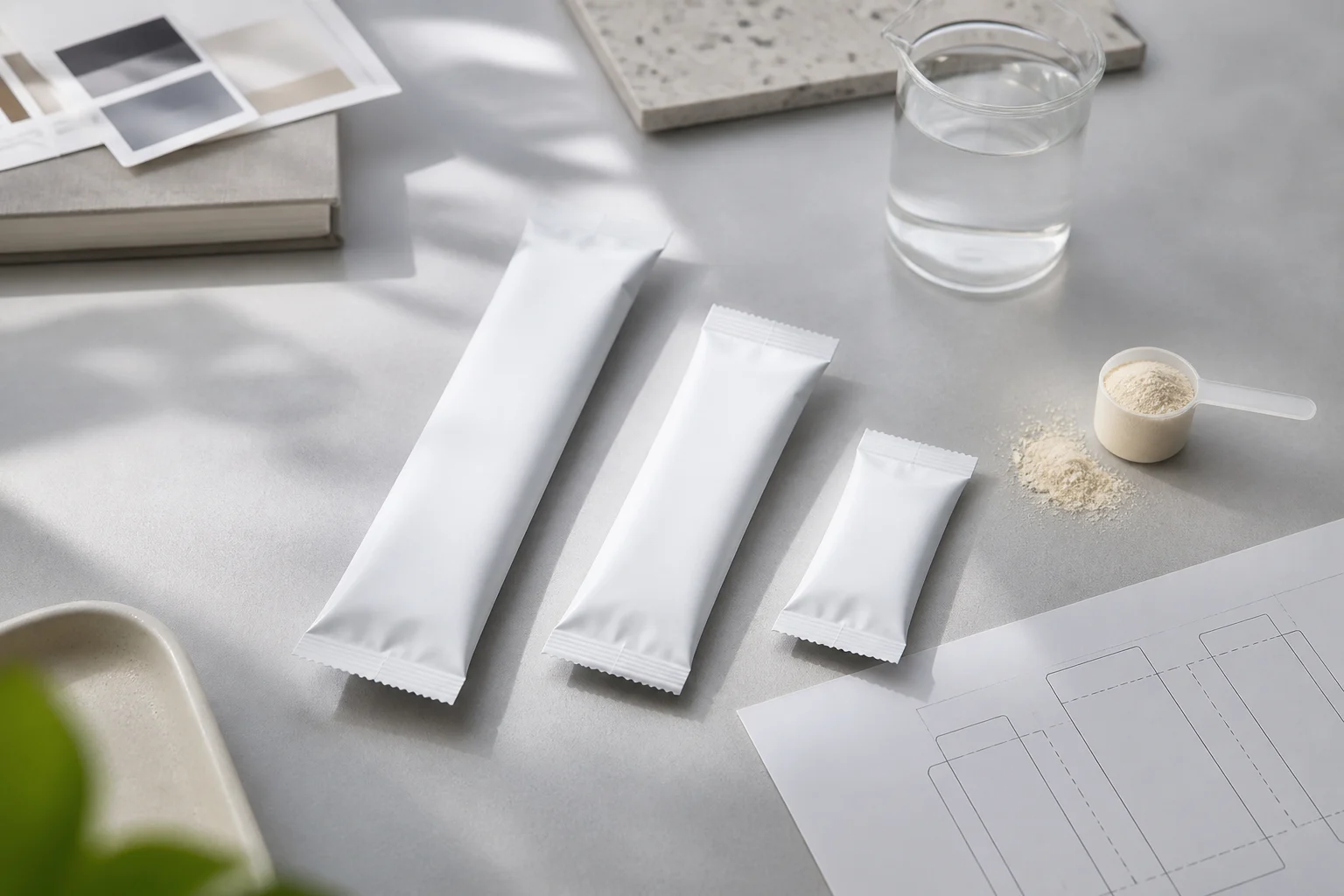
A sachet can be technically big enough yet look underfilled, seal poorly, waste carton space, or frustrate users when its real powder volume and headspace were never tested.
I size a powder sachet from actual powder fill volume and handling behavior, then validate usable headspace, seal margins, tear access, labeling, carton fit, and opening with representative filled packs.
I treat the pouch as a complete system. I confirm the product, material, filling, handling, and customer experience before I approve production.
Which Inputs Matter Before I Choose Sachet Dimensions?
Selecting a sachet from a competitor photo or a nominal serving weight can produce the wrong width, height, seal allowance, headspace, and carton layout.
I begin with the actual powder, target serving, bulk-density range, fill method, desired opening, required label area, market, carton count, and machine constraints before I request a first sachet size.
Serving weight is one input, not the finished volume. Two powders at the same declared weight can occupy different volumes because of density, aeration, particle shape, blend consistency, and settling. I ask for real product or a representative product and calculate a first trial from its observed fill behavior. I also map zones that do not hold product: side seals, top seal, bottom seal, tear notch, code area, and any safety margin required by the selected line. FDA’s net-quantity rule concerns how food amount is declared on the label; it does not supply a pouch dimension.1 I use the dieline guide to keep graphics and information out of functional seal zones, then request an unprinted sample.
How I make this decision specific
For “Which Inputs Matter Before I Choose Sachet Dimensions?” in this how do i size a single-serve sachet for powder fill volume and headspace review, I define the actual product, pouch configuration, intended use, and decision owner before I ask a supplier or tester for evidence. I keep the selected structure, component details, sample condition, and any stated test method together, then compare the result with the buyer’s actual route rather than a catalogue promise. That record lets me use the pouch-size guide as a decision aid and retain a specification that another team member can check.
For How Do I Size a Single-Serve Sachet for Powder Fill Volume and Headspace, I state what is known, the condition it applies to, and what must still be checked with the actual product. I do not transfer a number, a test result, or a feature choice from another product simply because its pouch looks similar. The result of “Which Inputs Matter Before I Choose Sachet Dimensions?” should give the buyer a clear next check, the supplier a precise request, and the project owner a record of the remaining uncertainty.
For How Do I Size a Single-Serve Sachet for Powder Fill Volume and Headspace, I request the exact pouch structure, component specification, and test conditions from the supplier. A broad material name or catalogue claim is not a production specification. The right next step is a representative filled sample, where relevant, with observations recorded before production is approved.
How Much Headspace and Seal Margin Does the Sachet Need?
A pouch filled too close to its top may contaminate a seal, distort the pack, and make the remaining panel or tear path difficult to use.
I establish headspace and seal allowance by filling representative sachets with actual powder, observing settling and seal-area cleanliness, and confirming selected-line requirements for that configuration.
I do not prescribe one headspace percentage or seal margin. The correct space depends on powder, pouch width, fill nozzle, product flow, packaging machine, target presentation, and opening feature. I test the proposed sachet at target fill, let powder settle as it would in process, then inspect whether the top area remains clean enough for the agreed seal. I also check whether a customer can grasp and tear the pack without losing powder. The related powder-seal contamination guide explains why fill and seal zones must be planned together. I treat a successful empty sample as only a geometry check; the filled, sealed, handled sample is the decision evidence.
How I make this decision specific
For “How Much Headspace and Seal Margin Does the Sachet Need?” in this how do i size a single-serve sachet for powder fill volume and headspace review, I define the actual product, pouch configuration, intended use, and decision owner before I ask a supplier or tester for evidence. I keep the selected structure, component details, sample condition, and any stated test method together, then compare the result with the buyer’s actual route rather than a catalogue promise. That record gives the buyer a decision aid and a specification that another team member can check.
For How Do I Size a Single-Serve Sachet for Powder Fill Volume and Headspace, I state what is known, the condition it applies to, and what must still be checked with the actual product. I do not transfer a number, a test result, or a feature choice from another product simply because its pouch looks similar. The result of “How Much Headspace and Seal Margin Does the Sachet Need?” should give the buyer a clear next check, the supplier a precise request, and the project owner a record of the remaining uncertainty.
How Do I Check Carton Fit and Customer Use?
A sachet dimension can fit the filler but still create a poor carton count, awkward dispensing, excess air space, or an opening experience customers dislike.
I pack representative filled sachets into the intended carton or trial divider, then evaluate count, orientation, dispensing, tear access, panel readability, and handling before I freeze the format.
I review the complete selling unit. I arrange filled sachets in the planned count and orientation, inspect whether the carton protects edges, and check what happens when a customer removes one pack at a time. I look for wasted volume, bulging, compression, sachets that twist or slide, and a narrow pack that is difficult to grip. The Reddit discussion is useful buyer context because the founder was planning a 30-count carton and had a narrow pack concept.2 It does not make that geometry right for another product. I compare the result with a representative sample and preserve observations in the specification record before requesting a commercial quotation.
How I make this decision specific
For “How Do I Check Carton Fit and Customer Use?” in this how do i size a single-serve sachet for powder fill volume and headspace review, I define the actual product, pouch configuration, intended use, and decision owner before I ask a supplier or tester for evidence. I keep the selected structure, component details, sample condition, and any stated test method together, then compare the result with the buyer’s actual route rather than a catalogue promise. That record gives the buyer a decision aid and a specification that another team member can check.
For How Do I Size a Single-Serve Sachet for Powder Fill Volume and Headspace, I state what is known, the condition it applies to, and what must still be checked with the actual product. I do not transfer a number, a test result, or a feature choice from another product simply because its pouch looks similar. The result of “How Do I Check Carton Fit and Customer Use?” should give the buyer a clear next check, the supplier a precise request, and the project owner a record of the remaining uncertainty.
For How Do I Size a Single-Serve Sachet for Powder Fill Volume and Headspace, I treat the filled pack as a separate check from the material data. I record the fill condition, seal area, opening or closure behavior, carton arrangement, handling observations, and limits of the comparison. That prevents a favourable bench result from becoming an unsupported claim about shelf life, transport, or every product route.
What Should I Confirm Before the Final Quote?
A supplier quote can look comparable while silently assuming a different fill profile, material structure, seal width, artwork panel, carton count, or test scope.
I confirm the approved filled sample, finished dimensions, fill condition, headspace, seal zones, tear feature, material proposal, label panel, carton arrangement, test scope, and change-control triggers before I request the final quote.
I finish with a clear written brief. It names the powder and market, target serving and observed fill condition, pouch width and height, seal and tear features, label and code zones, material proposal, food-contact documentation request, carton count, delivery route, sample evidence, and inspection record. ASTM F88/F88M can support a defined seal-strength comparison where needed, but sample condition and acceptance criteria belong in the project record.3 I then use the specification-sheet guide to keep material evaluation, representative sample or filled-pack trial, written confirmation, and a specification-based quote connected. I do not claim a universal pouch size, shelf life, MOQ, or line speed from a generic sachet layout.
How I make this decision specific
| Decision field | What I verify | Why it belongs in the quote brief |
|---|---|---|
| Actual powder and serving | Volume, flow, settling, and label basis. | Sets an evidence-led starting size. |
| Headspace and seals | Clean seal area and usable opening. | Connects size to filling reality. |
| Carton arrangement | Count, orientation, and access. | Prevents a unit-only decision. |
| Approved sample and record | Construction, conditions, observations. | Lets suppliers quote the same project. |
For “What Should I Confirm Before the Final Quote?” in this how do i size a single-serve sachet for powder fill volume and headspace review, I define the actual product, pouch configuration, intended use, and decision owner before I ask a supplier or tester for evidence. I keep the selected structure, component details, sample condition, and any stated test method together, then compare the result with the buyer’s actual route rather than a catalogue promise. That record gives the buyer a decision aid and a specification that another team member can check.
For How Do I Size a Single-Serve Sachet for Powder Fill Volume and Headspace, I state what is known, the condition it applies to, and what must still be checked with the actual product. I do not transfer a number, a test result, or a feature choice from another product simply because its pouch looks similar. The result of “What Should I Confirm Before the Final Quote?” should give the buyer a clear next check, the supplier a precise request, and the project owner a record of the remaining uncertainty.
For How Do I Size a Single-Serve Sachet for Powder Fill Volume and Headspace, I preserve the final decision in a written brief that names the approved sample, conditions, observations, open risks, and change triggers. I then use the packaging specification-sheet guide to keep the quotation tied to the evidence rather than to a remembered sample or a generic product name.
Conclusion
I choose packaging through evidence, filled-pack testing, and clear specifications. That process protects the product, the launch, and the customer experience.
Sources and Further Reading
- Electronic Code of Federal Regulations, 21 CFR 101.105 food-label net quantity of contents.
- Reddit r/smallbusiness, low-MOQ electrolyte sachet community discussion.
- ASTM F88/F88M, Seal Strength of Flexible Barrier Materials.
- FDA, Food Packaging and Other Substances that Come in Contact with Food.
- Unique Packaging pouch-size guide.
- Unique Packaging packaging specification-sheet guide.
Need a pouch specification?
I can review your product, size, quantity, artwork, and target market.