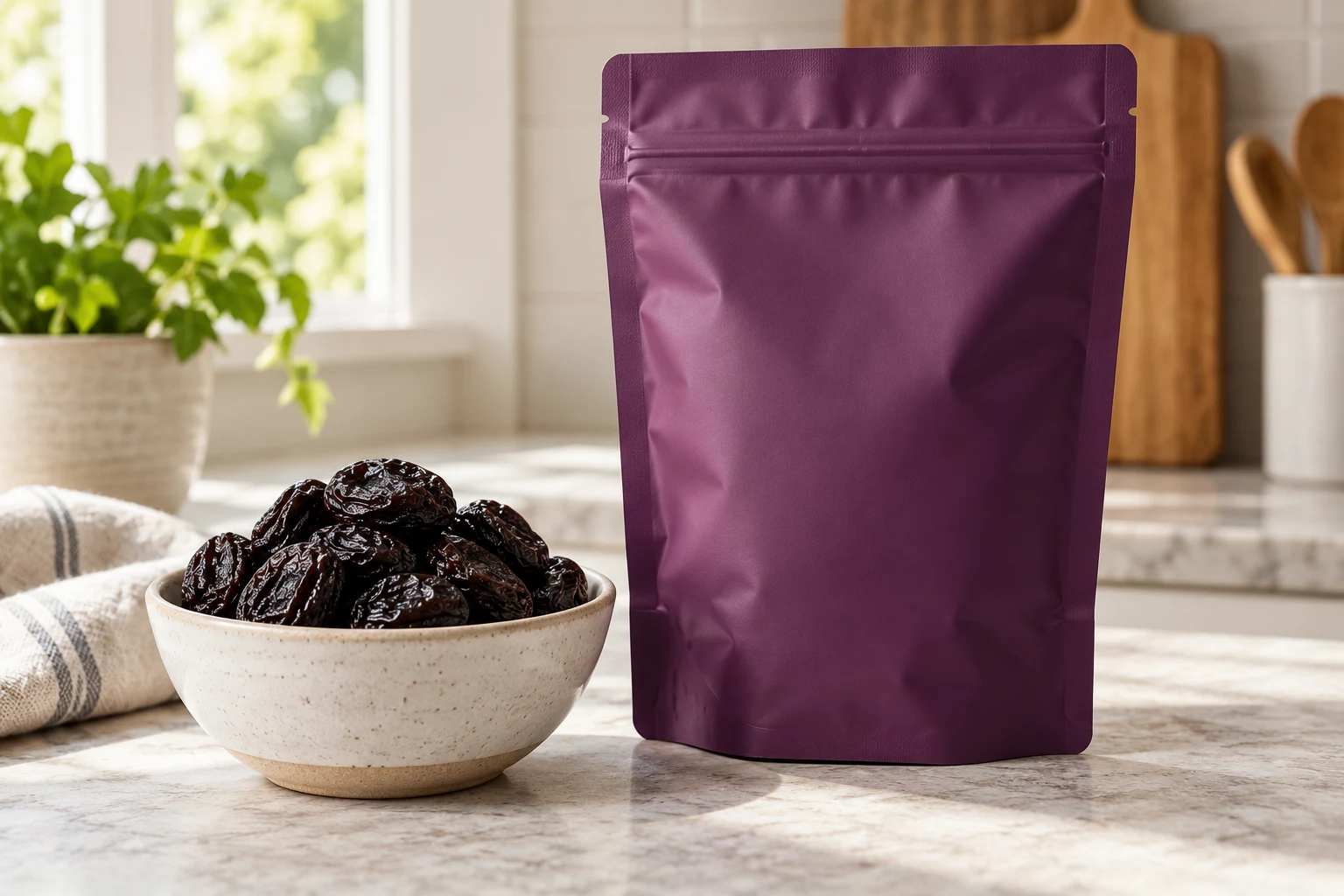
A prune pouch can look secure while customers struggle to close it, store the remainder, or understand the opening instructions.
I choose resealable pouches for prunes by defining the packed fruit condition, testing access and zipper closure, and checking protection with filled samples. I keep after-opening instructions specific to the product.
At Unique Packaging, I separate the fruit processor’s requirements from the converter’s pouch checks, then bring them together in one approval record.
Why Must I Define the Packed Prune First?
A dried-fruit label does not tell the converter the fruit condition at the moment it enters the pouch.
I document whole or pitted fruit, processing state, fill conditions, and intended storage. The food team defines product acceptance; I use that brief to compare pouch candidates.
I do not borrow a specification from crisp dried snacks. The California Prune Board describes prunes being held before final processing, then rehydrated, sterilized, inspected, and packed to order.1 That account is specific to the process described by the board. It is enough to show why I need the actual packed condition from this supplier. It does not establish the process, moisture level, or safety status of every prune product in the market.
My brief identifies whether the product is whole, pitted, diced, or another form, and records the processor’s approved description. A pouch intended for a retail bag of whole fruit is not automatically appropriate for puree or juice. I ask the food team which processing and filling conditions the packaging must tolerate. I also ask for its quality endpoints and storage instructions. The converter should not create those answers from a photograph of a competitor’s bag.
How I compare practical options
| Option | Potential reason to trial it | What still needs proof |
|---|---|---|
| Small pouch emptied in one use | A defined single-use task | Fill fit and complete initial seal |
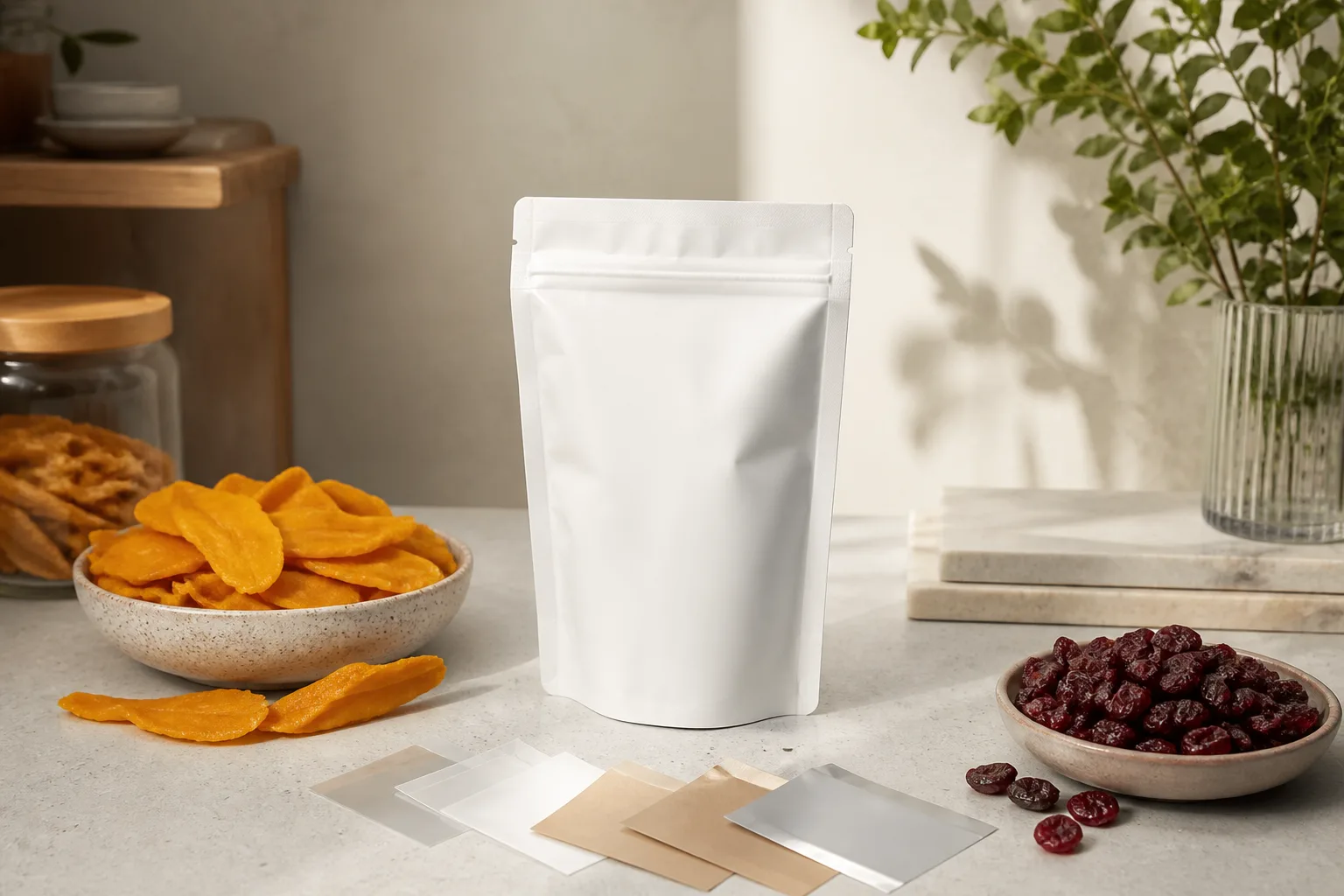
| Resealable family pouch | Repeated access to whole or pitted fruit | Closing task and remainder storage |
| Windowed resealable pouch | Showing the actual fruit | Window construction and storage comparison |
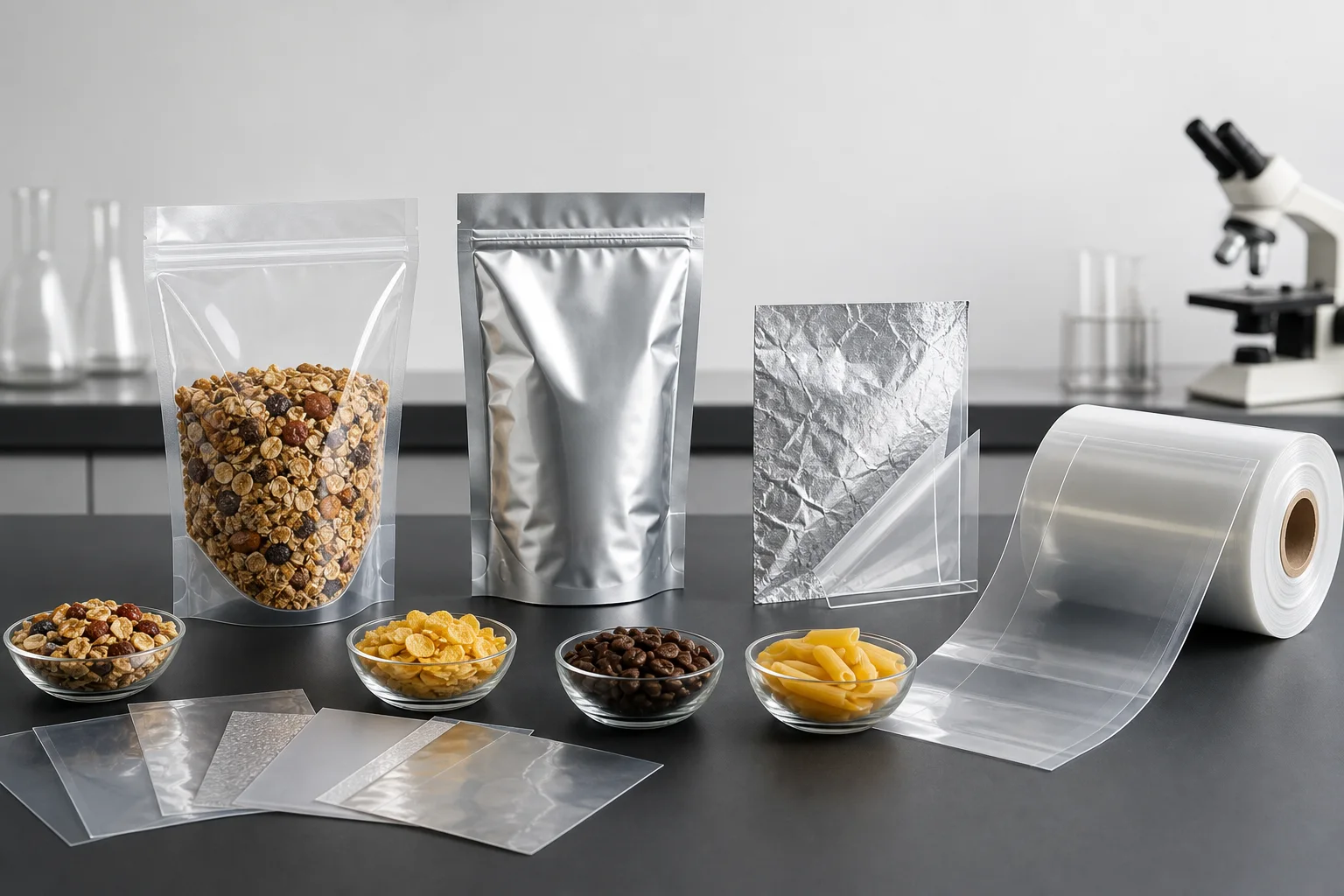
The table sets up a trial, not a rule that larger packs are better or that a window harms every prune. I compare the film constructions through the barrier-film assessment guide. For a water vapor report, I retain the specimen identity, thickness, test temperature, humidity conditions, units, and method. ASTM F1249 covers water vapor transmission through flexible barrier materials.5 The result helps describe the film; a filled pouch remains a separate test object.
I ask the processor to define the starting fruit condition and use a traceable lot across the comparison. If a sample changes in texture, I need to know whether the starting fruit, closure history, or storage environment differed before blaming the film. The dried-fruit packaging guide supplies the broader moisture and texture context. This prune-specific brief then focuses the work on soft fruit access and storage of the remainder. I keep process safety and sensory acceptance under the food team’s control rather than treating package appearance as proof.
How Do I Test Access and Reclosing After Opening?
A zipper is useful only if customers can find it, clear the opening, and close the filled pouch reliably.
I compare tear clearance, fruit access, closure engagement, and repeated use with the actual fill. I record handling problems without turning a convenience trial into a shelf-life claim.
I begin with a customer question rather than a closure catalogue. In an October 2023 r/Cooking discussion, a shopper with a large Costco bag asked how to keep the prunes fresh. A commenter suggested a thicker resealable bag, and the shopper replied that this answered the question.4 I treat this as one observed storage concern. I do not adopt the thread’s food-storage advice as scientific evidence or infer a universal preference for a particular zipper.
For the trial, I mark the intended tear path and have a participant open a filled pouch as supplied. I record whether the tear leaves enough material above the zipper to grip. I watch whether the pouch opens widely enough to remove fruit without dragging it along the closure. If the trial uses a utensil, I record it. I keep the sample fill consistent, because a loosely filled display sample can conceal a crowded mouth in the final retail pack.
What I record at each use
I ask the participant to remove the agreed amount, move any visible fruit away from the tracks using the approved handling method, and close the pack. I observe grip effort, missed sections, trapped residue, and whether the participant believes the pack is fully closed. I then inspect the closure separately. That distinction matters: confidence and verified engagement are different observations. I avoid describing a zipper as airtight without evidence for the complete closure under the proposed conditions.
I repeat the sequence under a written plan that matches the intended use. I record the number of openings, time between them, sample orientation, fruit lot, and storage conditions. If a sample becomes hard to close only near the end, I retain it and photograph the failure location. I check the remaining fruit distribution and folded panels before asking for another zipper profile. A different closure alone may not solve an opening that is too narrow.
The pouch-size guide helps me connect mouth width, fill volume, and headspace to a drawing. I also compare the declared fill with how the bag presents on a shelf. I avoid solving closure clearance by adding unexplained empty space. My approval record includes the opening sequence, a filled reference, and photographs of an accepted closure. The goal is a repeatable customer task, not a laboratory result invented from a few successful presses.
Which Storage Instructions and Purchase Records Do I Need?
A storage message copied from another brand can conflict with the actual prune product and its validation.
I use the food team’s product-specific instructions, verify the initial seals and distribution configuration, and lock the accepted pouch specification before ordering.
California Prunes advises resealing opened packs and keeping them under cool, dry conditions; it also describes an airtight container in the refrigerator as a way to retain moist texture.2 Sunsweet’s D’Noir page specifically tells customers to refrigerate that product after opening.3 I retain both scopes. I do not combine them into one universal storage instruction or assert that every prune pouch needs the same temperature after opening.
I ask the brand to approve wording for its own fruit, process, market, and storage study. The instruction needs to tell the customer what to close and where to keep the remainder. If the validated system requires transfer to another container, a zipper on the pouch must not suggest the opposite. The team also decides what information needs to remain with the food after transfer. I do not add an unverified number of days simply because the panel has room.
How I connect quality checks to purchasing
The unopened pouch still needs its own inspection plan. I record seal appearance, contamination, folds, and any observed leak location on samples from the intended filling process. ASTM F88/F88M addresses seal-strength testing.6 I request the specimen preparation and method details with any result. A seal-strength value does not prove that a consumer has engaged the zipper, nor does a zipper trial establish the integrity of the original heat seal. I document these checks separately.
I put filled pouches into the intended carton arrangement and agree a handling trial with the team responsible for the shipping route. I inspect the pouch corners, closure area, and carton after the chosen exposure. The record names sample conditioning, orientation, fill, method, and acceptance criteria. I do not promise a transit result without an actual test. Any film, zipper, pack size, or case-count change needs a review of which evidence remains applicable.
- Fruit form, process reference, fill range and approved storage wording.
- Layer construction, food-contact documentation and controlled revisions.
- Pouch dimensions, tear clearance, zipper code and closure-use record.
- Film reports, initial seal checks and packed handling observations.
- Approved drawing, retained filled samples and change-control owner.
FDA’s food-contact information links packaging components to their intended authorized use.7 I request evidence for this application and organize it through the pouch specification checklist. Material assessment comes first, followed by representative filled samples, written specification confirmation, and a quote for that specification. I leave price, timing, certification, and shelf-life claims out until the project confirms them. That keeps the buying decision attached to the actual prune product.
Conclusion
I specify the fruit, prove the closure task, and approve storage wording before buying a prune pouch against a controlled drawing.
Sources and Further Reading
- California Prunes: growing, final processing and packaging.
- California Prunes: home-storage FAQ.
- Sunsweet: D’Noir prunes product-specific storage advice.
- Reddit r/Cooking: storing a large bag of prunes, October 2023.
- ASTM F1249-25: water vapor transmission scope.
- ASTM F88/F88M-23: seal strength scope.
- FDA: food-contact packaging information.
Need a pouch specification?
I can review your product, size, quantity, artwork, and target market.