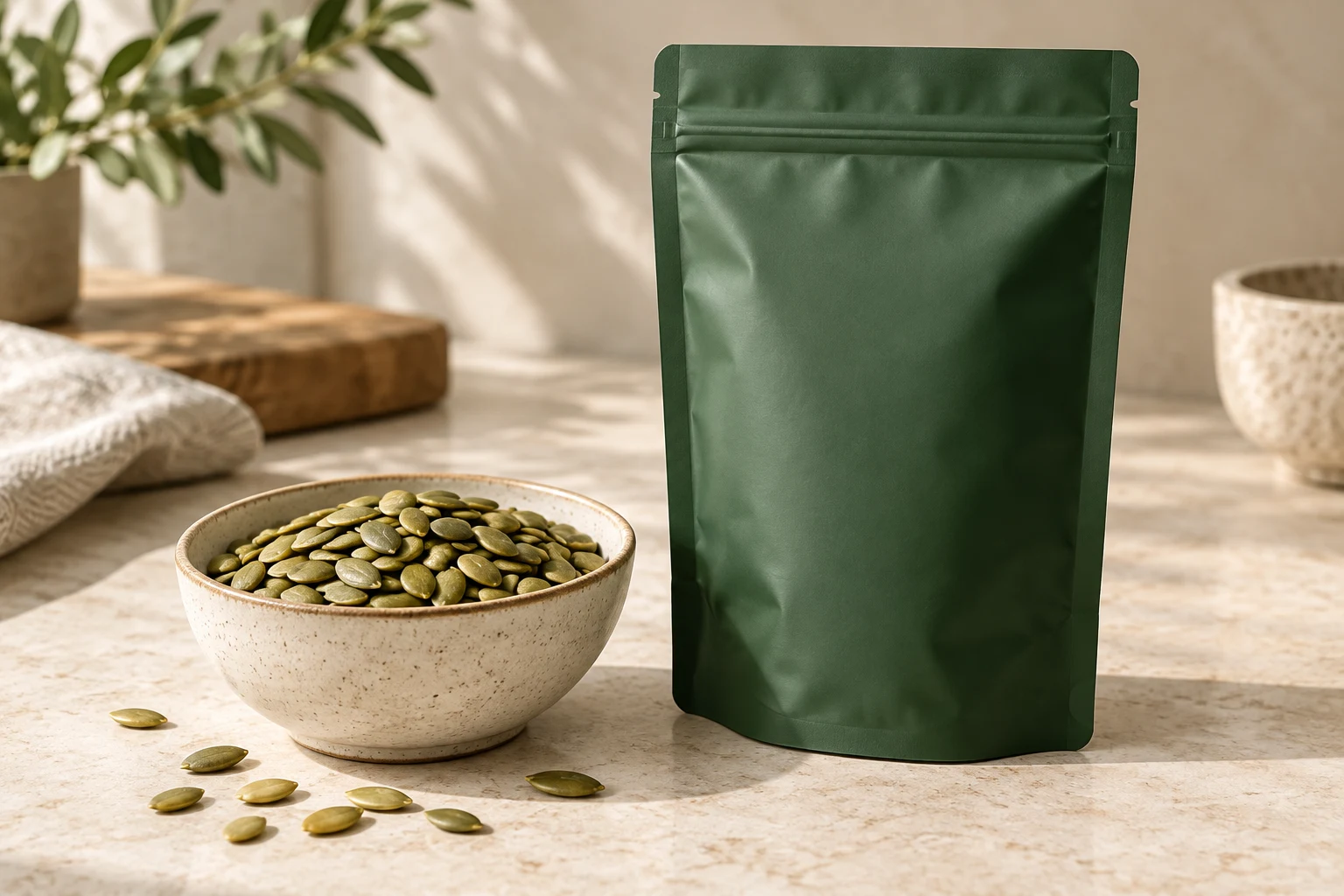
Pumpkin seeds can lose their appeal before the pouch looks damaged. A vague material order hides the cause. I start with a product-specific trial.
I choose pumpkin seed pouches by testing the actual seeds, film structure, seals, and intended storage route together. I compare protection and opening behavior, then approve a written specification before requesting a production quote.
I focus here on edible green pepitas and roasted seed snacks. Planting seeds, extracted pumpkin seed oil, and mixed snacks need different briefs.
Which Seed Details Change the Pouch Brief?
A hulled seed and a heavily seasoned snack may share a shelf. Treating them as one packaging job leaves important trial details missing.
I record whether the seeds are hulled, raw or roasted, salted or coated, and packed alone or in a blend. I also specify fill weight, sales channel, storage expectations, and how often customers will reopen the pouch.
I begin with the edible product rather than a photograph of a bag. Illinois Extension distinguishes pepitas from traditional pumpkin seeds and discusses their cooking uses and storage.1 That distinction helps me ask a precise question. Is the pack intended for green pepitas used in a kitchen, roasted in-shell seeds eaten as a snack, or a coated seed blend? I do not assume that one successful pack qualifies all three.
I request a representative product lot. I write down the seed supplier, processing route, coating recipe, packing temperature, and any product data the owner already has. I ask the food team which changes make the product unacceptable. The answer might concern aroma, crunch, appearance, or another measured property. Those are proposed trial endpoints, not claims that a particular pouch already prevents every change.
I match pack size to real use
A Reddit r/preppers participant wanted to buy a bulk bag of green pumpkin seeds and keep it for years without a freezer.5 I use that specific question as an example of a mismatch between quantity and expected use. I do not adopt the replies as storage advice, a safety assessment, or commercial shelf-life evidence. For a brand, the useful question is how much product the customer consumes between openings.
I compare a small snack serving with a larger kitchen pack. For the latter, I ask users to scoop the seeds, clear the opening, and close the zipper. I watch whether the mouth gives enough room for a spoon and whether the empty pack becomes awkward near the bottom. I use the pouch size guide to organize dimensions, then confirm them with seeds rather than water or another surrogate.
I also define the intended contact conditions. FDA separates food types and packaging conditions of use.2 I ask the converter to match supporting documents to the actual food and route. A document for a different structure does not settle this project. I keep the lot details, fill method, destination climate, intended storage, and customer use together so the material review has a clear boundary.
How Do I Compare Material Candidates Fairly?
A material name does not explain a seed pack result. Buying by appearance can conceal the conditions behind the supplier’s data.
I compare complete structures with the same product, pouch dimensions, and trial route. I ask for measured barrier data with methods and conditions, then check finished filled packs instead of assuming that a film number proves shelf life.
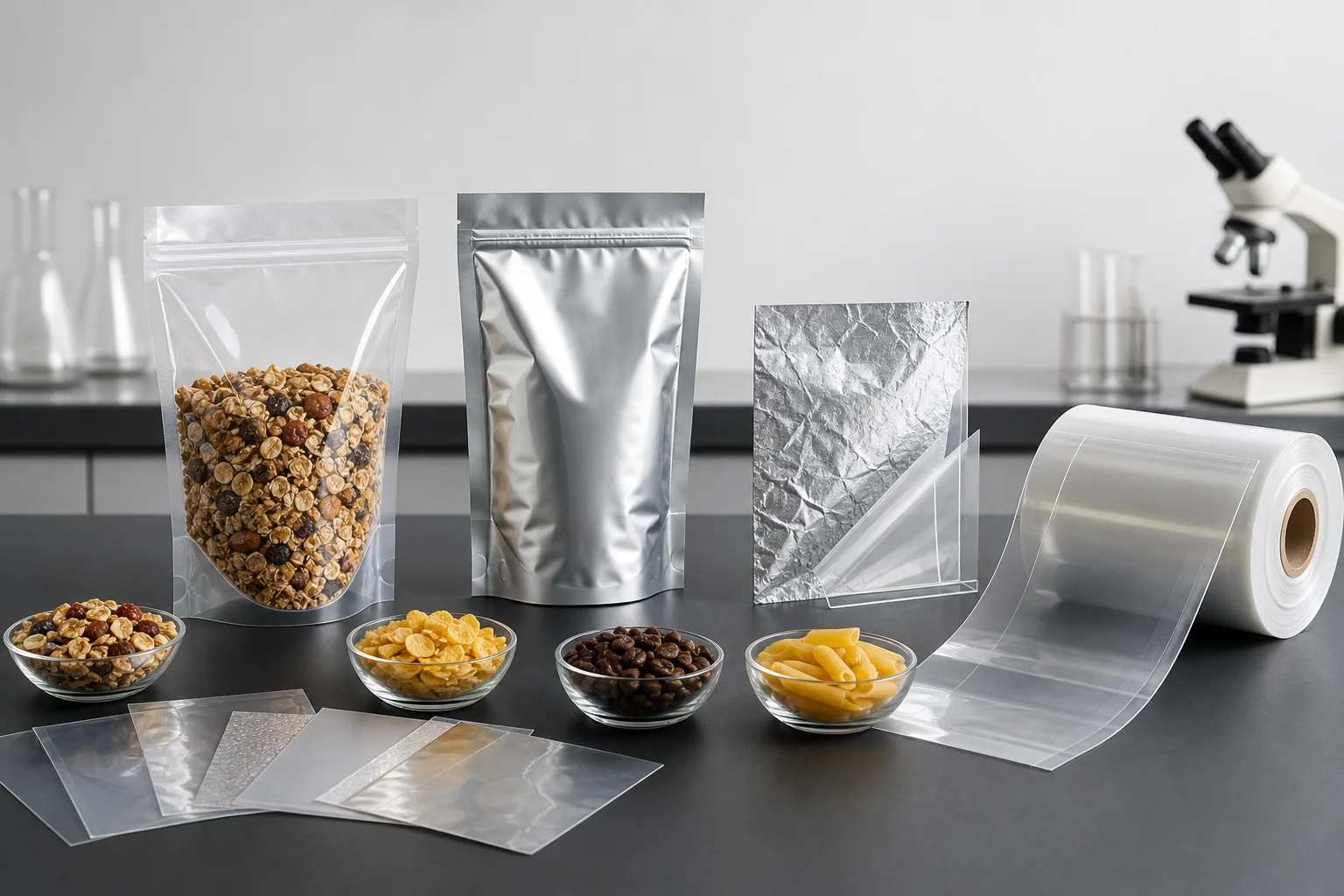
I use an opaque laminate, a metallized candidate, and a clear candidate as a manageable comparison when the converter can supply them for the intended food. These are options to assess, not a ranking of every material on the market. I keep printing, closures, and pouch geometry visible because a different zipper or seal margin can make two samples operationally different.
| Candidate | Useful application | Evidence I request |
|---|---|---|
| Opaque laminate | Seed snack where product visibility is optional | Exact layers, barrier report, filled-pack results |
| Metallized laminate | Candidate for a retail seed snack | Construction details and handling performance |
| Clear construction | Project that requires seed visibility | Whole-structure data and product trial |
The core food barrier guide explains how to organize the material assessment. I ask which data belong to the exact proposed structure. ASTM F1249 measures water vapor transmission through film and sheeting.3 I request the method version, specimen thickness, temperature, humidity on each side, units, and sample identity. I do not compare two reported values while those fields are unknown.
I write the exposure before interpreting results
For the filled-pack study, I ask the product team to define the intended storage route and a justified challenge route. I record each temperature and relative humidity, exposure duration, inspection interval, sample count, and acceptance rule before starting. If those choices are still unresolved, the report remains a study plan. I do not fill the gap with a universal storage temperature or an invented barrier threshold.
I retain an initial sample from the same seed lot for comparison. At planned intervals, I record the agreed product endpoints and the pouch condition. I identify whether observations came from unopened packs or packs opened during a handling trial. A resealed pack is a separate use condition. It cannot silently replace the unopened samples supporting a retail claim.
I review failures as questions to investigate. A tear near the gusset may call for a handling review. A changed aroma in an intact pack needs product and packaging investigation together. Visible damage does not identify every cause, and a neat-looking pouch does not prove that the food is acceptable. I ask for the evidence behind the conclusion rather than describing any candidate as guaranteed protection.
What Must Pass Before I Approve the Order?
A strong laboratory specimen can distract from a poor production seal. That leaves the buyer with attractive samples and an unproven filling process.
I approve representative filling and sealing trials, inspect finished packs, check opening and resealing, and retain the agreed specification. I request a quote only after the trial records and remaining product questions are clear.
I ask the packer to use the proposed pouch with the actual seeds. I record fill weight, headspace, filling speed, seal temperature, dwell time, and pressure. I include start-up packs and a planned steady-run sample. If seasoning is present, I check where it travels during filling. I do not deliberately contaminate saleable food; any challenge samples stay inside a controlled development trial.
ASTM F88/F88M concerns the seal strength of flexible barrier materials.4 I ask the tester to identify the method version, specimen width, support technique, test speed, conditioning, and failure mode. A strength value without its setup is incomplete evidence. I also ask the packer which finished-pack integrity assessment suits the structure. A peel measurement alone is not a shelf-life or leak guarantee.
I make the failure record useful
I photograph and locate seed fragments near the seal, wrinkled corners, damage around the notch, and any closure difficulty. I record these as observed failure modes, not expected defects in every seed pouch. I compare the affected pack with its filling settings and lot record. That makes corrective action more specific than asking for a vaguely stronger material.
I use the sample approval checklist to retain the accepted pouch and the written limits. I ask another person to open, pour, and reseal a filled pack. I observe spilled seeds, grip space, and access to the last portion. I then separate usability approval from the food team’s product study. Passing one does not automatically pass the other.
- Edible seed type, processing, coating, lot, and fill weight.
- Exact structure, thickness, dimensions, seal margins, zipper, and notch.
- Intended food-contact use and supporting documents.
- Barrier method, temperature, humidity, units, and agreed limits.
- Filling settings, seal checks, handling route, and retained samples.
- Opening and resealing criteria, change approval, and unfinished tests.
I transfer those fields to the written packaging specification. I then request a quote for the approved pumpkin seed project, giving quantity per design and delivery destination. The supplier must state price, MOQ, and timing for that specification. I publish none of those numbers here because this illustrative guide has no verified commercial offer or validated shelf-life result.
Conclusion
I choose packaging through evidence, filled-pack testing, and clear specifications. That process protects the product, the launch, and the customer experience.
Sources and Further Reading
Need a pouch specification?
I can review your product, size, quantity, artwork, and target market.