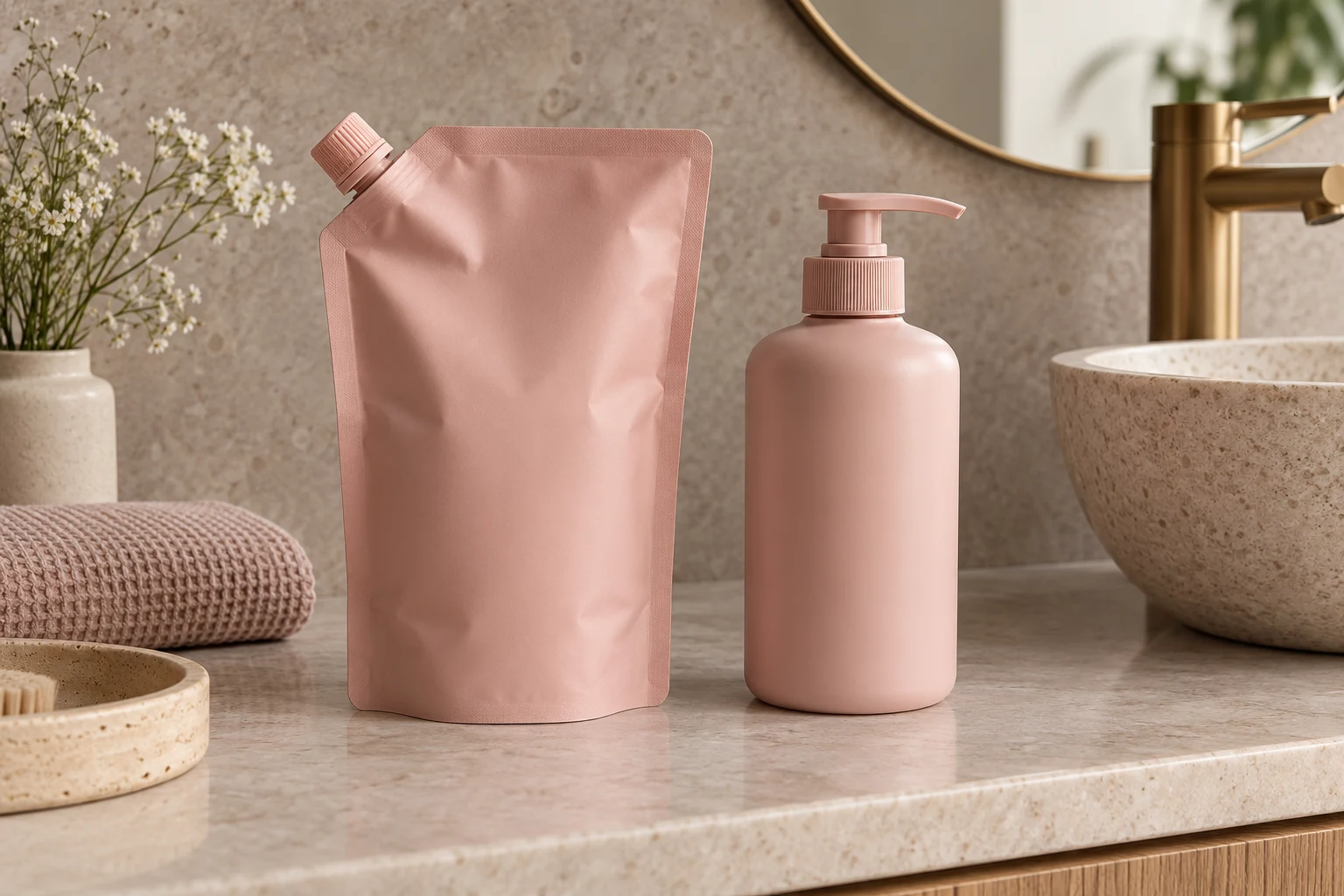
A shampoo refill can promise convenience yet leave users squeezing, spilling or guessing how to prepare the bottle. The whole refill routine needs review.
I test a shampoo refill spout pouch with the actual formula and intended bottle. I check pouring, pump clearance, residual product, material compatibility, seals and manufacturer-approved refill instructions before confirming the specification.
My starting point at Unique Packaging is the brand’s defined shampoo-and-bottle system. This is a development checklist for ordinary shampoo, with product safety decisions owned by the cosmetic manufacturer.
Which Bottle and Refill Routine Should I Design Around?
A pouch can pour well into a beaker and badly into a narrow pump bottle. Unclear fill instructions can make the final step messy.
I define the receiving bottle, neck opening, pump displacement and permitted refill routine first. I observe the complete transfer with the actual shampoo, including stopping, replacing the pump and storing any approved remainder.
I ask the brand whether the refill is intended for one named bottle or a defined family of bottles. I obtain the actual neck dimensions and the pump assembly, rather than comparing nominal bottle volume alone. I want to know how much usable headspace the pump needs and whether the consumer will make one transfer or several. I then choose prototype spout positions that can be held above that bottle without forcing an awkward angle.
Oribe's refill instructions offer a useful system-specific example. They tell users to remove the original pump, avoid introducing water or contaminants, leave room for the pump and retain any remainder in the refill pouch.1 I use that example to explain why the bottle is part of the packaging task. It does not establish that every shampoo or pouch supports the same routine.
I compare the task, rather than the spout diameter alone
| Design question | Sample observation | Decision |
|---|---|---|
| Can the spout approach the neck? | Clearance, grip and bottle stability | Fitment location and pouch shape |
| Can the user stop pouring? | Drip behavior and flow after squeeze release | Spout and formula review |
| Does the pump fit after refill? | Remaining headspace and overflow on insertion | Visible fill instruction |
| Can the remainder be stored? | Cap engagement and product on threads | Manufacturer-approved use plan |
I also ask what motivates the refill purchase. In a Reddit r/IndianBeautyTalks thread, the author compared refill value with bottles that often go on sale.2 I treat this as one consumer's buying perspective. I do not reproduce the prices or turn the post into a market-wide savings claim. For a brand, the practical question is whether its proposed refill offers a clear, usable reason to choose it at the actual selling price.
I use the spout pouch selection guide to organize the sample request. I keep environmental percentages and universal price savings out of the brief unless the brand supplies evidence for the exact pack, comparator and market. A refill format alone does not prove either outcome.
How Do I Review Formula Compatibility and Microbial Safety?
A film can look unchanged while a formula or closure needs further assessment. A successful pour cannot establish cosmetic safety.
I ask the cosmetic manufacturer to assess the finished formula, pouch, fitment and intended refill use together. I review compatibility under recorded conditions and keep microbial preservation evidence separate from physical packaging tests.
I identify the exact formula revision and its proposed contact materials. The packaging request names the sealant, laminate layers, fitment resin, cap and any liner. I ask the manufacturer which formula characteristics must be considered and which results are required before launch. I do not assume that one generic plastic code establishes compatibility with every fragrance, surfactant blend or viscosity. The proposed pouch is a candidate until the relevant product assessment is complete.
For chemical-resistance planning, ASTM D543 provides practices for evaluating plastics exposed to chemical reagents.3 Its public scope stresses the importance of exposure conditions. I ask the laboratory to record the formula or reagent, concentration where relevant, temperature, duration, applied stress and control samples. I also ask which observations it will report, such as appearance, dimensions or mechanical change. The laboratory must select an applicable study; this article does not set a universal exposure schedule or pass threshold.
I keep a compatibility record and a product safety record
FDA identifies inadequate packaging, contaminated water, poor storage and consumer use among possible routes of cosmetic microbial contamination.4 I therefore ask the cosmetic manufacturer how its evidence covers the intended refill sequence. A film report cannot answer that question by itself. I request review of the product in its proposed packaging and the consumer instructions, with appropriate specialist testing selected by the manufacturer. I do not describe the pouch as sterile or claim it makes an unsuitable formula safe.
The same discipline applies to instructions about bottles. L’Oréal Professionnel's Serie Expert guidance says to use its empty bottle without rinsing before the specified refill.5 That is a named product-system instruction. I do not copy it onto another brand or replace another manufacturer's approved cleaning directions. Oribe likewise warns against introducing water and contaminants. The correct instruction must come from the product owner and match the validated use.
I retain formula identity, material revisions, test conditions, results, limitations and approval status in the packaging specification record. If the fragrance, preservative system, contact layer or fitment changes, I ask the responsible team which assessment must be repeated. Written ownership is more useful than a vague assurance that a similar pouch has worked before.
How Do I Approve a Filled Shampoo Pouch Before Quoting?
A pouch that survives a desk review can still leak at the fitment, drain poorly or distort in its carton. A quote needs a defined approved sample.
I review representative filled pouches through sealing, storage orientation, carton handling and the approved refill routine. I document leakage, pouring and remaining product separately, then confirm the construction and instructions before requesting quotes.
I give the packer the intended shampoo, fill range, fitment and laminate revision. I ask it to retain the filling conditions and the actual seal settings used for the samples. I inspect the fitment attachment, the top seal if present, corners and cap engagement. I compare the result before and after the agreed storage and handling sequence. I record what was observed without presenting a bench exercise as a distribution certification.
ASTM F88/F88M covers measurement of seal strength and identifies the specimen failure mode.6 I ask the laboratory which seams can be sampled appropriately and how they will be conditioned and supported. I request technique, strip width and test speed with the result. The fitment attachment and closed cap need their own suitable checks; a film seal strip cannot establish their leak performance. The seal-leak guide helps keep failure locations distinct.
I measure useful outcomes in the refill exercise
I observe the user opening the pouch, positioning the bottle, starting the pour, stopping and replacing the pump. I record drips on threads, overflow, awkward grip and product remaining after the intended transfer. If the team wants to quantify residue, it agrees a weighing method and endpoint before comparing samples. I do not add water to improve drainage. Instructions must stay consistent with the product manufacturer's approved use.
I review the outer carton with the real filled pack. The test plan names pack count, orientation, supports and route conditions. I use the filled-pack distribution guide when deciding whether the project needs a laboratory simulation. A cosmetic pouch sent through parcels may need a different assessment from one shipped in a salon's consolidated case. I do not transfer an acceptance result between those routes.
My purchase checklist includes formula revision, nominal fill and range, bottle compatibility, usable headspace, laminate, fitment, cap, seal drawing, artwork, instructions, carton plan and retained samples. I add the test reports and any unresolved limits. I ask for written confirmation that the production proposal matches this record, then request a quote for the confirmed shampoo refill system. Commercial quantities, delivery dates and prices come from that response. If the proposed materials or closure change during quotation, I reopen the affected assessment before approval.
Conclusion
I approve shampoo refills only when formula evidence, bottle fit, pouring and use instructions support the same written specification and retained sample.
Sources and Further Reading
- Oribe, instructions for using a refill pouch with its original bottle.
- Reddit r/IndianBeautyTalks, Thoughts on shampoo refill pouches?.
- ASTM D543-21, chemical resistance of plastics scope.
- FDA, microbiological safety and cosmetics.
- L’Oréal Professionnel, Serie Expert shampoo refill instructions.
- ASTM F88/F88M-23, seal-strength scope.
Need a pouch specification?
I can review your product, size, quantity, artwork, and target market.