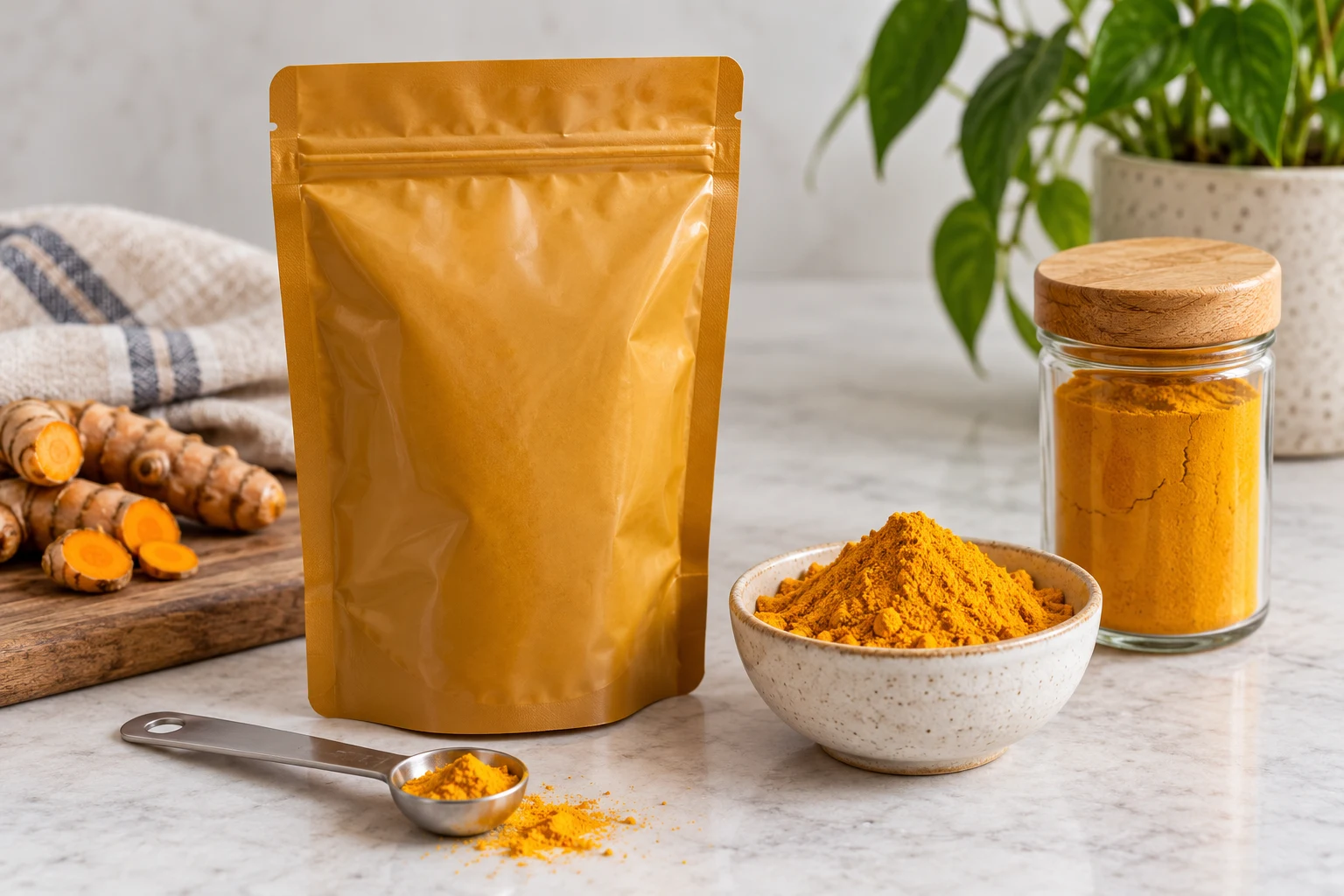
A bright turmeric refill can disappoint when powder cakes, aroma fades, or a narrow jar turns every refill into a spill.
I specify turmeric powder refill pouches around moisture and light protection, powder handling, jar access, and verified seals. I compare complete structures through filled trials before approving a written purchase specification.
At Unique Packaging, I use this sequence to turn a spice-brand brief into packaging questions the converter and filler can answer.
Which Material Evidence Matters for Turmeric Powder?
A gold-colored pouch says little about the protection of the powder inside it.
I compare the full structure, light transmission, moisture-barrier evidence, and aroma retention. I keep published study conditions separate from performance promised for a new commercial pouch.
I start with plain ground turmeric for cooking and spice-jar refills. A turmeric blend containing sugar, milk ingredients, or oil needs a separate product brief. NIFTEM identifies moisture pickup, caking, aroma loss, and light-related color deterioration as packaging concerns for turmeric powder.1 I ask the food team which of those changes ends acceptable quality for this product. That decision guides the trial instead of a generic request for the strongest bag.
A CFTRI abstract describes a 1979 comparison using 100 g fills in flat pouches stored at 27–35°C and 30–92% relative humidity. Its foil laminate performed best among the tested constructions for the reported protection measures.2 I use that as a reason to investigate the barrier layer. It does not identify the best film for every current refill system. The tested structures, seals, and storage conditions must remain attached to the finding.
A March 2026 paper also evaluates paper-based composite consumer packs for turmeric and nutmeg under accelerated conditions of 38 ± 1°C and 90 ± 2% relative humidity.3 I have verified the accessible abstract, not a complete laboratory report. I do not transfer its storage-life result to our packaging or use it as proof that any paper-faced bag has equivalent protection.
How I shortlist structures
| Candidate | Question I ask | Evidence needed |
|---|---|---|
| Opaque foil laminate | Does the complete pouch fit the product and line? | Defined structure, light protection and filled-pack study |
| Metallized or coated barrier film | Does the barrier remain suitable after conversion? | Film reports plus finished-pack observations |
| Clear or windowed option | Is product visibility worth the exposure? | Comparison under the intended display conditions |
These are comparison routes, not interchangeable specifications or guaranteed rankings. I use the core barrier-film guide to organize the material assessment. I then request current reports with units, specimen identity, temperature, humidity, and test method. ASTM F1249 addresses water vapor transmission through flexible barrier materials.5 A film result belongs in the evidence file, alongside checks of the converted pouch and its closures. I ask what changes if the supplier substitutes a coating, gauge, or adhesive before accepting a material name as the purchasing specification.
How Do I Make a Turmeric Refill Easy to Use?
A refill pouch can fit the shelf while failing at the mouth of the customer’s spice jar.
I trial opening clearance, controlled pouring, spoon access, and reclosing with the actual powder and receiving jar. I choose the fill size around the supported use sequence.
The intended jar is part of my brief. I record its opening, usable capacity, and whether the user will empty the whole pouch or retain some powder. A pouch used to fill one jar once has a different closure need from a larger refill opened many times. I do not add a zipper automatically, and I do not remove it merely because the pack is called a refill. I test the task the brand intends to show on its instructions.
In a February 2020 r/ZeroWaste thread about bulk-spice shakers, one commenter described using turmeric unevenly: a jar lasted months during some periods, then only weeks during a run of Indian cooking.4 That is a personal account, not a consumption forecast. I use the difference in use patterns to ask whether the proposed refill is too large for the brand’s intended customer. I do not turn the discussion into a claim that all spice users prefer bulk packaging.
For each candidate, I place a clean jar and tray on a stable bench. I open the pouch using the intended tear feature, transfer the agreed amount, stop, and close any remainder. I document where powder lands, whether the mouth collapses, whether a spoon catches on the zipper, and whether the user can identify the closing track. The tray helps distinguish powder delivered to the jar from powder lost during transfer. This is a proposed comparison procedure, not a performance claim.
What I inspect after transfer
I photograph the opening before and after use. I note powder on the tear edge, zipper, outside panels, and receiving jar. If a funnel is necessary, I decide whether the brand can reasonably expect the customer to have one. If the trial needs a wider mouth, I revisit the pouch drawing before artwork approval. The pouch-size guide helps organize dimensions, but the real powder and jar determine usable capacity.
I also separate consumer residue from contamination introduced on the filling line. The powder and zipper contamination guide supports that discussion. A clean hand-filled demonstration cannot establish production readiness. I retain both the filled reference and the receiving jar so the converter and brand can repeat the same transfer check after a design revision. I avoid claiming that a convenient opening alone extends freshness after opening.
What Should I Confirm Before Buying the Pouches?
An attractive filled sample can hide an untested seal or an undefined material substitution.
I confirm the food-contact use, finished structure, seal process, filled-pack observations, and written acceptance criteria before requesting a quote against the approved configuration.
I send the converter the powder identity, fill range, target countries, intended storage, jar-refill sequence, and filling equipment. For the United States, FDA describes food-contact packaging components and authorizations in relation to their intended use.7 I ask for documents tied to the proposed structure and contact conditions. A general food-grade phrase does not identify every component in a printed, laminated, converted pouch. I keep the document scope visible in the approval file.
I ask the filler to record the sealing setup used for each sample. The record includes jaw type, operating settings, seal width, powder-control steps, sample conditioning, and pouch lot. ASTM F88/F88M measures seal strength in flexible barrier materials.6 I request the relevant specimen details and observed failure mode with the result. I do not present a peel result as proof of all leak paths, nor invent a universal force threshold for turmeric packaging.
What goes into my procurement checklist
- Product identity, fill range, powder handling and intended markets.
- Drawing, usable opening, tear location, zipper and receiving jar.
- Layer construction, total gauge and controlled component revisions.
- Barrier reports with named methods and stated conditions.
- Sealing setup, inspection criteria and finished-pack trial records.
- Approved storage wording, retained samples and change-review triggers.
The storage comparison uses the brand’s intended conditions and a justified stress condition selected by its food team. I record actual temperature and relative humidity, the opening schedule, light exposure, observation dates, and the quality endpoint. I compare the same powder lot across candidate packs. I do not copy an accelerated condition from a paper and assume its result gives the market shelf life. The brand must connect its own evidence to the product claim.
Common failure observations include a top seal containing powder, a crease at a gusset, a zipper that will not engage after use, and a visible change in the powder during the study. I record the location and sample identity before proposing a cause. If a closure or film changes, I ask which previous results still apply. The written specification guide helps keep those decisions attached to the approved drawing.
I finish material assessment and a representative filled-pack trial before I ask for written specification confirmation and a specification-based quote. The commercial request states quantity per design and the approved configuration. I leave price, production timing, certifications, and storage-life promises open until the project supplies evidence. This prevents a supplier comparison from rewarding an undefined material or an omitted approval step.
Conclusion
I approve a turmeric refill only when the chosen structure protects the powder and the opening makes the intended refill task practical.
Sources and Further Reading
- NIFTEM-Thanjavur: Processing of Turmeric Powder, packaging chapter.
- CFTRI: 1979 ground-turmeric flexible-packaging study abstract.
- 2026 Food and Bioproducts Processing: turmeric and nutmeg packaging study, abstract.
- Reddit r/ZeroWaste: decorated bulk-spice shakers, February 2020.
- ASTM F1249-25: water vapor transmission method scope.
- ASTM F88/F88M-23: seal strength method scope.
- FDA: food packaging and food-contact substances.
Need a pouch specification?
I can review your product, size, quantity, artwork, and target market.