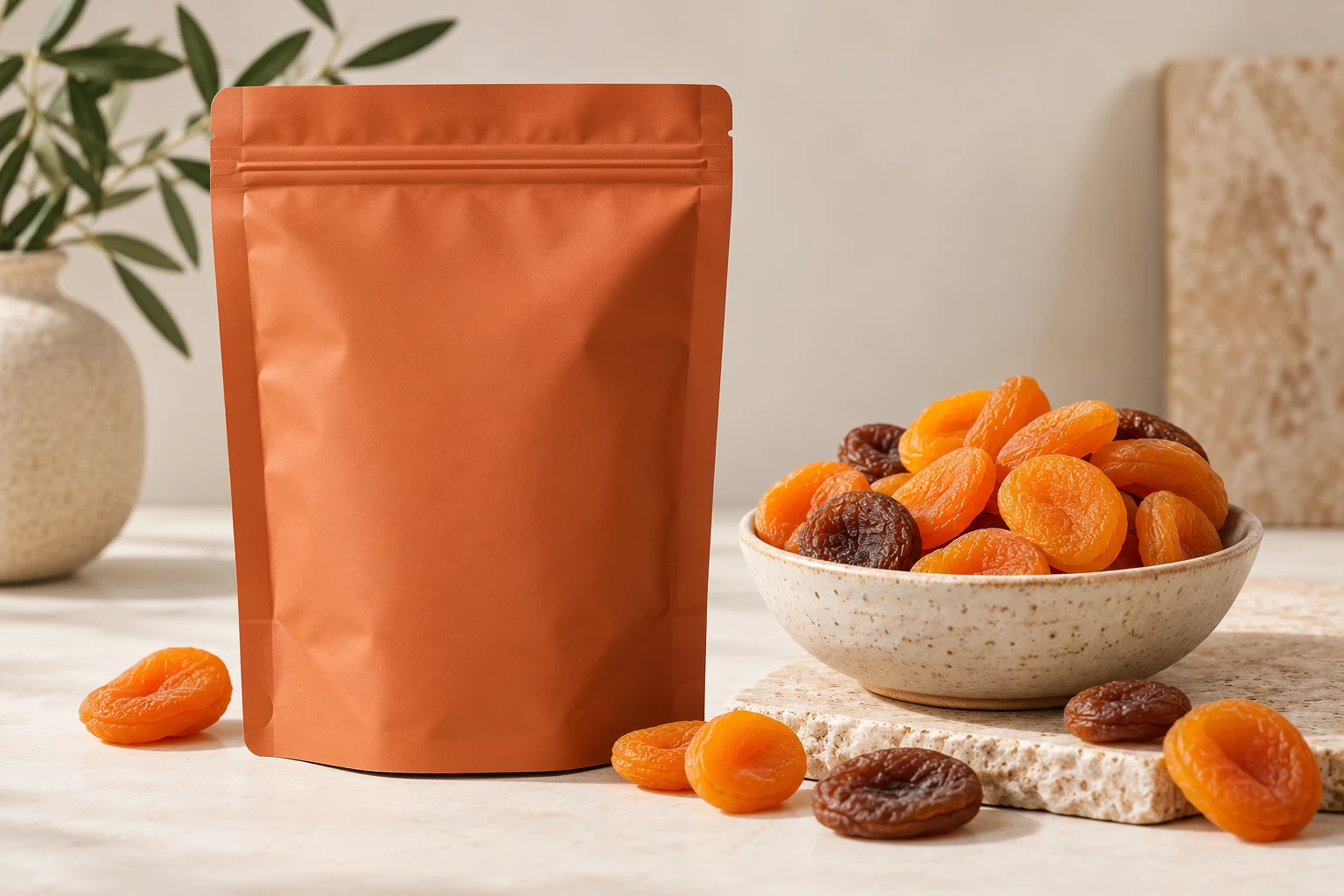
An apricot pouch can look convincing while hiding the wrong product assumptions. I identify the fruit treatment before deciding what the package must preserve.
I choose dried apricot pouches from the exact fruit specification, including treatment and cut, then compare opening, reclosure, material reports, and filled storage observations. I define acceptable texture and appearance with the food owner before approving samples and ordering.
At Unique Packaging, I place this brief in the dried-food cluster. Apricot treatment, piece size, and visible quality endpoints give it a different focus from a generic dried-fruit pouch.
Why Does Apricot Treatment Come Before Film Selection?
Orange and brown fruit can invite different assumptions about quality. I confirm the product treatment and starting condition before comparing changes during a pouch trial.
I record the apricot grade, treatment, cut, ingredient declaration, fill weight, and approved starting appearance. I agree texture and colour endpoints with the food team and retain a reference from the same lot.
I ask the fruit supplier whether the product has been sulfured, uses another pretreatment, or is supplied without that treatment. I retain the actual specification rather than classifying a shipment by colour alone. Colorado State University Extension describes pretreatments used for dried fruit and the role of sulfite treatments in colour preservation. That supports asking the question, not diagnosing the contents of an unknown bag.1
I also record whether the pouch contains halves, whole pieces, diced fruit, or a mixture. I inspect the size range with the food owner and retain photographs of the starting lot. If pieces naturally differ in appearance, I ask which variation belongs to the approved grade. A packaging trial needs a baseline that purchasing and quality staff can recognise later.
A March 2026 r/prepping question asked about long-term storage of unsulfured dried apricots and compared vacuum-sealed jars with mylar bags. I use the question to identify uncertainty about treatment and container choice. I do not adopt the replies as commercial food-safety advice or treat an oxygen absorber as an automatic solution for our fruit.2
What will count as a useful result?
I ask the food team to define texture and appearance observations before reviewing the candidate pouches. They may choose a repeatable firmness method, a controlled visual comparison, or other product-specific measurements. I keep acceptance criteria with the protocol. A statement that the fruit still looks fresh is difficult to compare if the lighting, reference sample, and judgement change every week.
I use the filled pouch dimension guide to compare actual fruit volumes. Apricot halves may settle differently from a diced grade. I check usable mouth space and the space above the food for the zipper and top seal. I do not borrow the net-weight capacity printed on a pouch intended for rice or a different dried fruit.
I leave ingredient, safety, and storage statements with the responsible food team. My task is to make the packaging brief match the approved food. If the grade or pretreatment changes, I reopen the affected trial questions. That prevents a successful sample containing one apricot product from becoming unsupported evidence for every later lot or a different product sold under the same broad name.
How Do I Compare Opened and Unopened Apricot Packs?
A zipper demonstration does not show what happens during repeated snacking. I separate the customer’s opening routine from the performance of an untouched package.
I compare first opening, fruit removal, zipper cleanliness, and full reclosure at several fill levels. I keep opened-use packs and unopened controls on separate records, with agreed storage conditions, observation dates, and quality endpoints.
I begin with the final-style top seal and tear feature. I ask a tester to open the pouch and remove a normal portion. I watch whether fruit can be taken out without pulling the mouth against the contents. I record visible residue at the lip and zipper, awkward gripping, and any need to reshape the bag before closing it.
I repeat the task at full, middle, and low fill levels. If pieces cling together or lie across the opening, I record what happened without declaring a universal cause. I compare candidates with the same apricot lot and portion routine. A wider mouth may help access, but the project still needs enough usable space to hold and reclose the pouch comfortably.
Colorado State’s guidance for home-dried fruit recommends tightly sealed storage in a cool, dry place. I use that limited guidance to explain why storage and closure belong in the conversation. I do not transfer its home-preservation storage periods to a commercial apricot product or use them to approve a proposed laminate.1
How I keep the two questions separate
I retain unopened controls alongside packs opened on a defined schedule. I record portion amount, time open, reclosure method, storage location, temperature, and humidity. I label samples with identities that remain readable throughout the study. If an opened pack changes while its unopened control does not, the team has a useful comparison, but it must still investigate before assigning a cause.
A published dried-fruit experiment compared apricots and raisins in specified containers and films at different temperatures. It measured several food and package-atmosphere attributes over time. I use the study design to support tracking product, package, and conditions together. Its results do not establish the performance of our fruit, zipper pouch, or proposed storage period.3
I ask the food team to decide the analytical work and any food-safety evaluation. I do not use a packaging inspection or an informal taste check as a safety decision. I retain the sample approval record with the selected observations and any unresolved concerns. That gives the converter a concrete request, such as more usable mouth space, without claiming that a closure change alone will deliver a new shelf life.
What Material Comparison Should Reach the Purchase Brief?
A supplier’s best barrier claim is hard to compare without conditions. I connect construction details, controlled tests, and actual apricot observations before requesting prices.
I compare complete material candidates, documented transmission and seal methods, intended food-contact use, and filled-pack observations. I confirm the fruit specification, pouch geometry, process settings, acceptance criteria, and substitution rules in writing.
I begin with the food barrier-film guide and ask for the complete proposed structure. I request each layer, thickness and tolerance, contact sealant, adhesive and print arrangement, zipper, and any window details. A foil-like appearance does not identify a barrier level. A clear window needs evidence for the offered construction rather than an assumption based on the rest of the pouch.
| Option or observation | Question I ask | Evidence for approval |
|---|---|---|
| Clear construction | Can buyers see the intended fruit grade? | Film identity and controlled appearance comparison |
| Opaque or metallized construction | Which product endpoint justifies the choice? | Transmission data plus the actual filled study |
| Different opening or zipper | Does access improve without a new closure problem? | Repeated-use observations at several fill levels |
Intertek identifies ASTM F1249 for water-vapour transmission, D3985 for oxygen transmission, and F88 for seal strength. I request temperature, humidity conditions, units, thickness, conditioning, and sample identity as applicable. I keep the peel setup and failure description with seal results. None of these method names provides an apricot shelf-life guarantee.4
What I retain from the filled trial
I ask the food owner and laboratory to approve the actual storage protocol. An illustrative comparison could include 23°C and 50% relative humidity, with another condition chosen for the intended route. Those are proposed project settings, not a universal apricot standard. I record sampling dates and the approved quality endpoints so that later observations can be compared fairly.
I inspect filling and sealing with the actual fruit. I look for residue in the top-seal zone, folds at thickness transitions, and incomplete zipper engagement. I identify each retained sample with its process settings. After agreed carton handling, I inspect for abrasion, opened seams, and fruit damage. I preserve unhandled controls and keep an informal bench check separate from a distribution-test claim.
FDA explains that food-contact status depends on the components and their intended conditions of use. I request documents for the actual materials and food-contact application. A broad supplier assurance does not establish that every film, adhesive, or closure substitution is covered.5
My written purchase specification names the fruit treatment and grade, fill, dimensions, construction, closure, artwork revision, coding area, carton plan, approved sample, and change-control owner. I request a specification-based quotation only after material assessment and a representative filled trial. I ask suppliers to disclose assumptions and keep unverified timing, quantity, price, certification, and performance claims out of the comparison.
Conclusion
I approve apricot pouches against the actual fruit treatment, defined quality endpoints, clean reclosure, filled trials, and a confirmed construction linked to the purchase order.
Sources and Further Reading
Need a pouch specification?
I can review your product, size, quantity, artwork, and target market.