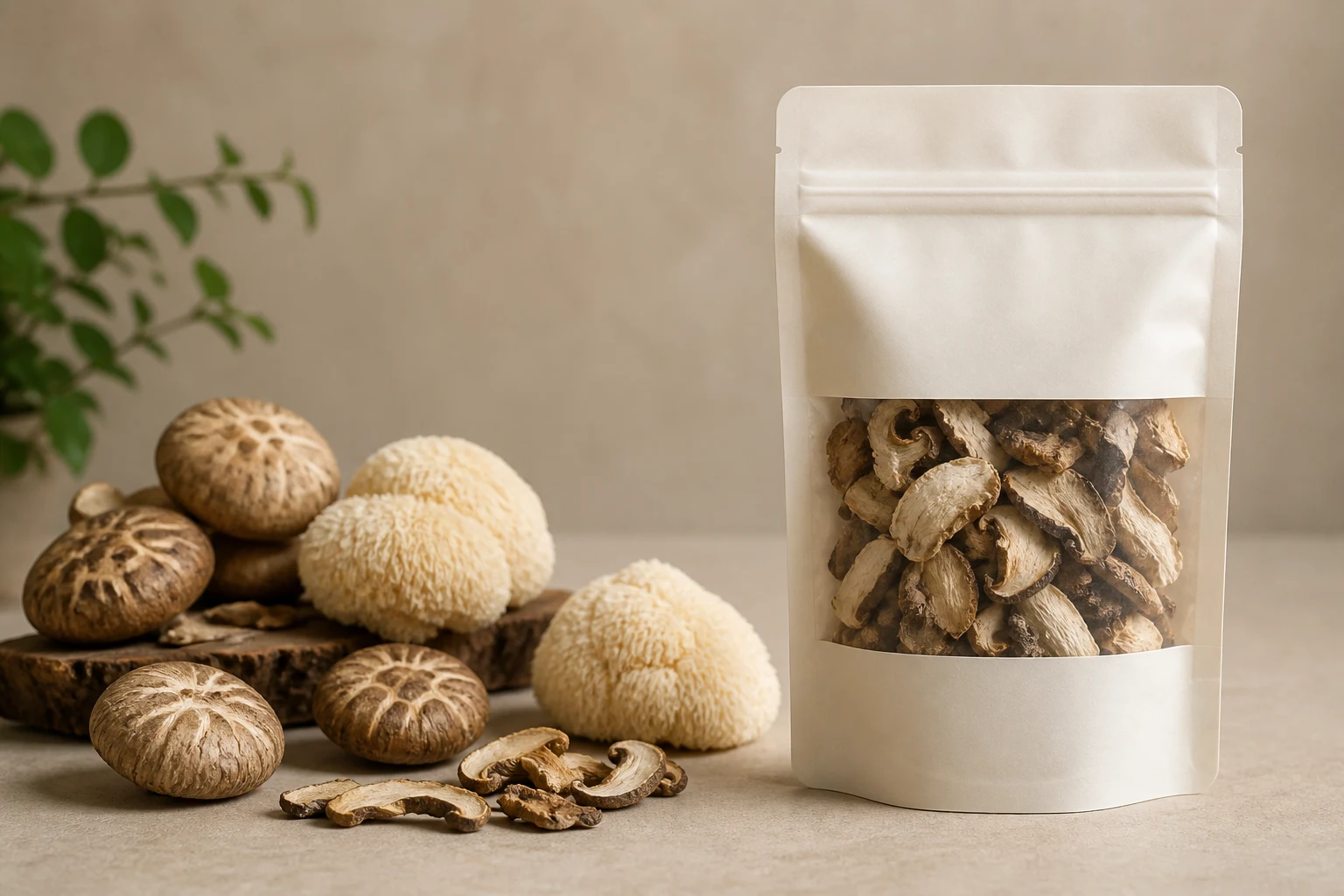
Dried culinary mushrooms can lose their intended texture when product condition, moisture exposure, pouch construction, and storage route are not evaluated together.
I package dried culinary mushrooms after I define the approved product condition and market, compare the exact pouch construction, check representative filled packs, and document the release specification.
I treat the pouch as a complete system. I confirm the product, material, filling, handling, and customer experience before I approve production.
What Product Condition Must I Confirm Before Choosing a Pouch?
A pouch cannot correct product condition when no one has recorded drying, cooling, handling, fill, market, storage route, or release checks.
I first define the approved dried-mushroom condition, intended use, target market, storage route, fill range, and quality checks before I compare film or closure options.
I write the decision in product terms. I identify the culinary mushroom type, cut form, approved condition, handling after drying, fill quantity, storage and delivery route, intended market, and the failure that matters most. USDA FSIS says freeze-dried foods must be packaged in moisture-proof, hermetically sealed containers.1 UMN Extension similarly advises packaging that prevents moisture exposure for dehydrated produce.2 Those references do not give a universal construction or life for this product, so I retain the food team’s own release criteria. The Reddit thread offers a real humidity concern but not a substitute for a defined product condition.3
How I make this decision specific
For “What Product Condition Must I Confirm Before Choosing a Pouch?” in this how do i package dried culinary mushrooms in a flexible pouch review, I define the actual product, pouch configuration, intended use, and decision owner before I ask a supplier or tester for evidence. I keep the selected structure, component details, sample condition, and any stated test method together, then compare the result with the buyer’s actual route rather than a catalogue promise. That record lets me use the best barrier film for food packaging guide as a decision aid and retain a specification that another team member can check.
For How Do I Package Dried Culinary Mushrooms in a Flexible Pouch, I state what is known, the condition it applies to, and what must still be checked with the actual product. I do not transfer a number, a test result, or a feature choice from another product simply because its pouch looks similar. The result of “What Product Condition Must I Confirm Before Choosing a Pouch?” should give the buyer a clear next check, the supplier a precise request, and the project owner a record of the remaining uncertainty.
For How Do I Package Dried Culinary Mushrooms in a Flexible Pouch, I request the exact pouch structure, component specification, and test conditions from the supplier. A broad material name or catalogue claim is not a production specification. The right next step is a representative filled sample, where relevant, with observations recorded before production is approved.
Which Pouch and Closure Details Should I Evaluate?
A general high-barrier request hides the format, sealant, pouch geometry, opening feature, documentation scope, and actual use conditions that suppliers need to compare.
I evaluate the exact pouch format, layer sequence, sealant, dimensions, opening or closure feature, food-contact scope, and representative sample rather than a material nickname.
I review the proposed construction with its sample in hand. I check whether the pouch supports the selected fill, whether the top seal has enough usable area, and whether the opening feature leaves a clean and practical customer interaction. FDA identifies packaging and its components as food-contact substances, so I request documentation for the selected construction and intended use.4 I link the request to the food-contact document guide and use the stand-up pouch size guide to keep filled dimensions visible. I do not turn a film property into a promise about every filled package.
How I make this decision specific
For “Which Pouch and Closure Details Should I Evaluate?” in this how do i package dried culinary mushrooms in a flexible pouch review, I define the actual product, pouch configuration, intended use, and decision owner before I ask a supplier or tester for evidence. I keep the selected structure, component details, sample condition, and any stated test method together, then compare the result with the buyer’s actual route rather than a catalogue promise. That record gives the buyer a decision aid and a specification that another team member can check.
For How Do I Package Dried Culinary Mushrooms in a Flexible Pouch, I state what is known, the condition it applies to, and what must still be checked with the actual product. I do not transfer a number, a test result, or a feature choice from another product simply because its pouch looks similar. The result of “Which Pouch and Closure Details Should I Evaluate?” should give the buyer a clear next check, the supplier a precise request, and the project owner a record of the remaining uncertainty.
How Do I Check the Filled Pouch and Carton?
An empty pouch can conceal sharp pieces, corner stress, seal contamination, unstable presentation, opening problems, and carton damage that appear only after real product is packed.
I check representative filled, sealed, cartoned, handled, opened, and reclosed pouches under stated project conditions before I approve the selected format.
I fill samples with the actual product condition and target range, then inspect product placement, seal appearance, corners, top-seal cleanliness, pouch footprint, carton orientation, and customer opening. If comparable seal evidence is required, ASTM F88/F88M provides a method for measuring flexible-barrier seal strength and identifying failure mode.5 I record the method, sample condition, and limit rather than declaring total package performance from one number. I retain the samples and use the filled-pouch distribution-testing guide when the project needs a route-specific plan.
How I make this decision specific
For “How Do I Check the Filled Pouch and Carton?” in this how do i package dried culinary mushrooms in a flexible pouch review, I define the actual product, pouch configuration, intended use, and decision owner before I ask a supplier or tester for evidence. I keep the selected structure, component details, sample condition, and any stated test method together, then compare the result with the buyer’s actual route rather than a catalogue promise. That record gives the buyer a decision aid and a specification that another team member can check.
For How Do I Package Dried Culinary Mushrooms in a Flexible Pouch, I state what is known, the condition it applies to, and what must still be checked with the actual product. I do not transfer a number, a test result, or a feature choice from another product simply because its pouch looks similar. The result of “How Do I Check the Filled Pouch and Carton?” should give the buyer a clear next check, the supplier a precise request, and the project owner a record of the remaining uncertainty.
For How Do I Package Dried Culinary Mushrooms in a Flexible Pouch, I treat the filled pack as a separate check from the material data. I record the fill condition, seal area, opening or closure behavior, carton arrangement, handling observations, and limits of the comparison. That prevents a favourable bench result from becoming an unsupported claim about shelf life, transport, or every product route.
What Must the Dried-Mushroom Purchase Specification Include?
A pouch approval cannot be repeated when the purchase brief contains artwork and dimensions but omits product condition, sample evidence, carton plan, limits, and reapproval triggers.
I issue a written brief covering the product condition, pouch and closure, food-contact market, sample observations, carton plan, acceptance criteria, retained reference, and changes requiring a new review.
The procurement path is simple but evidence-led: assess the materials, run a representative filled-pack trial, confirm the specification in writing, then request a quote on that defined basis. I record product condition and fill, pouch dimensions, construction, sealant, closure, food-contact market, artwork revision, sample configuration, carton arrangement, observations, acceptance status, and open risks. I name re-test triggers such as a drying or product change, fill change, structure or sealant change, closure change, dimension change, new carton, market, or delivery route. This makes the final quote a response to a real project rather than a generic shelf-life promise.
How I make this decision specific
| Specification item | Evidence I retain | Decision it supports |
|---|---|---|
| Product condition | Approved condition and handling context. | Representative pack review. |
| Pouch construction | Structure, dimensions, seal and closure details. | Material comparison. |
| Filled-pack trial | Product, carton, observations and limits. | Conditional release. |
| Change control | Named reapproval triggers. | Specification-based quote. |
For “What Must the Dried-Mushroom Purchase Specification Include?” in this how do i package dried culinary mushrooms in a flexible pouch review, I define the actual product, pouch configuration, intended use, and decision owner before I ask a supplier or tester for evidence. I keep the selected structure, component details, sample condition, and any stated test method together, then compare the result with the buyer’s actual route rather than a catalogue promise. That record gives the buyer a decision aid and a specification that another team member can check.
For How Do I Package Dried Culinary Mushrooms in a Flexible Pouch, I state what is known, the condition it applies to, and what must still be checked with the actual product. I do not transfer a number, a test result, or a feature choice from another product simply because its pouch looks similar. The result of “What Must the Dried-Mushroom Purchase Specification Include?” should give the buyer a clear next check, the supplier a precise request, and the project owner a record of the remaining uncertainty.
For How Do I Package Dried Culinary Mushrooms in a Flexible Pouch, I preserve the final decision in a written brief that names the approved sample, conditions, observations, open risks, and change triggers. I then use the packaging specification-sheet guide to keep the quotation tied to the evidence rather than to a remembered sample or a generic product name.
Conclusion
I choose packaging through evidence, filled-pack testing, and clear specifications. That process protects the product, the launch, and the customer experience.
Sources and Further Reading
- USDA FSIS, Does freeze-drying make food shelf stable?.
- UMN Extension, Safely dehydrating produce for school food service.
- Reddit r/MushroomGrowers, dried-mushroom storage community observation.
- FDA, Food Packaging and Other Substances that Come in Contact with Food.
- ASTM F88/F88M, Seal Strength of Flexible Barrier Materials.
- Unique Packaging barrier-film guide.
Need a pouch specification?
I can review your product, size, quantity, artwork, and target market.