Dry yeast can arrive in a tidy pack yet become awkward to measure and protect after opening. I check both journeys before buying pouches.
I choose dry yeast pouches by the yeast supplier's storage instructions, intended dose, opening frequency, filling method, barrier evidence, and filled-pack results. I compare sealed sachets with resealable larger packs without treating the zipper as an unopened-package seal.
I work from the baker's routine back to a written material and closure specification.
Should I Buy Single-Use Sachets or a Larger Pouch?
A large pack looks convenient until the user needs a small dose. A tiny sachet can leave an unwanted remainder too.
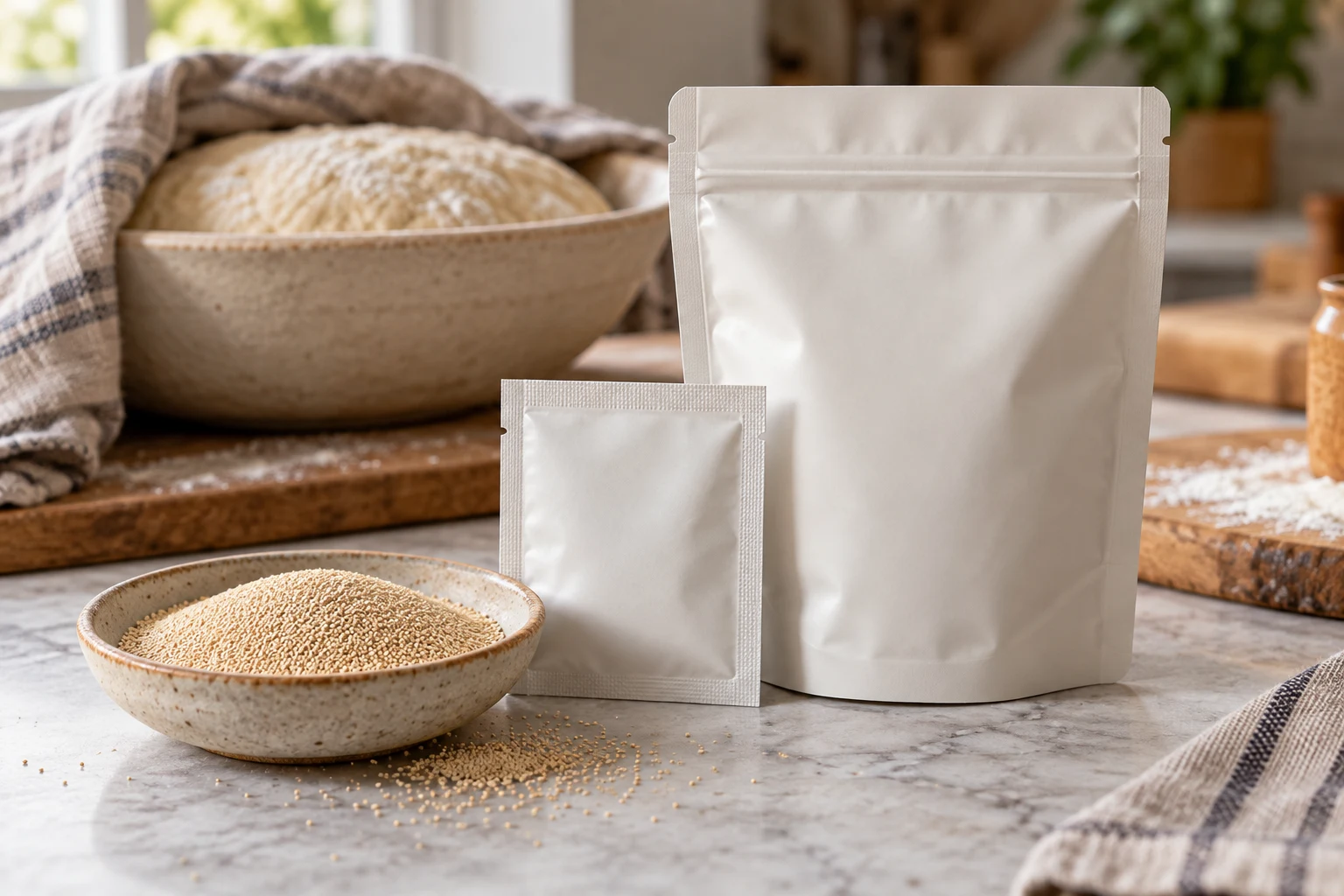
I choose sachets when the intended recipe uses the full portion. I consider a larger resealable pouch when repeated measurement is normal, then test access, closure, and the storage routine required for the specific yeast.
I start with a usage brief. I name the yeast product, intended baker, typical recipe, quantity used each time, and expected opening frequency. I ask whether the pack goes into a cupboard, refrigerator, or freezer according to the ingredient supplier's instructions. Those are separate buying situations. I do not copy a small retail sachet into a bakery programme simply because both contain dry granules.
Red Star's instructions for its one-pound Saf-instant Red product describe a vacuum-sealed unopened pack. After opening, the company calls for airtight, cold storage and prompt resealing after measuring.1 I keep that guidance tied to that named product. It does not establish the storage life of another yeast, a different laminate, or a new retail format. My own package must be checked with its ingredient supplier.
I turn customer habits into a format comparison
| Format | Useful situation | Decision I test |
|---|---|---|
| Sealed sachet | A planned full dose | Clean opening and complete emptying |
| Resealable pouch | Repeated measurement | Spoon access and reliable reclosure |
| Vacuum-style brick | A larger initial purchase | First opening and transfer instructions |
A September 2026 r/Breadit discussion shows why this matters. Users describe keeping bulk yeast in a freezer and refilling a smaller refrigerator jar; others use the original packet or a separate container.2 I treat this as attributed user behaviour. I do not adopt the thread's storage-duration claims or advice about different yeast types. The practical lesson is that customers may change containers after opening, so the pack and instructions need a clear next step.
I fill each candidate with the real granules. I measure a dose, pour the last portion, and observe powder caught in folds. I check whether a spoon reaches the product without stretching the mouth. Then I compare the filled dimensions using the pouch sizing guide. A format passes this stage when the intended person can use it correctly and understands how to protect what remains. An attractive empty sample cannot answer those questions.
Which Barrier and Seal Evidence Should I Request?
A supplier's high-barrier label can hide an unknown structure and test condition. That leaves no fair basis for comparing yeast packs.
I request the exact laminate, thickness, food-contact evidence, and transmission data under stated conditions. I also request seal-strength evidence for the actual seal construction and a trial with the intended yeast filling process.
I ask for a layer-by-layer description rather than a colour or trade name. The supplier should identify the outside film, any barrier layer, adhesive system, product-contact layer, and nominal thickness. I also identify every closure component. A foil-looking pouch is not enough information to tell me what is inside the structure. I retain a marked sample alongside the written specification so purchasing and production refer to the same candidate.
I use the core barrier-film guide to organise the comparison. I ask suppliers which oxygen and moisture tests they used, what the units mean, and whether results describe flat film or finished packages. I do not convert a flat-film number into a yeast shelf-life claim. A seam, closure, filling condition, or handling change needs its own evidence.
I specify conditions before comparing reports
ASTM F1249 is a water-vapour transmission method for plastic film and sheeting.3 For a first supplier comparison, I propose a common test temperature of 23°C and a 50% relative-humidity gradient, then ask the laboratory to confirm and record its actual chamber conditions, specimen orientation, conditioning, and method suitability. These are proposed project conditions, not a required yeast-pack specification. I request a separate condition if the intended route demands it.
ASTM F88/F88M addresses seal strength of flexible barrier materials.4 I want the report to name specimen width, support technique, test speed, conditioning, seal location, and failure mode. I compare like with like. I do not invent a universal pass value for dry yeast. My production team and ingredient owner must agree the acceptance criteria before testing. I also check actual sealed packs for channels, folds, and granules trapped in the seal.
FDA's food types and conditions-of-use framework distinguishes packaging applications by the food and use.5 I therefore request documents that cover the chosen product-contact components and intended filling and storage conditions. A generic food-grade claim is insufficient for this review. I connect unresolved documentation questions to the food-contact evidence guide, then hold approval until the supplier identifies the exact construction covered. Material assessment must precede artwork and order quantities.
How Do I Approve the Filled Pack and Buying Specification?
A pouch can pass a bench test and still frustrate bakers. I need a realistic opening trial and a traceable buying record.
I approve a representative filled-pack trial covering sealing, handling, first opening, measurement, and reclosure. I then confirm the construction, instructions, acceptance criteria, and change controls in writing before requesting a quote against that specification.
I ask the packer to run the candidate on the intended equipment. I record the product lot, fill mass, pouch size, film lot, sealing temperature, pressure, dwell time, and line speed. I keep the seal area clear during the trial, but I also inspect the start and end of the run for product dust. A clean hand-filled pouch is a useful early sample. It does not replace evidence from the proposed production process.
I separate unopened checks from opened use. Before opening, I inspect seams and package shape after the planned carton handling. After opening, I watch a user find the tear notch, reach the granules, measure a dose, and close the pack. I compare observations after repeated use. I do not call a zipper hermetic because it clicks shut. I ask which function the zipper is expected to provide and how the project will verify it.
I define the failure before the remedy
If yeast lodges in the zipper, I review filling access and closure placement. If the first tear runs into the closure, I review notch position and opening geometry. If the pouch changes shape after handling, I inspect the seam and record the event rather than guessing that the film is too thin. If users transfer the product to a jar, I check whether the instructions remain available after transfer. Each observation should produce one specific revision and another trial.
My purchasing checklist names the yeast product and supplier-approved storage routine; fill quantity and usable pouch volume; laminate and product-contact components; closure, notch, and seal dimensions; agreed test conditions and acceptance limits; artwork and date-code areas; retained sample references; and changes that require approval. I keep the recipe or dose information with the ingredient owner. The packaging supplier should not invent food-use instructions to fill a blank panel.
I use the line-trial data guide to record evidence consistently. Once the candidate is approved, I ask for a quotation against the confirmed specification. I request separate assumptions for quantity, designs, and delivery rather than publish an unsupported MOQ or lead time. If the supplier changes the sealant, zipper, thickness, or source of film, I reopen the relevant checks. My final approval is a documented decision for one yeast product and one route, with remaining risks named clearly.
Conclusion
I choose packaging through evidence, filled-pack testing, and clear specifications. That process protects the product, the launch, and the customer experience.
Sources and Further Reading
Need a pouch specification?
I can review your product, size, quantity, artwork, and target market.