Freeze-dried treats can arrive crisp and premium, yet a weak pouch can let moisture, breakage, odor loss, or a poor zipper undo that work.
I choose freeze-dried pet treat packaging by matching barrier, puncture resistance, pouch volume, zipper, seal system, and distribution tests to the real treat, shelf-life target, and sales route.
I start with the finished product. Then I test the package around the moments where it can actually fail.
What Does a Freeze-Dried Treat Pouch Need to Protect?
A bag that merely holds treats is not enough when crisp texture, aroma, and fragile pieces depend on the environment inside it.
I first define the treat’s moisture, oxygen, aroma, light, breakage, and food-contact risks, then ask the supplier for evidence on the exact pouch structure.
I begin with the real treat, not a generic pet-food bag. Freeze-dried meat cubes, liver pieces, fruit inclusions, and powdered toppers do not all behave the same. Some are sharp and can stress a pouch corner. Some create loose dust that can reach a seal area. Some lose their desired texture when moisture enters. I ask the product team for target water activity, moisture specification, fat level, intended shelf life, fill temperature, and the markets where the pack will be sold. This tells me which risks are critical and which are only assumptions.
For US-bound products, FDA treats pet food and treats as animal food and requires them to be safe, produced under sanitary conditions, and truthfully labeled.1 Packaging does not replace a sound product process, but it must be appropriate for contact and use. I therefore ask for the chosen material structure, the food-contact documentation for its intended use, total thickness, sealant, and barrier data at stated test conditions. I do not accept a vague promise that a bag is “high barrier.”
I separate product protection from marketing
A pouch can look natural or premium and still be wrong for a crisp treat. Moisture transmission, oxygen transmission, seal continuity, and puncture resistance answer different questions. I use the barrier-film guide to frame material choices, then compare the actual specification. I also check whether the product needs light protection, an odor barrier, or a clear window. Each feature can change the structure and the test plan.
A Reddit pet-treat discussion usefully highlights that moisture content and water activity are not interchangeable when people think about shelf stability.2 That is community context, not a packaging claim. I use it to insist on product data and filled-pack tests before I choose a material. The correct pouch protects the stated product target; it does not make an unsupported shelf-life promise.
Which Pouch Format and Size Should I Choose?
A visually attractive pouch can tip, waste shelf space, crush fragile pieces, or leave too little room for a zipper after filling.
I select format and size from the actual filled volume, particle shape, headspace, opening method, and retail or ecommerce handling—not from gram weight alone.
I fill samples before I approve dimensions. The same declared weight can occupy very different volumes when treats are airy, irregular, dense, or partly powdered. I measure the product’s settled volume, then add enough headspace for the seal, zipper, opening feature, and reasonable product movement. A pouch that is overfilled can stress the top seal and make the zipper hard to use. A pouch that is too large can look empty, let pieces move too much, and create poor shelf presentation.
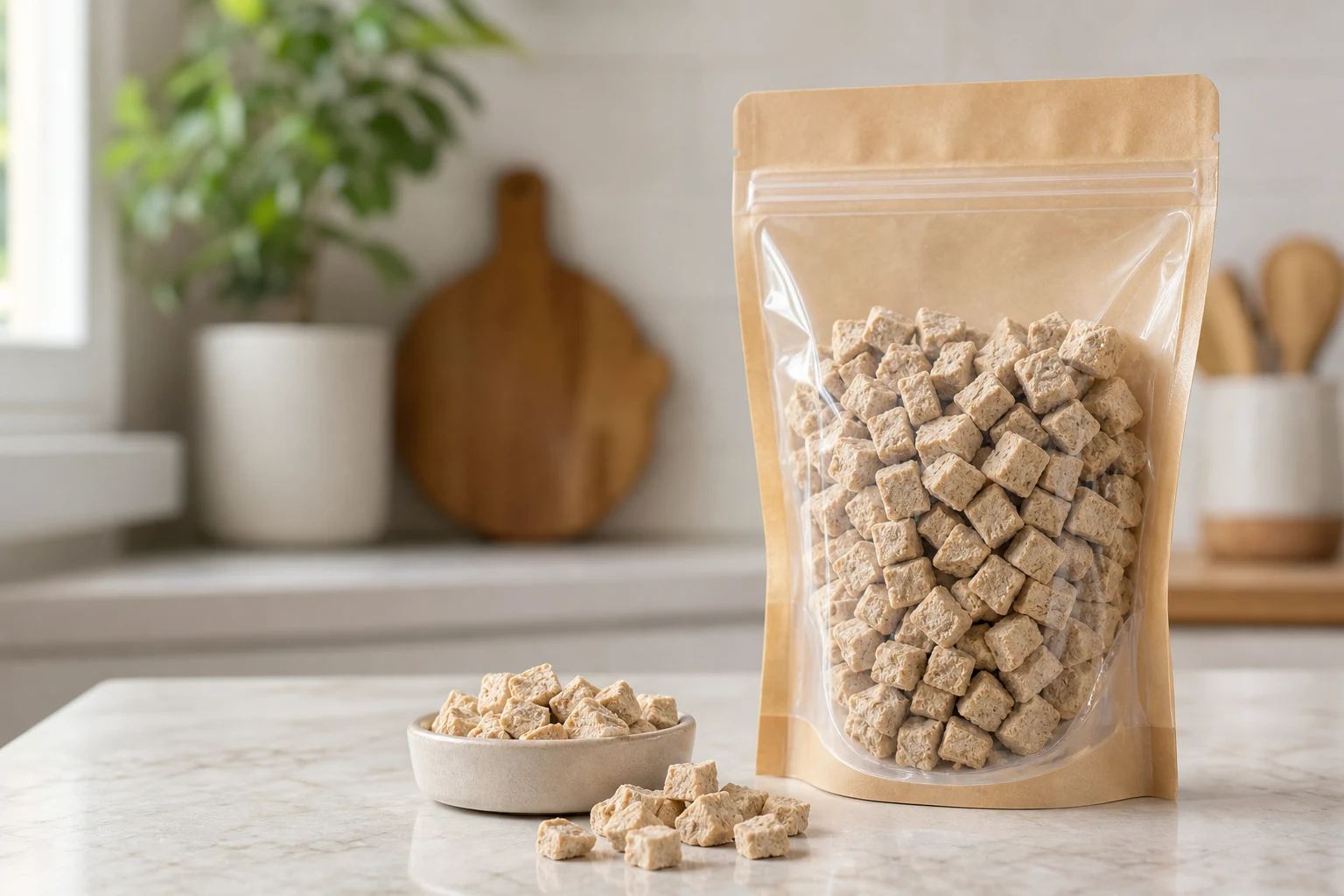
A stand-up pouch is often practical for small and medium treat packs because it can stand, carry a zipper, and show a clear front panel. A flat-bottom bag can offer a more stable footprint for a heavier premium range. Neither name is a final specification. I compare filled width, height, gusset, top-seal clearance, and carton orientation. The stand-up pouch size guide and flat-bottom bag guide provide a useful starting framework, but I approve only a filled sample.
I test the customer opening sequence
| Check | Risk | Evidence I keep |
|---|---|---|
| Filled volume | Bag looks empty or overfilled. | Target-weight sample. |
| Headspace | Weak top seal or trapped pieces. | Marked fill line. |
| Zipper position | Awkward opening and reseal. | Open-close trial. |
| Base stability | Tipping or poor shelf face. | Standing-shelf photo. |
I ask people who did not choose the pouch to open it. They should find the tear feature, avoid damaging the zipper, and reclose the pouch after taking out a treat. I repeat that check after the pouch has been packed in a carton. A user in a dog-training thread described using the fine “dust” from a freeze-dried treat bag as a topper.3 That is a specific customer insight. It makes me check breakage and powder control, rather than assuming every piece reaches the customer intact.
How Do I Prevent Leaks, Punctures, and Crushed Treats?
A good laboratory sample can fail after sealing dust, sharp treat edges, carton compression, drops, and repeated handling all work together.
I reduce damage by matching film toughness and seal width to the treat, controlling seal contamination, then testing filled pouches through packing, drops, compression, and opening.
I inspect the failure mode before I request a fix. A pinhole near a sharp piece is not the same as a weak top seal. A zipper that peels away is not the same as a crushed pouch caused by an over-tight carton. I look at the pouch body, bottom gusset, corners, zipper transitions, and seal edge. I also check whether loose crumbs can enter the seal zone during filling. If the product creates powder, I work with the filler on settling, static control, filling height, and cleaning before I raise the sealing temperature.
ASTM F88/F88M describes a method used to compare seal strength in flexible barrier materials.4 I use comparable seal evidence when a project needs a release criterion, but I do not mistake one peel number for total pack performance. I also inspect seal width, wrinkles, channels, zipper placement, and retained samples. The seal-leak guide gives the process checks I apply before mass production.
I test the whole pack route
I put filled packs into the planned carton. Then I check them after controlled drops, stacking, vibration, and ordinary handling. I compare the first pouch in the carton with the units at corners and edges. I look for rub marks, crushed treat pieces, split seals, unstable bases, and powder migration. If the product ships through ecommerce, I use the realistic inner pack and outer carton rather than treating a bare pouch as the system.
FDA advises consumers not to buy pet food or treats in visibly damaged packaging.5 That is a direct reminder that visible package condition affects trust as well as function. I retain the successful sample and record film, zipper, seal settings, fill weight, carton count, and any handling limits. If a feature, laminate, thickness, or carton changes, I repeat the relevant check. That small discipline protects a new launch from a repeatable failure.
What Should I Approve Before Production?
A supplier quote can omit the details that decide whether a pet-treat pouch runs consistently and arrives in the condition a buyer expects.
Before production, I approve a complete filled-pack specification, the exact material and zipper, artwork zones, test criteria, sample evidence, carton pack, and change-control process.
I turn the sample into a clear specification. It names the pouch format, dimensions, gusset, structure, thickness, finish, zipper type and height, tear feature, top-seal width, target fill range, and all artwork safe areas. I also state the product, particle shape, acceptable powder level, storage condition, and carton count. This gives the brand and converter one reference. It is far better than approving a photo or relying on a material name that may mean different things at different factories.
Food-contact packaging needs to match intended use. FDA explains that packaging and its components are food-contact substances and that the intended use matters in the safety assessment.6 I therefore keep the relevant declaration and the final product condition with the specification. I also keep barcode, lot-code, and label areas clear of folds, seals, and heavy texture. The custom pouch dieline guide helps make those zones visible before print.
I set a practical release plan
My approval record includes filled photos, seal observations, zipper tests, carton checks, and the agreed acceptance limits. I identify which samples are retained and who can approve a material or process change. I do not allow a supplier to substitute a film, zipper, valve, coating, or thickness without review, because each change can alter the pouch’s behavior. I also decide when to run a pilot order before the largest quantity.
I finish with a customer-use check. Can a shopper read the pack, open it, take out a treat, and close it again without spilling dust or damaging the pouch? I connect this to the quality-control process and the MOQ and total-cost guide. A clear specification costs less than rejected packaging, rework, damaged product, and a preventable customer complaint. That is the standard I use for a freeze-dried pet-treat launch.
Conclusion
I choose packaging through evidence, filled-pack testing, and clear specifications. That process protects the product, the launch, and the customer experience.
Sources and Further Reading
- FDA, Pet Food.
- Reddit r/foodscience, shelf life in semi-moist pet treats.
- Reddit r/Dogtraining, freeze-dried treat dust community discussion.
- ASTM F88/F88M, seal strength of flexible barrier materials.
- FDA, safe handling of pet food and treats.
- FDA, food-contact packaging information.
- Unique Packaging barrier-film guide.
- Unique Packaging quality control.
Need a pouch specification?
I can review your product, size, quantity, artwork, and target market.