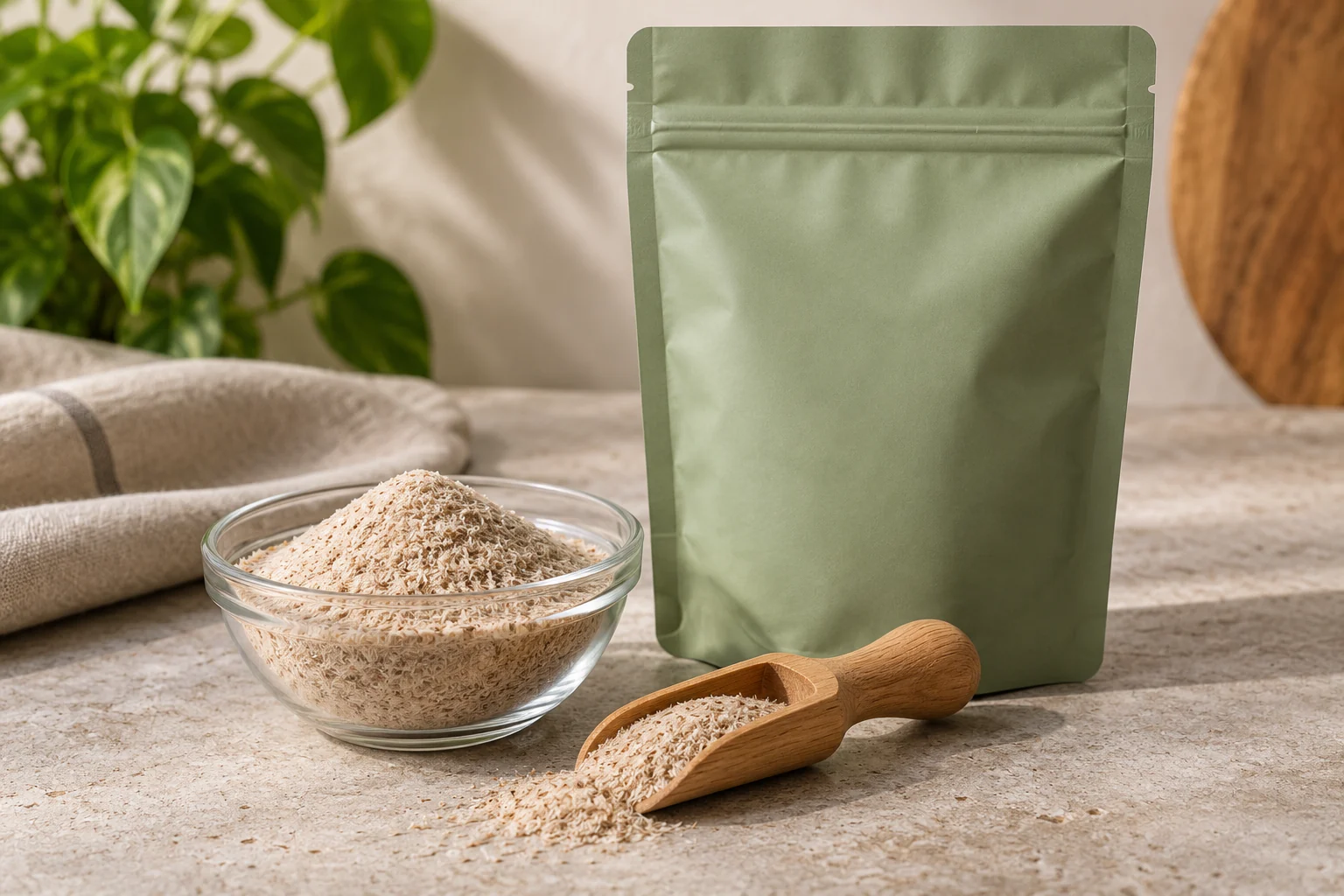
A large powder pouch can fit the declared weight yet make scooping, identifying the product, and closing the zipper awkward every day.
I choose resealable psyllium husk pouches by testing actual fill volume, scoop clearance, reclosure, label visibility, and documented material suitability. I approve the filled sample and written specification before ordering the production version.
I approach this as a packaging decision for a fiber-product brand. Product classification, instructions, and any health claims remain with the qualified product and label reviewers.
Should I Choose a Large Pouch or Smaller Packs?
Copying another brand's pouch size can leave too little working room or create a pack that does not match the customer's routine.
I compare the actual product volume and intended use before choosing the format. A large resealable pouch supports repeated access; smaller sealed packs change the opening routine, label area, and packing work. Neither format is automatically the better choice.
I start with the actual product rather than a photograph of a similar fiber supplement. I ask whether the launch uses whole husks, husk powder, or a formulated blend. I weigh representative fills and observe their volume in the proposed pouch. I include the space needed for sealing and later access. A pouch that barely holds the target mass on a sample table may still fail my practical opening check.
A 2026 r/travel discussion gives a specific reason to compare formats. The original poster described buying a large generic psyllium bag and wanting something more manageable for a trip. Other users described original containers, smaller packets, and bags containing scoops.1 These are individual routines, not proof that one format is preferred by the market. They do show useful questions for a brand interview: how much does the customer carry, and what information stays with it?
What changes when the pack becomes smaller?
| Format | Question for my trial | Tradeoff I record |
|---|---|---|
| Large resealable pouch | Can the scoop enter and leave cleanly? | Access space, reclosure, and storage footprint. |
| Smaller resealable pouch | Does the reduced size still allow useful label space? | Working volume and artwork constraints. |
| Single-opening sachet | Can the intended contents be emptied as directed? | More individual opening and packing steps. |
I do not repeat airport advice from the discussion as a travel rule or promise that a sealed sachet avoids screening. My article concerns packaging usability. If the brand wants travel claims, it needs separate current checks for its markets. I keep the label and product identity readable on each proposed retail unit regardless of the chosen size.
For the first prototype, I use the stand-up pouch sizing guide to organize dimensions, then fill physical samples. I ask evaluators to store, open, scoop, and reclose them in the intended way. I keep their observations with the exact drawing revision. This avoids approving the large version and assuming a scaled-down version will behave the same.
What Should I Check Around the Scoop and Zipper?
A pouch can close neatly when empty but become frustrating after powder reaches the mouth or a scoop no longer fits comfortably.
I check usable mouth width, fill clearance, tear path, scoop movement, and repeated zipper closure with the actual product. I keep the product's approved storage and safety information visible while testing the opening sequence.
I place the intended scoop next to a filled prototype and ask someone outside the design team to use it. I observe whether their hand can enter without pulling the seal area, whether powder brushes against the zipper, and whether the mouth collapses while they work. I repeat the check at a lower fill level. A pouch that works when almost full can be a different experience near the bottom.
I record the tear position separately from the zipper position. The first opening should leave the functional closure available and make the remaining label easy to read. I ask evaluators to show when they believe the zipper is fully closed. I then inspect the closure rather than treating their impression as an airtightness test. If the track is visibly obstructed, I record that condition and review the geometry or routine.
How much information must stay with the product?
NOW Foods instructs users of its organic psyllium husk powder to store that product in a cool, dry place after opening. Its page also includes a liquid-intake caution.2 I treat those as product-specific examples showing why storage and safety copy need real label space. I do not copy its dose, warning wording, certification, or ingredient claims onto another brand's product. My qualified reviewer supplies the approved content for the actual SKU.
I reserve space for product identity, lot coding, directions, required declarations, and any applicable warnings before I choose a decorative panel layout. The pack should still show that information after the tear strip is removed. If the final artwork moves important text into a fold or seal, I review the revised proof on a filled sample. A flat PDF can hide the effect of a curved front panel.
I use the pouch dieline guide for these clearances. For the contact structure, FDA's component-status guidance makes intended use part of the assessment.3 I request relevant documentation for the chosen film and use rather than describing the finished pouch as FDA approved. Any clinical, nutritional, or shelf-life claim needs its own evidence outside this usability trial.
How Do I Compare Film Evidence and Approve Production?
A good-looking trial pouch leaves an ordering risk if the quote names a different film, zipper, thickness, or finished size.
I compare identified film reports, seal specimens, and representative filled samples, then lock the approved construction and drawing. My purchasing record names test conditions, observations, acceptance criteria, and which changes require another review.
I ask the converter to name the proposed construction and its intended contact use. I connect the review to the barrier-film selection guide, but I do not set a universal moisture-barrier threshold for psyllium. The product owner must define the protection target and evidence needed for the actual formulation and route. A polymer name alone is not that evidence.
ASTM F1249-20 describes water-vapor transmission testing through film and sheeting.4 For the comparison, I request the tested structure, thickness, temperature, humidity conditions, units, conditioning, and method edition. I flag results obtained under different conditions instead of placing them in a misleading ranking. I ask the laboratory to explain how the selected evidence relates to the intended filled package.
Which approval records do I keep?
For a filled-pouch trial, I identify product lot, mass, fill setup, pouch revision, sealing settings, and storage conditions. I document the opening and scooping routine separately. I ask the team to agree on unacceptable observations before testing. Those may include powder loss during opening, an obstructed zipper, an unreadable code, a damaged seal, or a pouch that cannot stand as the project requires. The trial reports what happened under the recorded conditions; it does not establish clinical effectiveness or a universal storage life.
- Product form, formulation revision, target market, and approved label text.
- Fill range, scoop dimensions, mouth width, zipper height, and tear path.
- Exact film construction, thickness, contact evidence, and test-report identity.
- Trial conditions, opening routine, sample count, and approved acceptance limits.
- Artwork and drawing revisions, traceable samples, and change-control rules.
I use the written specification sheet to connect these records. I ask for a quote against the approved scope after the representative samples have been reviewed. If a supplier offers a different zipper or film, I keep that option clearly separate until its affected checks pass. I do not add unsupported claims about MOQ, pricing, delivery, sustainability, or shelf life.
On the repeat order, I compare the received sample with the retained approval. I look at the practical features that mattered in the trial, including mouth clearance and label position. That closes the gap between a useful prototype and an order description that another buyer can understand without having attended every sample meeting.
Conclusion
I approve psyllium pouches around real fill volume, comfortable scoop access, readable product information, documented materials, and a purchase specification tied to reviewed samples.
Sources and Further Reading
Need a pouch specification?
I can review your product, size, quantity, artwork, and target market.