A striking saffron pack can disappoint when aroma changes, tiny threads become hard to retrieve, or the material was chosen from appearance alone.
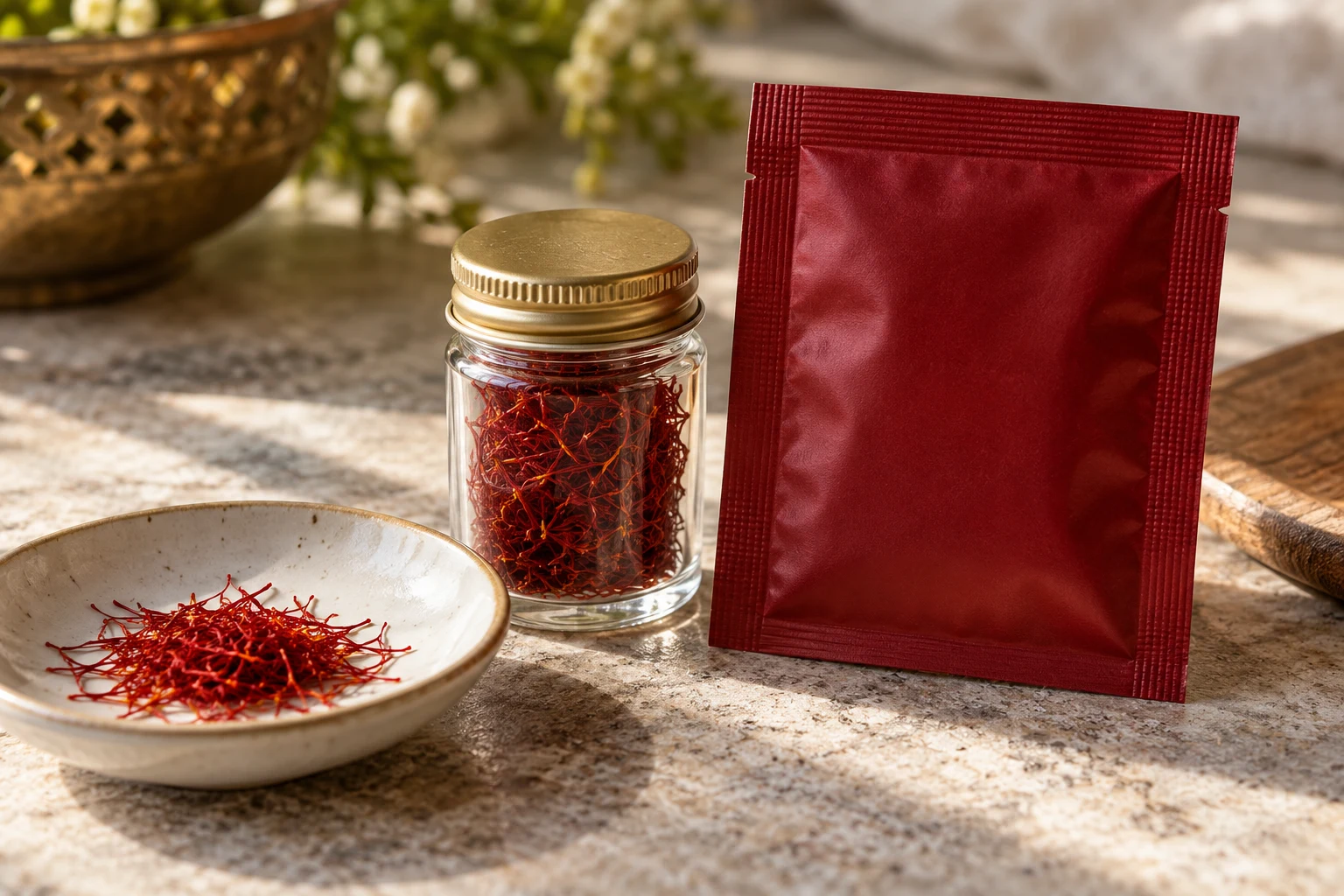
I start with a tightly closed small vial as a benchmark, then consider a sachet only when product-contact, aroma, moisture, light, recovery, and handling trials support its exact construction.
At Unique Packaging, I would rather recommend a different format than make a flexible pack claim that the saffron evidence cannot support.
Why Should a Small Vial Be My Starting Benchmark?
A general spice pouch recommendation can miss saffron-specific aroma concerns and the small quantities customers open and handle.
I benchmark an airtight small vial because saffron handling guidance favors screw-top glass jars or snap-top vials, then compare alternative packs under the same documented product and storage conditions.
I begin with the food rather than the pouch catalogue. The University of Vermont’s March 2020 handling recommendations favor airtight screw-top glass jars or snap-top vials and dark storage. The authors also raise concern about important compounds moving into plastic or paper packaging.
1I take that warning seriously when someone asks for a flexible saffron sachet. It does not supply a measured result for every modern laminate, but it is a reason to require a proper comparison rather than declaring a bag suitable because it is opaque.
The cited saffron-packaging chapter identifies humidity, oxygen, light, and temperature as protection considerations.
3I turn those into questions for the product team. What change matters for this lot? Which storage and use route is intended? What evidence will distinguish the candidate from the reference? I do not attach an invented oxygen-transmission target or shelf-life number to that list. The barrier-film guide is a way to organize material questions, not a substitute for saffron testing.
In the r/AskCulinary thread, a person who described growing saffron in Kashmir asked how to store it after moving to Dubai and noticing aroma and moisture problems.
2I cite the question as a real use-context difference. I do not adopt the thread’s fridge, freezer, or additive suggestions as validated instructions. The useful buying insight is that storage and opening conditions can change after the product reaches a customer.
I compare three candidates at the same intended portion: a closed vial, a vial inside a light-shielding carton, and a specifically identified sachet. I separate direct food contact from outer presentation. A pouch or carton used around a closed vial has a different role from film touching the threads. This distinction lets the buyer consider flexible outer packaging without pretending that it has replaced the primary container’s function.
My benchmark record includes the saffron lot, drying and release information supplied by the producer, portion, container closure, storage route, and quality-review plan. If the buyer has no suitable reference container, I arrange one before evaluating printed sachet artwork. A practical comparison starts with known samples and a defined question, not the assumption that the smallest shipping format must be the best product pack.
How Do I Compare Portion Size and Product Recovery?
A tiny pack can waste threads or complicate filling when the opening, seal area, and portion were never tested together.
I compare portion size, fill accuracy, clean seal clearance, opening control, thread recovery, and lot identification using actual saffron and production-style samples.
I agree the intended serving or retail portion with the brand and packer. Then I ask them to show how it will be weighed, transferred, and checked. Saffron threads are small, so an attractive oversized envelope can make a modest portion difficult to see or retrieve. I use actual threads for the trial and keep handling losses separate from net product packed. An empty mockup cannot reveal either problem.
For a sachet, I inspect the opening and seal area after filling. Threads should not be deliberately trapped across the top seal to make the sample look full. I ask whether the tear feature gives a controlled opening and whether users can tip the contents onto a suitable surface without cutting into the product zone. For a vial, I inspect closure access and the ease of retrieving the agreed portion. I record both successful and failed attempts under the same trial instructions.
This comparison table defines observations I would collect. It does not claim that one construction has passed them.
| Format | Use question | Evidence before approval |
|---|---|---|
| Small closed vial | Can the customer retrieve the portion and close it again? | Closure and recovery trial |
| Vial with outer carton | Does the outer pack protect presentation during the route? | Packed transport and display review |
| Opaque sealed sachet | Does the identified film preserve quality and open cleanly? | Contact, quality, sealing and recovery evidence |
I ask users who did not design the pack to complete the opening task. I note hesitation, where the threads collect, and whether the pack can be emptied without unusual tools. A candidate meant for one complete use has a different brief from a larger reserve pack. I do not add a zipper merely because other spice products use one. At this scale it must earn its complexity through the actual use sequence.
The producer’s storage advice also belongs in the evaluation. University of Vermont guidance includes identifying storage containers by lot.
1I carry that traceability into the printed or coded pack, sample register, and customer support record. The specification-sheet guide helps capture the dieline, code area, opening, portion, and component revisions together. My aim is a pack that a buyer can reproduce and a customer can use, with no need to guess whether a later sample represents the approved construction.
What Must a Sachet Trial Prove Before I Order?
An opaque appearance or a generic food-contact declaration cannot establish aroma retention, product compatibility, or the shelf life of a saffron pack.
I require a defined material, intended-use documents, comparison with the reference vial, agreed quality measurements, and filled handling trials before approving any sachet order.
I request the complete proposed sachet structure and its revision. That includes the product-contact layer, barrier layers where present, adhesive system, printing location, thickness, and seal geometry. If the quotation only says foil bag, I ask for the actual construction before sending it to the food team. A material name does not resolve the concern raised by the saffron handling guidance, and an outer metallized appearance does not tell me what touches the threads.
I check the food-contact documents against the intended food and storage conditions. FDA’s tables distinguish food types and conditions of use.
4That is a document scope check. It does not prove aroma retention, package integrity, or the quality of this saffron lot. The food-contact documents guide helps keep those separate questions visible while the product owner decides which evidence is required.
Where moisture-barrier data are relevant, I request the test method, material identity, thickness, temperature, humidity conditions, units, and acceptance basis. ASTM F1249 is a method for water-vapor transmission through flexible barrier materials.
5I compare reports only after those conditions are understood. I ask a qualified laboratory to define any further product and packaging work; I do not invent a numeric barrier threshold, assume a window equals an opaque film, or claim that a dry-film report answers aroma compatibility.
My filled trial keeps the reference vial and candidate sachet on the same documented schedule. The plan identifies storage exposure, review intervals, quality criteria set by the saffron producer, sample coding, and who can approve results. It includes product recovery and inspection after the intended carton handling. Any sensory review uses an agreed procedure and does not replace other product-quality or safety work required by the responsible business.
Before requesting a final price, I write down the approved portion, construction, pouch dimensions, seal zones, opening feature, code area, carton arrangement, reports, acceptance criteria, and change triggers. The quality-tests guide helps assign each check a purpose. I then request a quotation against that written specification. If the sachet cannot meet the agreed benchmark, I keep the vial and reconsider only the outer pack. That is a valid sourcing outcome, not a reason to soften the evidence standard.
Conclusion
I choose saffron packaging against a vial benchmark and release only the construction, portion size, handling route, and quality evidence that the product supports.
Sources and Further Reading
- University of Vermont, Saffron Post Harvest Handling, March 2020.
- Reddit r/AskCulinary, grower asks about saffron storage after moving to Dubai.
- Saffron packaging, chapter abstract, Science Technology and Health, 2020.
- FDA, food types and conditions of use for food-contact substances.
- ASTM F1249-25, water-vapor transmission method scope.
Need a pouch specification?
I can review your product, size, quantity, artwork, and target market.