A narrow stick pack can look efficient, while a sachet can look simple, yet the wrong choice can frustrate filling, opening, packing, and repeat purchase.
I choose a stick pack or sachet after I define serving size, powder flow, target market, filling equipment, opening use, carton format, and a filled-pack trial for the exact product.
I treat the pouch as a complete system. I confirm the product, material, filling, handling, and customer experience before I approve production.
What Is the Practical Difference Between a Stick Pack and a Sachet?
A format name hides the real trade-off when the team has not defined how much powder must fit, how it flows, and how the customer opens it.
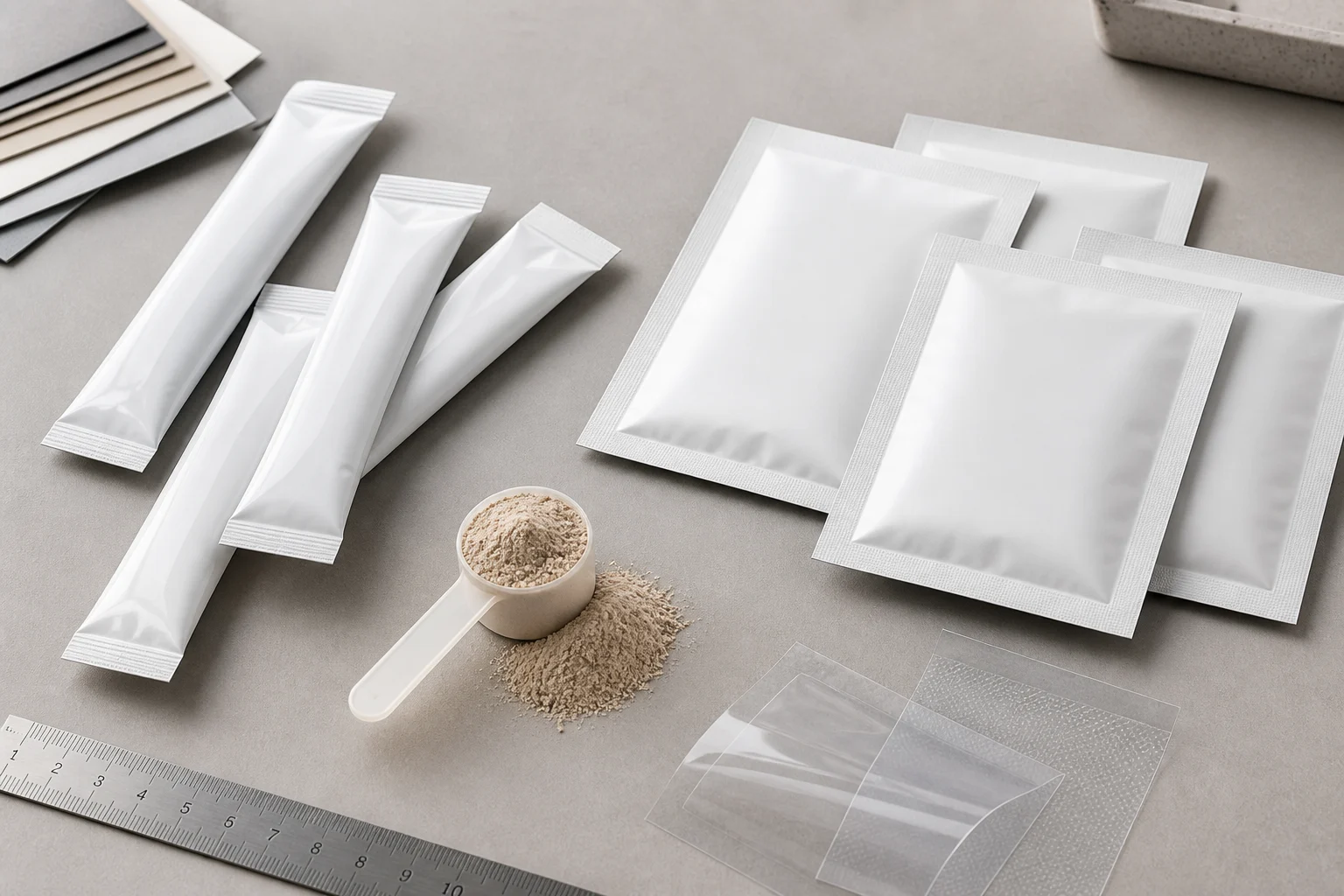
I treat a stick pack as a narrow single-serve tube-like pack and a sachet as a wider flat sealed pack, then compare usable volume, opening, carton fit, and line compatibility with the real powder.
I begin with the serving and use moment. A narrow stick pack can suit a pour-into-water routine where a slim opening and compact carton arrangement are useful. A wider three- or four-side-seal sachet can offer more panel area and may suit powders that need a broader fill profile or a different opening action. Neither description decides the project alone. Powder bulk density, particle behavior, desired serving, required label area, distribution route, and the selected machine determine the practical fit. PMMI lists both sachet form-fill-seal and stick or tube form-fill-seal equipment, which is a reminder that the converting route must be named before dimensions are approved.2 I compare the actual pack geometry in the powder-format guide rather than assume that a narrow pack is always more efficient.
How I make this decision specific
For “What Is the Practical Difference Between a Stick Pack and a Sachet?” in this how do i choose stick-pack or sachet packaging for powder products review, I define the actual product, pouch configuration, intended use, and decision owner before I ask a supplier or tester for evidence. I keep the selected structure, component details, sample condition, and any stated test method together, then compare the result with the buyer’s actual route rather than a catalogue promise. That record lets me use the protein-powder format guide as a decision aid and retain a specification that another team member can check.
For How Do I Choose Stick-Pack or Sachet Packaging for Powder Products, I state what is known, the condition it applies to, and what must still be checked with the actual product. I do not transfer a number, a test result, or a feature choice from another product simply because its pouch looks similar. The result of “What Is the Practical Difference Between a Stick Pack and a Sachet?” should give the buyer a clear next check, the supplier a precise request, and the project owner a record of the remaining uncertainty.
For How Do I Choose Stick-Pack or Sachet Packaging for Powder Products, I request the exact pouch structure, component specification, and test conditions from the supplier. A broad material name or catalogue claim is not a production specification. The right next step is a representative filled sample, where relevant, with observations recorded before production is approved.
Which Powder and Serving Inputs Change the Format Decision?
A gram value alone can mislead when powders have different bulk density, flow, aeration, headspace needs, and settling behavior.
I establish the real powder density range, serving target, desired headspace, dust behavior, fill method, and opening requirement before I choose the initial stick-pack or sachet dimensions.
I ask the brand or co-packer for the real product, not a generic powder category. Fine, aerated, hygroscopic, oily, granular, or blended powders can behave differently at the hopper and inside a small pack. I make blank samples, fill at the intended condition, and check whether the pack looks underfilled, too tight, hard to seal, or awkward to pour. I keep the filled sample beside the pouch-size guide only as a reminder that dimensions follow product volume; its numbers are not transferred automatically to a sachet. FDA notes that packaging components, including adhesives and colorants, can be food-contact substances.1 I therefore request the selected structure and documentation after the format direction is clear.
How I make this decision specific
For “Which Powder and Serving Inputs Change the Format Decision?” in this how do i choose stick-pack or sachet packaging for powder products review, I define the actual product, pouch configuration, intended use, and decision owner before I ask a supplier or tester for evidence. I keep the selected structure, component details, sample condition, and any stated test method together, then compare the result with the buyer’s actual route rather than a catalogue promise. That record gives the buyer a decision aid and a specification that another team member can check.
For How Do I Choose Stick-Pack or Sachet Packaging for Powder Products, I state what is known, the condition it applies to, and what must still be checked with the actual product. I do not transfer a number, a test result, or a feature choice from another product simply because its pouch looks similar. The result of “Which Powder and Serving Inputs Change the Format Decision?” should give the buyer a clear next check, the supplier a precise request, and the project owner a record of the remaining uncertainty.
How Should I Test Filling, Opening, and Carton Fit?
An empty sample may look polished while the real powder creates seal contamination, poor tear access, weak carton count, or a difficult customer pour.
I test representative filled packs through the intended filling, sealing, opening, carton-packing, and handling sequence, then record which format meets the agreed acceptance checks.
I run a short practical comparison. I watch powder flow at the fill point, inspect the seal area for dust, allow the pack to cool, and check the top and side seals before I move to cartons. I ask users to tear and pour without coaching. I note spills, narrow-opening frustration, sharp edges, poor grip, and whether a carton divider protects the packs. ASTM F88/F88M is a method for measuring seal strength in flexible barrier materials, so it can support a defined comparison when seal data are needed.3 I do not turn the standard into a generic pass claim. The Reddit post in the sources also shows why an early brand may need to compare launch quantity and carton count before it commits; it is community context, not supplier evidence.4
How I make this decision specific
For “How Should I Test Filling, Opening, and Carton Fit?” in this how do i choose stick-pack or sachet packaging for powder products review, I define the actual product, pouch configuration, intended use, and decision owner before I ask a supplier or tester for evidence. I keep the selected structure, component details, sample condition, and any stated test method together, then compare the result with the buyer’s actual route rather than a catalogue promise. That record gives the buyer a decision aid and a specification that another team member can check.
For How Do I Choose Stick-Pack or Sachet Packaging for Powder Products, I state what is known, the condition it applies to, and what must still be checked with the actual product. I do not transfer a number, a test result, or a feature choice from another product simply because its pouch looks similar. The result of “How Should I Test Filling, Opening, and Carton Fit?” should give the buyer a clear next check, the supplier a precise request, and the project owner a record of the remaining uncertainty.
For How Do I Choose Stick-Pack or Sachet Packaging for Powder Products, I treat the filled pack as a separate check from the material data. I record the fill condition, seal area, opening or closure behavior, carton arrangement, handling observations, and limits of the comparison. That prevents a favourable bench result from becoming an unsupported claim about shelf life, transport, or every product route.
What Must I Put in the Purchase Specification?
A supplier cannot quote or reproduce a good sample reliably when the buyer asks only for stick packs or sachets without product and performance context.
I specify the chosen format, finished dimensions, product and fill condition, material proposal, food-contact market, seal zones, opening feature, print panels, carton pack, sample scope, and acceptance criteria.
I write the brief so each party can review the same decision. It identifies powder type, intended serving, density range if known, target fill, desired headspace, pouch format, dimensions, material proposal, product-contact market, sealing arrangement, tear feature, artwork revision, code area, carton count, and delivery route. I add a representative filled sample, written material confirmation, trial observations, and final commercial quotation. The dieline guide keeps graphics away from seal and tear zones, while the specification-sheet guide helps preserve the release record. I assess materials, run a filled-pack trial, confirm the written specification, then request a quote on that same basis.
How I make this decision specific
| Specification item | Why I record it | Decision it supports |
|---|---|---|
| Serving and fill condition | Powder volume changes pack geometry. | Initial dimensions and headspace. |
| Format and opening | Customer use differs by width and tear path. | Stick pack or sachet selection. |
| Material and market | Food-contact use is construction-specific. | Documentation request. |
| Trial and carton evidence | Empty samples hide handling risks. | Specification-based quote. |
For “What Must I Put in the Purchase Specification?” in this how do i choose stick-pack or sachet packaging for powder products review, I define the actual product, pouch configuration, intended use, and decision owner before I ask a supplier or tester for evidence. I keep the selected structure, component details, sample condition, and any stated test method together, then compare the result with the buyer’s actual route rather than a catalogue promise. That record gives the buyer a decision aid and a specification that another team member can check.
For How Do I Choose Stick-Pack or Sachet Packaging for Powder Products, I state what is known, the condition it applies to, and what must still be checked with the actual product. I do not transfer a number, a test result, or a feature choice from another product simply because its pouch looks similar. The result of “What Must I Put in the Purchase Specification?” should give the buyer a clear next check, the supplier a precise request, and the project owner a record of the remaining uncertainty.
For How Do I Choose Stick-Pack or Sachet Packaging for Powder Products, I preserve the final decision in a written brief that names the approved sample, conditions, observations, open risks, and change triggers. I then use the custom pouch dieline guide to keep the quotation tied to the evidence rather than to a remembered sample or a generic product name.
Conclusion
I choose packaging through evidence, filled-pack testing, and clear specifications. That process protects the product, the launch, and the customer experience.
Sources and Further Reading
- FDA, Food Packaging and Other Substances that Come in Contact with Food.
- PMMI, packaging-machinery categories.
- ASTM F88/F88M, Seal Strength of Flexible Barrier Materials.
- Reddit r/smallbusiness, low-MOQ electrolyte sachet community discussion.
- Unique Packaging powder-format guide.
- Unique Packaging packaging specification-sheet guide.
Need a pouch specification?
I can review your product, size, quantity, artwork, and target market.