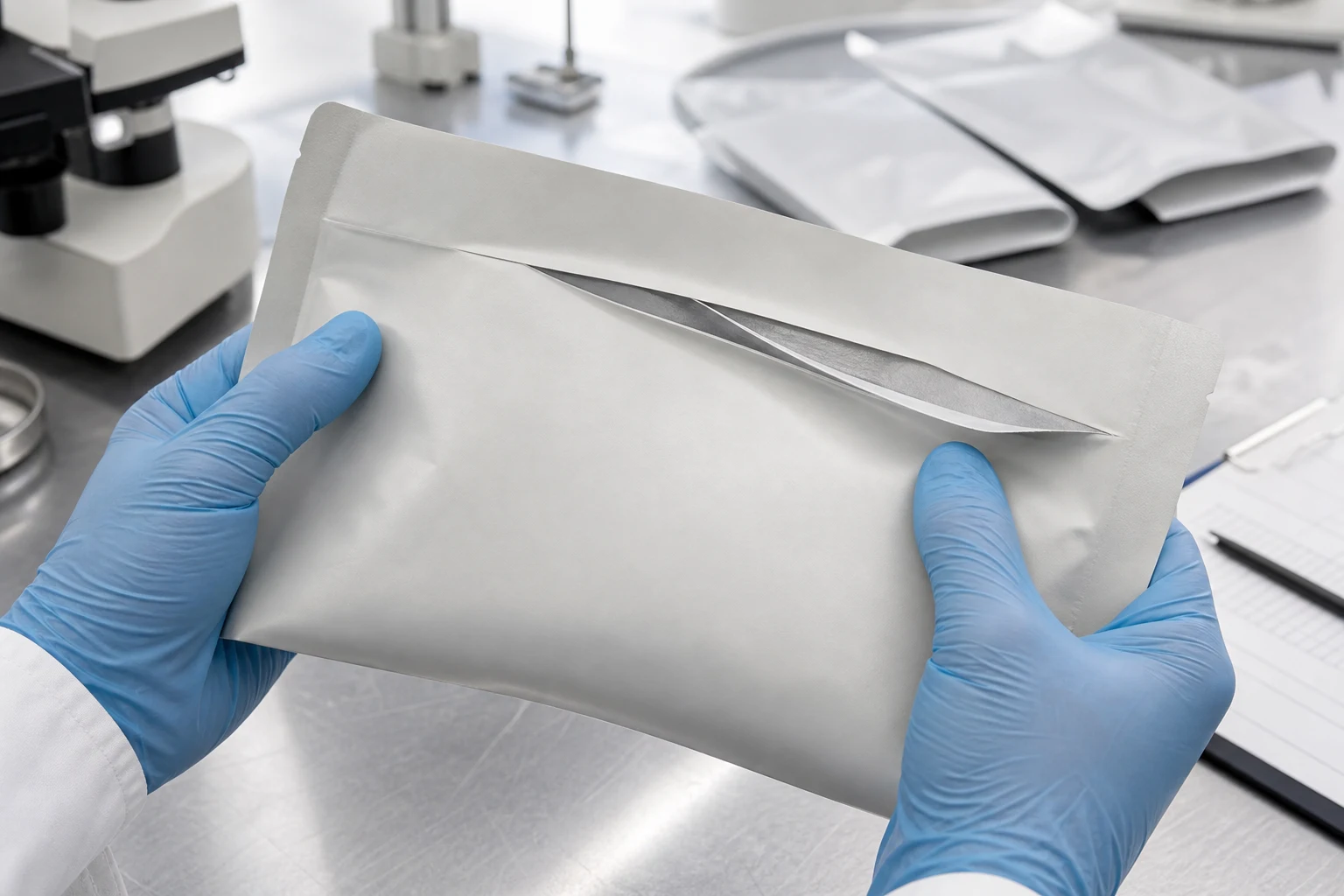
A pouch can look sound after conversion yet separate later when cure, surface preparation, product contact, heat, or flexing was never verified together.
I diagnose flexible-packaging delamination by locating the separating interface, tracing the actual structure and process, then testing a controlled corrective sample with the product and route it must survive.
I treat the pouch as a complete system. I confirm the product, material, filling, handling, and customer experience before I approve production.
What Does Delamination Look Like?
Bubbles, whitening, loose layers, edge lift, and a split laminate can look alike until I identify the exact interface and when the change began.
I inspect the pouch to identify the separating layers, location, timing, product exposure, and handling history before I label the failure or choose a corrective action.
I retain the failed pouch, an intact comparison pouch, the applicable roll or lot information, and photos of both sides before I peel or cut anything. I note whether the separation is between print and film, film and adhesive, adhesive and barrier layer, or another interface. I also check whether it begins at an edge, fold, seal, window, or rubbed panel. That basic map prevents a visible symptom from being mistaken for the root cause.
How I make this decision specific
| Observation | What I check | Evidence I retain |
|---|---|---|
| Edge lift | Timing and interface | Lot and photos |
| Bubble or haze | Layer separation | Marked sample |
| Fold failure | Flex route | Filled comparison |
| Product-side split | Product exposure | Storage record |
For “What Does Delamination Look Like?” in this what causes flexible packaging delamination review, I define the actual product, pouch configuration, intended use, and decision owner before I ask a supplier or tester for evidence. I keep the selected structure, component details, sample condition, and any stated test method together, then compare the result with the buyer’s actual route rather than a catalogue promise. That record lets me use the flexible packaging quality-tests guide as a decision aid and retain a specification that another team member can check.
For What Causes Flexible Packaging Delamination, I state what is known, the condition it applies to, and what must still be checked with the actual product. I do not transfer a number, a test result, or a feature choice from another product simply because its pouch looks similar. The result of “What Does Delamination Look Like?” should give the buyer a clear next check, the supplier a precise request, and the project owner a record of the remaining uncertainty.
For What Causes Flexible Packaging Delamination, I request the exact pouch structure, component specification, and test conditions from the supplier. A broad material name or catalogue claim is not a production specification. The right next step is a representative filled sample, where relevant, with observations recorded before production is approved.
Which Lamination Variables Should I Check First?
A laminate bond depends on more than adhesive selection; surface condition, mix, coat weight, nip, web handling, and cure can change the result.
I review the exact substrates, surface treatment, adhesive system, mix and application record, lamination settings, cure conditions, and any process change before I approve a cause theory.
I compare the production record with the approved specification. I look for changes to film supplier, treatment level, coating, ink, adhesive ratio, pot life, line speed, drying, nip setting, winding, storage, and cure time. I do not claim that one variable caused the failure until a controlled comparison supports it. Multilayer films rely on an adhesive bond line, and the correct corrective action depends on the real substrate-and-adhesive combination rather than a trade name.
How I make this decision specific
For “Which Lamination Variables Should I Check First?” in this what causes flexible packaging delamination review, I define the actual product, pouch configuration, intended use, and decision owner before I ask a supplier or tester for evidence. I keep the selected structure, component details, sample condition, and any stated test method together, then compare the result with the buyer’s actual route rather than a catalogue promise. That record lets me use the flexible packaging quality-tests guide as a decision aid and retain a specification that another team member can check.
For What Causes Flexible Packaging Delamination, I state what is known, the condition it applies to, and what must still be checked with the actual product. I do not transfer a number, a test result, or a feature choice from another product simply because its pouch looks similar. The result of “Which Lamination Variables Should I Check First?” should give the buyer a clear next check, the supplier a precise request, and the project owner a record of the remaining uncertainty.
How Can Product and Distribution Stress Reveal a Weak Bond?
A bond may remain acceptable in a dry flat sample but change when oil, acid, moisture, heat, compression, or repeated flexing acts on a filled pouch.
I test the proposed structure with the actual product, fill condition, storage profile, carton, and handling route so I can distinguish a conversion issue from a product or distribution interaction.
I start with a filled sample at the target weight and condition. I inspect it through sealing, cooling, storage, cartoning, stacking, flexing, drops, and consumer opening. I separate delamination from a seal or leak failure and from a barrier shortfall described in the barrier-film guide. I do not convert a community report or a laboratory observation into a shelf-life claim. I use it to define a test that fits the actual product. Where food contact is involved, I request documentation for the actual structure and intended use, including the layers and adhesive system that form the finished package.
How I make this decision specific
For “How Can Product and Distribution Stress Reveal a Weak Bond?” in this what causes flexible packaging delamination review, I define the actual product, pouch configuration, intended use, and decision owner before I ask a supplier or tester for evidence. I keep the selected structure, component details, sample condition, and any stated test method together, then compare the result with the buyer’s actual route rather than a catalogue promise. That record lets me use the flexible packaging quality-tests guide as a decision aid and retain a specification that another team member can check.
For What Causes Flexible Packaging Delamination, I state what is known, the condition it applies to, and what must still be checked with the actual product. I do not transfer a number, a test result, or a feature choice from another product simply because its pouch looks similar. The result of “How Can Product and Distribution Stress Reveal a Weak Bond?” should give the buyer a clear next check, the supplier a precise request, and the project owner a record of the remaining uncertainty.
For What Causes Flexible Packaging Delamination, I treat the filled pack as a separate check from the material data. I record the fill condition, seal area, opening or closure behavior, carton arrangement, handling observations, and limits of the comparison. That prevents a favourable bench result from becoming an unsupported claim about shelf life, transport, or every product route.
How Do I Confirm the Corrective Action?
Changing an adhesive, film, or setting without a controlled comparison can hide the problem until the next order repeats it.
I confirm a delamination correction by comparing defined samples, documenting the changed variable, inspecting the filled packs after relevant stress, and retaining an approved reference sample.
I make a written correction plan that names the suspected interface, controlled change, sample configuration, product condition, and acceptance check. I compare the amended sample against the previous configuration rather than relying on a verbal assurance. If the structure changes, I update the specification and artwork-safe areas where relevant. My release record identifies materials, process settings, cure route, sample date, observations, limits, and owner for future change control. For supplier review I send the failed and intact samples, lot details, actual product, storage route and approved structure through the delamination assessment request; the next steps are a controlled material review, corrective sample, revised specification and only then a quotation for the approved construction.
How I make this decision specific
For “How Do I Confirm the Corrective Action?” in this what causes flexible packaging delamination review, I define the actual product, pouch configuration, intended use, and decision owner before I ask a supplier or tester for evidence. I keep the selected structure, component details, sample condition, and any stated test method together, then compare the result with the buyer’s actual route rather than a catalogue promise. That record lets me use the flexible packaging quality-tests guide as a decision aid and retain a specification that another team member can check.
For What Causes Flexible Packaging Delamination, I state what is known, the condition it applies to, and what must still be checked with the actual product. I do not transfer a number, a test result, or a feature choice from another product simply because its pouch looks similar. The result of “How Do I Confirm the Corrective Action?” should give the buyer a clear next check, the supplier a precise request, and the project owner a record of the remaining uncertainty.
For What Causes Flexible Packaging Delamination, I preserve the final decision in a written brief that names the approved sample, conditions, observations, open risks, and change triggers. I then use the packaging specification sheet guide to keep the quotation tied to the evidence rather than to a remembered sample or a generic product name.
Conclusion
I choose packaging through evidence, filled-pack testing, and clear specifications. That process protects the product, the launch, and the customer experience.
Sources and Further Reading
- FEICA, migration testing guidance for adhesives intended for food-contact materials.
- Reddit r/chemistry, flexible-packaging adhesive community discussion.
- FDA, food packaging and food-contact substances.
- ASTM F88/F88M, seal strength of flexible barrier materials.
- Unique Packaging quality-tests guide.
- Unique Packaging specification sheet guide.
Need a pouch specification?
I can review your product, size, quantity, artwork, and target market.