Retort pouches can support shelf-stable foods, but a suitable-looking laminate alone cannot prove that the product, seals and thermal process are safe or validated.
Retort pouch packaging is a complete food-and-container system: the pouch structure, product, sealing conditions, scheduled thermal process, handling and records must be validated together by qualified parties.
I treat the pouch as a complete system. I confirm the product, material, filling, handling, and customer experience before I approve production.
What Makes a Pouch Retortable?
A pouch cannot be called retort-ready merely because it is multilayer or heat-sealable; it must match the actual thermal process, food, seals, and handling route.
I define a retort pouch by its qualified material structure, seals, dimensions, filling configuration, and ability to maintain package integrity through the specified thermal process and cooling conditions.
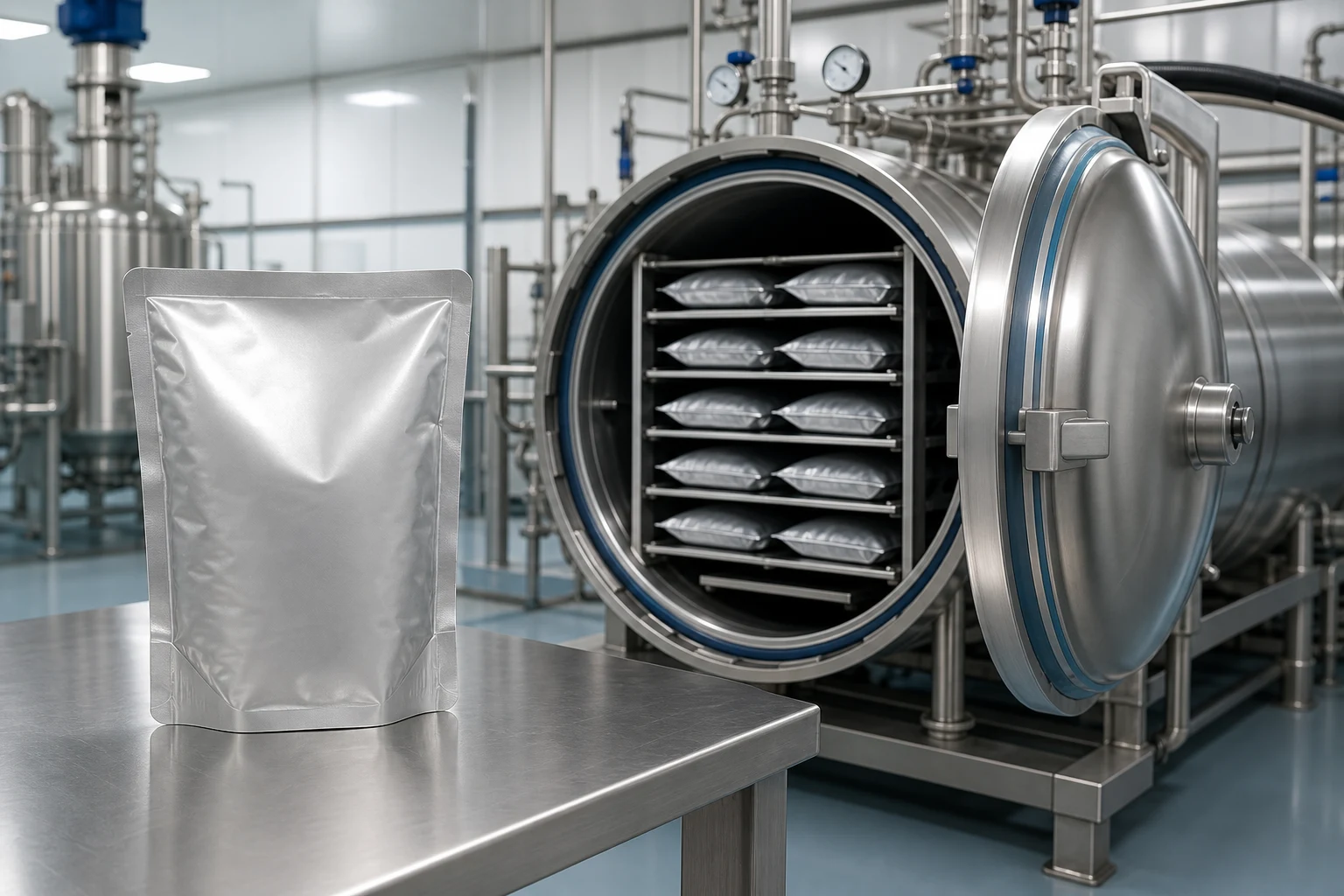
Retort pouches and retortable pouches are flexible packages designed as part of a validated in-container thermal-processing system; “retort packaging” is not a single stock material. I start with food, process route, pouch format, fill weight, headspace, and market. Sauces, ready meals, pet food and other products can create different viscosity, particle, oil, fill and handling conditions, so the application name alone cannot select the structure. The material must be considered with sealant, adhesives, inks, fitments, and any clear or metallic barrier layer, then connected to the barrier-film evidence. I do not generalize a retort capability from another product or pouch size. Maximum thickness, product viscosity, particle size, pouch orientation, and basket configuration can all matter to the process. The qualified process authority and packaging supplier need the same controlled specification.
How I make this decision specific
For “What Makes a Pouch Retortable?” in this how are retort pouches specified and validated review, I define the actual product, pouch configuration, intended use, and decision owner before I ask a supplier or tester for evidence. I keep the selected structure, component details, sample condition, and any stated test method together, then compare the result with the buyer’s actual route rather than a catalogue promise. That record lets me use the flexible packaging quality-tests guide as a decision aid and retain a specification that another team member can check.
For How Are Retort Pouches Specified and Validated, I state what is known, the condition it applies to, and what must still be checked with the actual product. I do not transfer a number, a test result, or a feature choice from another product simply because its pouch looks similar. The result of “What Makes a Pouch Retortable?” should give the buyer a clear next check, the supplier a precise request, and the project owner a record of the remaining uncertainty.
For How Are Retort Pouches Specified and Validated, I request the exact pouch structure, component specification, and test conditions from the supplier. A broad material name or catalogue claim is not a production specification. The right next step is a representative filled sample, where relevant, with observations recorded before production is approved.
Which Sealing Conditions Must Be Controlled?
A channel, wrinkle, contamination, weak bond, or poorly controlled seal can defeat an otherwise appropriate retort pouch before or during thermal processing.
I control actual seal-bar temperature, pressure, dwell time, seal-area cleanliness, pouch presentation, and startup checks, then document the conditions used for the validated configuration.
FDA’s guide identifies seal-bar temperature, pressure, and dwell time as critical factors in heat sealing retort pouches. I translate that into a project-specific control plan rather than publish a universal setting. I examine the pouch after filling and sealing and confirm that food, grease, moisture, or folds have not interrupted the seal area. If the format has a spout, zipper, or tear feature, I ensure its geometry is covered by the approved configuration. An empty pouch does not substitute for production-style filled samples.
How I make this decision specific
For “Which Sealing Conditions Must Be Controlled?” in this how are retort pouches specified and validated review, I define the actual product, pouch configuration, intended use, and decision owner before I ask a supplier or tester for evidence. I keep the selected structure, component details, sample condition, and any stated test method together, then compare the result with the buyer’s actual route rather than a catalogue promise. That record lets me use the flexible packaging quality-tests guide as a decision aid and retain a specification that another team member can check.
For How Are Retort Pouches Specified and Validated, I state what is known, the condition it applies to, and what must still be checked with the actual product. I do not transfer a number, a test result, or a feature choice from another product simply because its pouch looks similar. The result of “Which Sealing Conditions Must Be Controlled?” should give the buyer a clear next check, the supplier a precise request, and the project owner a record of the remaining uncertainty.
How Is the Thermal Process and Package Integrity Validated?
Thermal processing and package integrity have different questions, and neither is proven by a label, visual check, or unqualified trial.
I coordinate package validation with the food process authority’s product-specific thermal process, then use relevant filled-pouch integrity checks and records to confirm the approved system is followed.
I do not prescribe a time-and-temperature schedule for a food product. A qualified process authority establishes the scheduled process for the actual product and package. FDA guidance describes visual examinations and examples such as burst, vacuum or bubble, tensile seal-strength, and drop testing. I use methods and frequencies suitable to the project risk and regulatory context, recording pouch structure, dimensions, fill condition, seal settings, process identifiers, observations, and accepted limits.
How I make this decision specific
For “How Is the Thermal Process and Package Integrity Validated?” in this how are retort pouches specified and validated review, I define the actual product, pouch configuration, intended use, and decision owner before I ask a supplier or tester for evidence. I keep the selected structure, component details, sample condition, and any stated test method together, then compare the result with the buyer’s actual route rather than a catalogue promise. That record lets me use the flexible packaging quality-tests guide as a decision aid and retain a specification that another team member can check.
For How Are Retort Pouches Specified and Validated, I state what is known, the condition it applies to, and what must still be checked with the actual product. I do not transfer a number, a test result, or a feature choice from another product simply because its pouch looks similar. The result of “How Is the Thermal Process and Package Integrity Validated?” should give the buyer a clear next check, the supplier a precise request, and the project owner a record of the remaining uncertainty.
For How Are Retort Pouches Specified and Validated, I treat the filled pack as a separate check from the material data. I record the fill condition, seal area, opening or closure behavior, carton arrangement, handling observations, and limits of the comparison. That prevents a favourable bench result from becoming an unsupported claim about shelf life, transport, or every product route.
What Should the Release Record Include?
A passed pilot loses value when the next run cannot identify the pouch version, product, line conditions, thermal-process record, or acceptance decision.
I keep a release record linking approved pouch construction, components, artwork, product and fill condition, seal controls, scheduled process, inspection results, deviations, and retained samples.
I establish change control before the first commercial run. The record identifies what triggers review: material or adhesive change, pouch dimension change, new fitment, different fill weight, alternate product formulation, line adjustment, thermal-process change, or carton change. I make responsible parties and acceptance actions visible. This is not a promise of shelf life or commercial sterility. It is traceable evidence for the food manufacturer, process authority, and packaging supplier to assess whether the approved system remains the same. Before commercial discussion, I organize product and process-authority inputs, fill weight, pouch dimensions, component list, structure proposal, seal controls, inspection plan and sample scope in the packaging specification sheet. I then use the retort-pouch assessment request to review material feasibility and a sample route; final process validation remains with qualified parties, and quotation follows the agreed pouch specification.
How I make this decision specific
| Release field | Owner or source | Evidence to lock |
|---|---|---|
| Product and thermal process | Food manufacturer and process authority | Controlled product, fill and scheduled-process identifiers |
| Pouch construction | Packaging supplier | Layer structure, dimensions, components and intended use |
| Sealing and inspection | Filling operation | Approved settings, checks, limits and deviations |
| Commercial order | Buyer and supplier | Approved sample, artwork revision, quantity and change control |
For “What Should the Release Record Include?” in this how are retort pouches specified and validated review, I define the actual product, pouch configuration, intended use, and decision owner before I ask a supplier or tester for evidence. I keep the selected structure, component details, sample condition, and any stated test method together, then compare the result with the buyer’s actual route rather than a catalogue promise. That record lets me use the flexible packaging quality-tests guide as a decision aid and retain a specification that another team member can check.
For How Are Retort Pouches Specified and Validated, I state what is known, the condition it applies to, and what must still be checked with the actual product. I do not transfer a number, a test result, or a feature choice from another product simply because its pouch looks similar. The result of “What Should the Release Record Include?” should give the buyer a clear next check, the supplier a precise request, and the project owner a record of the remaining uncertainty.
For How Are Retort Pouches Specified and Validated, I preserve the final decision in a written brief that names the approved sample, conditions, observations, open risks, and change triggers. I then use the seal-leak prevention guide to keep the quotation tied to the evidence rather than to a remembered sample or a generic product name.
Conclusion
I choose packaging through evidence, filled-pack testing, and clear specifications. That process protects the product, the launch, and the customer experience.
Sources and Further Reading
- FDA, guide to inspections of low-acid canned-food manufacturers, Part 3.
- Reddit r/foodscience, retort-pouch community discussion.
- FDA, low-acid canned-food inspection guide, thermal-process records.
- ASTM F88/F88M, seal strength of flexible barrier materials.
- Unique Packaging quality-tests guide.
- Unique Packaging seal-leak prevention guide.
Need a pouch specification?
I can review your product, size, quantity, artwork, and target market.